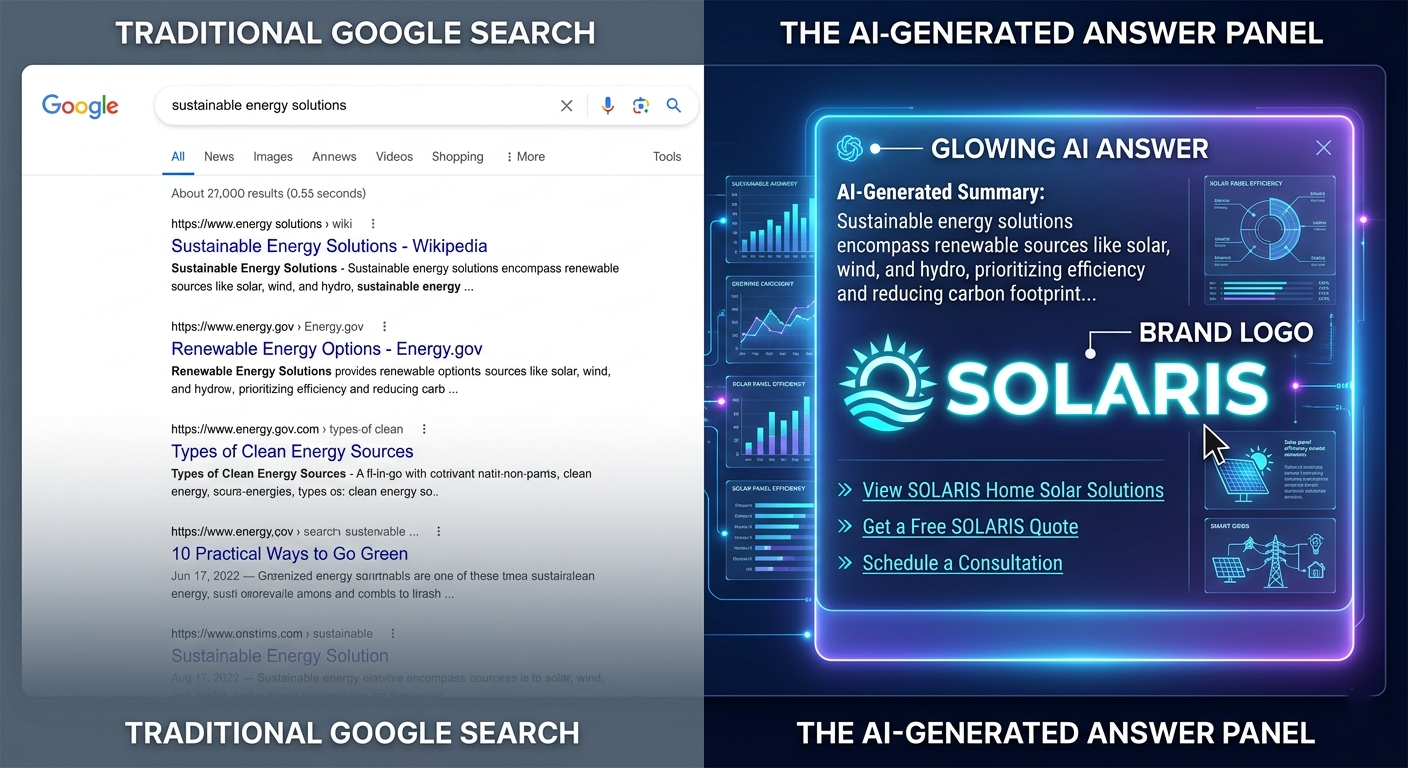
The Search Revolution Nobody Warned You About
Think about the last time you actually clicked through to a website from a search engine. Not skimmed an AI-generated answer. Not got your question resolved inside a search interface. Actually clicked, loaded a page, and read an article the way we all did just three or four years ago.
For a growing segment of internet users, that behaviour is becoming surprisingly rare. AI-powered search experiences, from Google's AI Overviews to ChatGPT Search, Perplexity, Microsoft Copilot, and a wave of emerging generative discovery platforms, are fundamentally changing how people find information, make decisions, and discover brands online.
This is not a gradual, comfortable transition. It is a structural shift in how the web works. And for businesses, marketers, and content creators who have spent years mastering traditional Search Engine Optimisation (SEO), it raises an urgent and uncomfortable question: if AI is summarising and synthesising content rather than directing users to click through, what happens to the visibility model we've built everything on?
The answer is not panic. The answer is adaptation, and specifically, it is a new discipline called Generative Engine Optimisation, or GEO.
This guide is the most comprehensive introduction to GEO available in 2026. Whether you are an SEO professional assessing your strategy, a business owner wondering how to stay discoverable, or a marketer trying to understand the future of organic visibility, this article will give you everything you need: clear definitions, practical strategy, actionable steps, and a realistic view of where search is heading.
"In 2026, ranking on Google is necessary but no longer sufficient. The brands winning the next decade of digital visibility are the ones being referenced, summarised, and recommended inside AI-generated answers."
What Is Generative Engine Optimisation (GEO)?
Generative Engine Optimisation (GEO) is the practice of structuring, creating, and positioning your content, brand, and online presence so that AI-powered search engines, large language models (LLMs), and generative answer systems surface, reference, cite, or recommend your brand when answering user queries.
In plain English:
GEO is the set of strategies that help your brand show up inside AI-generated answers, not just in the traditional ranked links of a search engine results page (SERP).
Where traditional SEO optimises for algorithms that rank pages, GEO optimises for AI systems that synthesise answers. The target audience has shifted from a search engine's ranking algorithm to the AI systems that generate conversational, comprehensive responses to user queries.
A Concrete Example
Imagine a user types into Perplexity or ChatGPT Search: "What is the best project management software for remote teams in 2026?"
A traditional search engine returns a list of blue links. The user picks one and reads it. Your ranking determines whether you appear on page one.
A generative AI system synthesises an answer: "For remote teams in 2026, the most recommended options include [Brand A] for its integration capabilities, [Brand B] for ease of onboarding, and [Brand C] for enterprise-scale features..." — drawing on its training data, real-time retrieval, and authority signals to decide which brands and sources to reference.
GEO is the discipline of making sure your brand is one of those referenced. It's the difference between being found and being cited.
KEY DEFINITION: Generative Engine Optimisation (GEO) is the emerging practice of optimising digital content, brand presence, and online authority so that AI-powered search and answer systems surface, recommend, or cite your brand in response to relevant user queries.
While SEO asks: 'How do I rank on page one?' GEO asks: 'How do I become the answer AI gives?' |
Why GEO Matters in 2026 and Beyond
The timing of GEO is not arbitrary. Several converging forces have made 2026 the inflection point at which brands can no longer afford to treat AI search as a future concern.
The Numbers Behind the Shift
AI-Powered Search Adoption Is Accelerating:
Google's AI Overviews now appear on a substantial and growing proportion of search queries. ChatGPT Search, Perplexity, and Microsoft Copilot collectively handle hundreds of millions of queries every month. The adoption curve is steep and accelerating.
Zero-Click Search Is Expanding:
When AI answers a question completely within the search interface, users have no reason to click through to a source. Zero-click answers are growing as a share of total searches, directly reducing organic traffic to websites that rank but are not cited.
AI Search Visitors Convert Better:
Early data from brands tracking AI search referrals suggests that visitors who arrive via AI-generated citations often show higher purchase intent and engagement than typical organic search visitors — because AI has already pre-qualified them with a contextual recommendation.
Younger Users Are Searching Differently:
Significant proportions of users under 35 now use conversational AI tools as their primary research interface — particularly for product discovery, learning, and professional information gathering. These users are not on page two of Google. They're asking Claude, ChatGPT, or Perplexity.
B2B Discovery Is Shifting to AI:
Enterprise buyers, startup founders, and procurement teams are increasingly using AI tools to research vendors, compare solutions, and shortlist suppliers before any human sales conversation begins. Your GEO presence is increasingly your first impression in B2B contexts.
| OPPORTUNITY SIGNAL: Research into GEO effectiveness suggests that well-structured, authoritative, citation-ready content can dramatically increase a brand's appearance rate in AI-generated answers. Because GEO is so new, first-mover advantage in your niche is genuinely achievable — there is white space here that does not exist in traditional SEO. |
How AI Search Engines Actually Work
To optimise for AI search, you need to understand, at least conceptually, what is happening inside these systems when they generate an answer. You don't need to be an AI engineer. But understanding the mechanisms helps you make smarter content and positioning decisions.
The Three Core Components of AI Search
Large Language Models (LLMs):
The AI brain. LLMs are trained on enormous volumes of text data from across the internet — books, articles, websites, forums, research papers, and more. Through this training, they develop a vast compressed understanding of language, concepts, facts, and relationships. When you ask an AI a question, the LLM generates a response based on this learned understanding. Critically: what was published before the model's training cutoff, and how prominently it appeared across the web, influences what the model "knows" and tends to cite.
Retrieval-Augmented Generation (RAG):
Many AI search systems enhance LLM responses with real-time web retrieval. When you submit a query, the system simultaneously searches the live web, retrieves relevant current content, and feeds it into the LLM to inform its answer. This is how systems like Perplexity and ChatGPT Search cite live sources. Your content's recency, authority, and retrieval-friendliness matters here.
Semantic Understanding and Knowledge Synthesis:
Unlike traditional search engines that primarily match keywords, AI systems understand meaning, context, intent, and conceptual relationships. They synthesise information across multiple sources into a coherent answer rather than directing you to the best single source. This is why keyword optimisation alone is insufficient for GEO — what matters is conceptual depth, topical authority, and the overall trustworthiness of your brand across the web.
What AI Systems Look for When Generating Answers
When an AI search system decides which brands, sources, or perspectives to include in a generated answer, it is implicitly evaluating a cluster of signals:
Factual accuracy and verifiability
Topical depth and expertise signals
Consistency of brand mentions across authoritative sources
Structural clarity of content (how easily it can be parsed and summarised)
Author and brand authority signals
Trustworthiness and reputation signals from across the web
Understanding these signals is the foundation of every GEO strategy we'll discuss in this guide.
GEO vs Traditional SEO: A Complete Comparison
GEO is not a replacement for SEO, at least not yet. In 2026, both disciplines matter. But understanding their fundamental differences is essential for allocating resources, planning content strategy, and building a future-resilient digital presence.
| Traditional SEO | Generative Engine Optimisation (GEO) |
|---|---|
| Optimises for ranking algorithms | Optimises for AI answer generation |
| Target: Search Engine Results Pages (SERPs) | Target: AI-generated summaries & responses |
| Primary metric: Page ranking position | Primary metric: Brand citation frequency in AI answers |
| Keyword density and relevance | Semantic depth, topical authority, and context |
| Backlink quantity and quality | Entity authority and brand consistency across web |
| Click-through rate from SERP | Brand mentioned and summarised within AI answers |
| Content matches search intent | Content is comprehensively authoritative on a topic |
| Technical optimisation (speed, crawlability) | Structural clarity for AI parsing and summarisation |
| Meta tags and title optimisation | Direct-answer formatting, FAQ structure, definitions |
| Monthly ranking reports | AI citation monitoring and brand mention tracking |
| Domain Authority (DA) score | Entity recognition and knowledge graph presence |
| Focus: Be the best result | Focus: Be the most citable, trustworthy source |
"SEO asks: 'How do I rank #1?' GEO asks: 'How do I become the answer?' These are related but fundamentally different questions, and in 2026, smart marketers are optimising for both."
Do I Still Need Traditional SEO?
Yes — emphatically. Traditional search remains a massive source of web traffic, and Google's organic results still drive billions of clicks every day. SEO is not dead; it is contextualising. GEO is not a replacement strategy, it is an additive layer that ensures your brand is visible across the full spectrum of how users now discover information.
The most future-resilient digital strategy in 2026 integrates both: strong traditional SEO foundations plus deliberate GEO optimisation layered on top. Think of it as multi-channel search visibility, the same way brands learned to maintain presence across both desktop and mobile.
How Brands Get Featured in AI-Generated Answers
The central question of GEO practice: what makes an AI system choose to reference your brand rather than a competitor? The answer involves a combination of content quality, authority building, structural clarity, and consistent brand presence across the web.
The Six Pillars of AI Visibility
| Pillar | What It Means | Why AI Systems Respond to It |
|---|---|---|
| Topical Authority | Comprehensive, expert-level coverage of your niche | AI systems recognise brands that consistently demonstrate expertise across a topic area |
| Entity Optimisation | Your brand is clearly defined and consistently referenced across the web | LLMs build entity models — consistent entity signals increase recognition and citation probability |
| Content Citability | Your content is structured for easy quotation and summarisation | AI retrieval systems select content that is clearly formatted and directly answerable |
| Factual Accuracy | Your content contains verifiable, accurate information with clear sourcing | Accuracy signals trustworthiness — AI systems trained to avoid misinformation favour reliable sources |
| E-E-A-T Signals | Experience, Expertise, Authoritativeness, Trustworthiness demonstrated clearly | Google and other systems use E-E-A-T as a quality filter; AI systems implicitly apply similar criteria |
| Digital Footprint Consistency | Your brand is mentioned positively across reviews, media, directories, and industry sites | Cross-web brand consistency reinforces entity authority and trust signals in AI training data |
The Brand Consistency Principle
One of the most underappreciated aspects of GEO is the importance of consistent brand identity across the entire digital ecosystem. AI systems synthesise information from hundreds or thousands of sources. When they encounter the same brand described in consistent, authoritative terms across multiple independent sources, industry publications, review platforms, professional directories, press coverage, and social media, they develop a stronger, more confident entity model for that brand.
This means GEO is not just a content strategy. It is a brand strategy, a PR strategy, and a reputation management strategy. Every earned media mention, every positive review, every guest post, every podcast appearance, and every industry directory listing contributes to the web of signals that AI systems use to determine whether and how to reference your brand.
Core GEO Ranking Factors: What Drives AI Visibility
Based on available research, expert analysis, and observed patterns in how AI systems generate answers, the following factors appear to be among the most significant drivers of brand visibility in AI-generated search responses.
| GEO Factor | Description | Optimisation Approach |
|---|---|---|
| Semantic Depth | Comprehensive topic coverage that addresses a subject from multiple relevant angles | Write pillar content that thoroughly covers all key aspects of your topic, not just surface-level summaries |
| Entity Recognition | Your brand, product, and team are clearly defined as distinct entities across the web | Use consistent naming, maintain a Knowledge Panel, claim business listings, publish author bios |
| E-E-A-T Compliance | Demonstrable experience, expertise, authoritativeness, and trustworthiness | Author credentials, case studies, original research, expert quotes, transparent sourcing |
| Structured Data / Schema | Machine-readable markup that helps AI systems understand your content | Implement Article, FAQ, HowTo, Product, Person, and Organisation schema markup |
| Conversational Relevance | Content matches how people actually ask AI systems questions (natural language) | Write in natural Q&A format; anticipate the exact questions users ask conversational AI |
| Citation Worthiness | Content contains distinct, quotable insights, statistics, or frameworks | Produce original data, unique frameworks, memorable definitions, and research-backed claims |
| Freshness & Accuracy | Content is current, accurate, and regularly updated | Establish a content update schedule; mark publication and update dates clearly |
| Topical Cluster Coverage | Your site comprehensively covers a topic area, not isolated pages | Build topic clusters with pillar pages and supporting content that links semantically |
| Source Credibility | Your site is referenced by credible third-party sources | Pursue editorial coverage, expert quotes, industry partnerships, and academic citations |
| Readability & Clarity | Content is well-structured, easy to parse, and directly answers questions | Use clear H2/H3 headings, short paragraphs, definitions, and direct-answer formats |
Step-by-Step GEO Strategy for Beginners
Understanding GEO concepts is the foundation. Implementing GEO strategy is the work. Here is a practical, phase-by-phase roadmap for building AI search visibility — whether you're starting from scratch or evolving an existing SEO strategy.
Phase 1: Research and Intent Mapping
Map Your AI Query Landscape:
Identify the specific questions your target audience is likely to ask AI systems about your category. These are typically more conversational and contextual than traditional keyword queries. Tools like Perplexity, ChatGPT, and Google's AI Overview results can reveal what answers currently exist in your space — and where the gaps are.
Identify Who Is Currently Being Cited:
Run your target queries through multiple AI search platforms and note which brands, publications, and sources are consistently cited. This is your competitive GEO landscape, the authoritative voices AI systems currently trust in your category.
Conduct an Authority Gap Analysis:
Compare your current content coverage, external mentions, and authority signals against the brands being cited. Where are you strong? Where are you invisible? This gap analysis becomes the foundation of your GEO content and authority-building plan.
Phase 2: Create Citation-Worthy Content
Develop Pillar Content:
For each core topic in your niche, create comprehensive, authoritative, long-form content that addresses the subject from every relevant angle. This is content that could serve as the definitive reference on a topic — the kind of source an AI would naturally cite when generating an answer.
Produce Original Research and Data:
Original data is one of the most powerful GEO assets available. Surveys, case studies, industry benchmarks, and proprietary research make your content uniquely quotable. AI systems frequently cite specific statistics and data points — and if your brand produces that data, you become the source.
Write Direct-Answer Sections:
Structure your content so that clear, direct answers to specific questions are immediately visible — in definitions boxes, FAQ sections, numbered summaries, and highlighted key takeaways. AI retrieval systems can extract these structured elements easily for use in generated responses.
Demonstrate Expertise Explicitly:
Don't assume AI systems will infer your expertise — demonstrate it explicitly. Include author credentials, publication dates, data sources, methodology notes, and expert perspectives. The E-E-A-T signals that Google's quality evaluators assess are also the signals AI systems use to gauge trustworthiness.
Phase 3: Build Entity Authority
Optimise Your Google Knowledge Panel:
Claim and enhance your Google Business Profile, Wikipedia entry (where appropriate), and Wikidata presence. These structured entity databases directly inform how AI systems understand and represent your brand.
Pursue Earned Media and PR:
Coverage in authoritative publications — industry journals, major news outlets, respected blogs — is one of the most powerful GEO signals available. Each reference to your brand in a trusted source strengthens your entity model and citation probability.
Build Topic Cluster Architecture:
Organise your content into topical clusters — a comprehensive pillar page on each major topic, supported by a network of related content that links back to it. This cluster structure signals topical authority to both traditional search engines and AI systems.
Implement Schema Markup Comprehensively:
Structured data in Schema.org format makes your content significantly more machine-readable. Prioritise Article, FAQ, HowTo, Product, Person, and Organisation schema types relevant to your content. Schema markup helps AI retrieval systems extract and correctly attribute your content.
How to Write Content AI Engines Prefer
At the content level, GEO optimisation involves specific writing and structural choices that make your content easier for AI systems to parse, trust, and cite. This is not about gaming an algorithm — it is about writing better, clearer, more useful content. Helpfully, these choices are also better for human readers.
The AI-Preferred Content Checklist
Open with a clear, direct definition or answer:
AI systems frequently look for a clear, early statement of what something is. Don't bury your definition or key answer after three paragraphs of preamble.
Use natural question-and-answer structure:
Mirror the conversational way users ask AI questions. Structure sections around "What is X?", "How does Y work?", "Why does Z matter?" — the exact question formats used in AI queries.
Cite your sources clearly:
Reference data points, statistics, and claims with clear attributions. Content that demonstrates factual grounding is more likely to be trusted and cited by AI systems than unsourced assertions.
Write semantically rich, contextual content:
Include related concepts, synonyms, and contextual explanations naturally. AI systems assess semantic completeness — content that comprehensively addresses a topic's conceptual landscape performs better than keyword-stuffed shallow content.
Include a comprehensive FAQ section:
FAQ sections are among the most cited content structures in AI answers. They package clear questions and direct answers in a format that AI retrieval systems find easy to extract and reference.
Maintain appropriate content length with depth:
Longer, more comprehensive content consistently performs better in AI citations — not because of length per se, but because length usually correlates with the topical depth that AI systems value.
GEO Content Formatting Best Practices
Formatting is not merely an aesthetic consideration in GEO, it is a functional one. The structural choices you make in how you present content directly affect how easily AI systems can parse, extract, and reference it.
| Formatting Element | GEO Value | Implementation Guidance |
|---|---|---|
| H1/H2/H3 Heading Hierarchy | Signals content structure to AI retrieval systems | Use keyword-rich, question-format headings; ensure logical H1>H2>H3 hierarchy |
| Definition Boxes | Highly citable; AI loves clear definitions | Open each major concept section with a clear, standalone definition |
| FAQ Sections | One of the most cited structures in AI answers | Place comprehensive FAQ at end of major articles; use exact question format |
| Numbered Lists | Easy for AI to extract as sequential steps or ranked items | Use for how-to content, step-by-step guides, ranked recommendations |
| Comparison Tables | AI easily extracts tabular comparisons for structured answers | Use for competitive comparisons, feature matrices, SEO vs GEO differences |
| Summary Boxes / TL;DRs | AI retrieval systems often extract summary sections first | Add a clear key takeaways box at article top or bottom |
| Data and Statistics | Highly citable; AI systems frequently reference specific figures | Include relevant statistics with source attribution throughout content |
| Author Bio with Credentials | Strengthens E-E-A-T and entity authority signals | Include detailed author bio with relevant credentials, links, and photo |
| Internal Linking | Reinforces topical cluster structure and authority signals | Link comprehensively within your topic cluster; use descriptive anchor text |
| External Citations | Demonstrates factual grounding and source credibility | Link out to authoritative sources; be a reliable node in the web of knowledge |
Common GEO Mistakes to Avoid
As GEO emerges as a discipline, many brands are making foundational mistakes that undermine their AI visibility. Knowing what not to do is as valuable as knowing what to do.
| The Mistake | Why It Hurts Your GEO |
|---|---|
| Publishing thin AI-generated content at scale | AI systems are increasingly able to identify low-quality, low-originality AI content — and consistently deprioritise it |
| Treating GEO as a keyword exercise | AI search optimises for topical authority and semantic depth, not keyword frequency |
| Ignoring brand consistency across platforms | Inconsistent brand descriptions across the web fragment your entity model and reduce citation probability |
| Failing to update old content | Outdated content that contains stale statistics or superseded information signals unreliability to AI systems |
| No clear author expertise signals | Anonymous or credential-free content lacks the E-E-A-T signals AI systems use to assess trustworthiness |
| Over-optimising for a single AI platform | GEO should target the full ecosystem of AI search systems, not only one platform |
| Ignoring structured data / schema | Without machine-readable markup, AI retrieval systems must work harder to understand your content — and may choose a more structured competitor |
| Producing content without original insight | Generic summaries of widely known information offer AI systems nothing they cannot find elsewhere — and nothing worth citing |
| Neglecting earned media and PR | Content authority alone is insufficient without the third-party citation network that validates your expertise in AI training data |
| Measuring GEO with traditional SEO metrics only | Click-through rate and ranking position don't capture AI citation frequency — you need GEO-specific monitoring tools and KPIs |
Best GEO Tools and Platforms for 2026
The GEO tooling landscape is evolving rapidly. Some tools were built specifically for AI search optimisation; others are established SEO platforms adding GEO-relevant features. Here is the current landscape of what is most useful for GEO practitioners.
| Tool / Platform | Primary GEO Use Case | Best For |
|---|---|---|
| Semrush | AI Overview tracking, entity monitoring, content gap analysis | Agencies and in-house SEO teams building GEO into existing workflows |
| Ahrefs | Content authority analysis, backlink profile for entity building, keyword research for AI query mapping | Content strategists building topical authority clusters |
| Surfer SEO | Content structure optimisation, semantic keyword integration, NLP-aligned writing guidance | Content writers optimising article structure for AI readability |
| Clearscope | Content depth and semantic completeness analysis, topical coverage scoring | Teams producing pillar content who need semantic completeness feedback |
| Frase | AI query research, content brief generation, optimisation against top-cited sources | GEO beginners who need guided content research and structuring |
| Perplexity | Research tool to test how your brand appears in AI-generated answers; competitor citation analysis | Any GEO practitioner doing citation landscape research |
| ChatGPT / Claude | Testing AI answer generation for target queries, content draft generation, FAQ development | Content teams building GEO-optimised content at scale |
| Google Search Console | AI Overview impression tracking (emerging), traditional SEO signals feeding GEO authority | All GEO practitioners as baseline measurement infrastructure |
| Schema App / Merkle Schema Tool | Structured data implementation, schema markup generation and validation | Technical SEO specialists implementing GEO schema strategy |
| Brand24 / Mention | Monitoring brand mentions across the web — key for entity authority tracking | PR-integrated GEO teams monitoring cross-web brand consistency |
PRO TIP — MANUAL GEO TESTING: Regularly test your brand's AI visibility manually by querying target questions across Perplexity, ChatGPT Search, Google AI Overviews, and Microsoft Copilot. Track which competitors appear, what sources are cited, and where your brand does or doesn't appear. This qualitative intelligence is currently as valuable as any automated tool output. |
Real-World GEO Examples and Case Studies
Case Study 1: B2B SaaS Brand Achieves AI Citation Dominance
A mid-size project management software company had strong traditional SEO rankings but noticed their organic traffic beginning to plateau as AI search adoption grew. An audit revealed that despite ranking well on Google, their brand was rarely cited in AI-generated answers to relevant queries like "best project management software for remote teams" or "how to choose project management software for 2026."
The GEO intervention involved three core actions: first, producing three comprehensive pillar articles that covered their target topics with genuine depth, original survey data, and clear expert attribution. Second, pursuing a focused PR campaign that earned them coverage in five respected B2B technology publications. Third, restructuring their product pages with FAQ schema markup and direct-answer formatted content.
Within four months, manual testing showed the brand appearing in AI-generated answers on relevant queries across Perplexity, ChatGPT Search, and Google AI Overviews. Traffic from AI search referrals became measurable and showed meaningfully higher conversion rates than traditional organic traffic, consistent with the general pattern of higher-intent AI search visitors.
Case Study 2: Independent Consultant Builds AI-First Authority
A financial planning consultant with no team, a modest website, and limited SEO history built GEO-first authority in their niche through a highly targeted content strategy. Rather than attempting to compete across broad financial planning topics, they chose three specific sub-topics — retirement planning for freelancers, SIPP optimisation, and income diversification strategies — and produced the most comprehensive, accurately sourced, expertly written content available online on each.
Within six months, they had become one of the most consistently cited sources in their chosen niche across multiple AI search platforms. Client enquiries explicitly attributing the discovery to "AI recommended you" became a regular occurrence. The lesson: in GEO, depth of authority in a narrow niche outperforms surface-level coverage of a broad topic.
Case Study 3: E-Commerce Brand Recovers AI Visibility After Algorithm Update
An e-commerce retailer specialising in sustainable home goods experienced a sharp decline in AI search citations after Google's AI Overview algorithm was updated to weight E-E-A-T signals more heavily. Their content, while well-structured, had weak author attribution and no original research.
The GEO recovery strategy focused on adding detailed expert author attribution to their content, commissioning a sustainability impact study producing original data, and systematically updating their 40 highest-performing articles with current statistics and improved sourcing. Within eight weeks, AI citation rates returned to previous levels and continued growing.
The Future of SEO and GEO: What Comes Next
Predicting the future of AI-powered search is an exercise in informed extrapolation rather than certainty. But the directional trends are clear enough to plan around.
Near-Term (2026–2028): Coexistence and Integration
Traditional search engines are not disappearing. Google processes an extraordinary volume of queries daily and its advertising model remains highly profitable. What changes is the proportion of queries handled primarily by AI-generated answers versus traditional ranked results, and that proportion will continue shifting toward AI.
The most important near-term development is the convergence of SEO and GEO into a unified discipline. The best traditional SEO practices, building genuine authority, creating comprehensive content, maintaining technical excellence, are also strong GEO foundations. The strategies diverge at the margins: GEO adds entity optimisation, conversational structure, and AI-specific citation monitoring on top of the SEO core.
Medium-Term (2028–2032): AI-Native Discovery
The medium-term sees increasingly personalised, contextual AI search experiences. Rather than one-size-fits-all AI answers, systems develop the ability to synthesise answers personalised to individual user context, history, and preferences. This makes brand consistency and trust signals even more important, personalised AI recommendations will still be anchored to trustworthy, authoritative entities.
Voice and conversational discovery will continue growing, particularly in mobile and smart device contexts. The conversational query format that GEO-optimised content already targets becomes increasingly dominant.
Long-Term (2032+): AI Commerce and Autonomous Discovery
Looking further out, AI agents capable of conducting full research and purchase workflows on behalf of users create a new commercial discovery layer. An AI agent shopping for business software on behalf of a company doesn't browse a website, it queries AI systems and evaluates structured data to make recommendations. The brands with the strongest AI visibility and machine-readable entity presence will be the ones that AI agents recommend and select.
This is the long-term horizon of GEO: not just being found by humans through AI search, but being selected by AI agents acting autonomously. Building that foundation now, authority, structure, entity clarity, trustworthiness, positions your brand for this future.
GEO Implementation Checklist
Use this comprehensive checklist to audit and action your GEO strategy. Work through each phase systematically — GEO is a long-term investment, not a one-time fix.
| Priority | GEO Action Item | Status | Notes |
|---|---|---|---|
| HIGH | Audit current AI search citations (manual query testing across 3+ AI platforms) | To Do | |
| HIGH | Map conversational AI queries in your niche | To Do | |
| HIGH | Identify top 3 authority gaps vs. currently cited competitors | To Do | |
| HIGH | Create / update pillar content for 3 core topics | To Do | |
| HIGH | Add FAQ sections with schema markup to top 10 articles | To Do | |
| HIGH | Implement Article, FAQ, and Organisation schema markup | To Do | |
| HIGH | Add detailed author bios with credentials to all content | To Do | |
| HIGH | Claim and optimise Google Business Profile and Knowledge Panel | To Do | |
| MED | Build topical cluster architecture for top 3 content areas | To Do | |
| MED | Launch a PR / earned media campaign for authoritative citations | To Do | |
| MED | Produce original research or data (survey, case study, benchmark) | To Do | |
| MED | Update top 20 articles with current data and improved sourcing | To Do | |
| MED | Optimise Wikidata entity entry for your brand | To Do | |
| MED | Implement HowTo and Person schema markup where applicable | To Do | |
| MED | Audit brand consistency across all major directories and listings | To Do | |
| LOW | Set up AI citation monitoring (manual + Brand24/Mention tools) | To Do | |
| LOW | Develop GEO KPI dashboard (citation frequency, AI referral traffic) | To Do | |
| LOW | Pursue podcast, webinar, and guest content for entity authority | To Do | |
| LOW | Explore Wikidata contribution and Wikipedia presence (where eligible) | To Do | |
| LOW | Schedule quarterly GEO audits to track citation progress | To Do |
Conclusion: The GEO Opportunity Is Now — And It's Real
Let's be honest about where we are: Generative Engine Optimisation is not yet a mature discipline with a settled playbook. We are in the early stages of a fundamental shift in how digital discovery works, and the strategies that will define the next decade of organic visibility are being developed right now, in real time, by brands willing to experiment, measure, and adapt.
That uncertainty is not a reason to wait. It is precisely the reason to move early.
In traditional SEO, the most valuable opportunities were captured years ago. The brands that built domain authority in 2010 and 2015 still benefit from compounding advantages today. GEO is at that same early stage now. The entity authority you build today, the citation-worthy content you publish this year, the earned media coverage you pursue in the next 12 months, these are the GEO equivalent of those early SEO investments. They compound.
The fundamentals of GEO are not mysterious. They are the same fundamentals that have always defined trustworthy, authoritative, useful content: be genuinely expert, be genuinely helpful, be genuinely accurate, and be consistently present where your audience looks for answers. The difference in 2026 is that those answers increasingly come from AI, and building the signals that AI systems use to decide what to cite is the new frontier of digital visibility.
"The brands that win the next decade of digital visibility will not be the ones that outsmarted an algorithm. They will be the ones that built genuine authority — and structured it so that AI could find, understand, and cite it."
You now have the foundation: the concepts, the strategy, the checklist, and the context. The next move is yours. Start with one pillar article, one FAQ update, one PR pitch, one schema markup implementation. GEO is a long game — but it begins with a single, deliberate step.
Frequently Asked Questions About GEO
Q: What is Generative Engine Optimisation (GEO) in simple terms?
A: GEO is the practice of optimising your online presence so that AI-powered search systems, like ChatGPT Search, Perplexity, Google's AI Overviews, and Microsoft Copilot — reference, cite, or recommend your brand when generating answers to user queries. Where traditional SEO focuses on ranking in a list of blue links, GEO focuses on being the source AI systems trust and choose to cite in their generated responses.
Q: Is GEO replacing traditional SEO?
A: Not yet — and possibly not entirely. Traditional search remains a massive traffic source, and the most effective digital marketing strategies in 2026 integrate both SEO and GEO. Think of GEO as an additive discipline that ensures your brand is visible across the full spectrum of how modern users discover information — both traditional search results and AI-generated answers.
Q: How do I know if my brand is appearing in AI-generated answers?
A: The most reliable method currently is manual testing: regularly query your target topics across multiple AI search platforms (Perplexity, ChatGPT Search, Google AI Overviews, Microsoft Copilot) and note whether and how your brand appears. Tools like Brand24 and Mention can track web-wide brand mentions that contribute to AI visibility. Some SEO platforms (Semrush, Ahrefs) are beginning to add AI Overview tracking features.
Q: How long does GEO take to show results?
A: GEO, like traditional SEO, is a long-term investment. Authority builds over time. Brands typically begin seeing measurable improvement in AI citation rates within 3–6 months of consistent GEO activity, though this varies significantly by niche competitiveness, current authority level, and the quality of the GEO strategy implemented. Early wins, such as appearing in citations for niche, less-competitive queries, can happen faster.
Q: Can small businesses or solo professionals compete in GEO?
A: Yes — and in some ways GEO is more equalising than traditional SEO. While domain authority and backlink volume still matter, GEO places significant weight on genuine topical expertise, content depth, and entity clarity. A highly knowledgeable solo professional who produces genuinely authoritative, well-structured content on a specific niche can outperform larger brands that produce broader but shallower content.
Q: Which AI platforms should I prioritise for GEO?
A: In 2026, the most important platforms to monitor and optimise for are: Google's AI Overviews (still the highest-volume search context), Perplexity (rapidly growing, especially among research-oriented users), ChatGPT Search (significant and growing user base), and Microsoft Copilot (important for B2B and enterprise contexts). Prioritise based on where your specific audience is most active.
Q: Does GEO require technical expertise?
A: Some GEO tactics — like schema markup implementation — have a technical component. However, the majority of GEO strategy is accessible to any content creator or marketer: writing better, more authoritative content; building genuine expertise signals; pursuing earned media coverage; and structuring articles for AI readability. Technical implementation can be handled by a developer or a technical SEO specialist as part of a broader GEO strategy.
Q: What is the relationship between E-E-A-T and GEO?
A: Very close. Google's E-E-A-T framework: Experience, Expertise, Authoritativeness, Trustworthiness — was originally developed as a quality assessment standard for human content evaluators. AI search systems appear to apply similar (though not identical) signals when determining which sources to trust and cite. Building strong E-E-A-T, through author credentials, original research, transparent sourcing, and third-party validation, is one of the most foundational GEO investments you can make.
Affiliate Integration Opportunities
Semrush Affiliate Program — Natural placement in Section 12 (Tools) and GEO Implementation Checklist
Ahrefs Affiliate Program — Section 12 (Tools) alongside entity authority building content
Surfer SEO / Clearscope / Frase — Section 9 (Writing Content) and Section 12 (Tools)
Coursera / Udemy GEO / AI Marketing Courses — CTA section and sidebar widgets
Schema App — Section 8 (GEO Strategy Phase 3) and Implementation Checklist
This article is intended for informational and strategic guidance purposes. GEO is an emerging and rapidly evolving discipline; specific platform behaviours and best practices may change as AI search systems continue to develop. All recommendations reflect available research and expert consensus as of 2026.