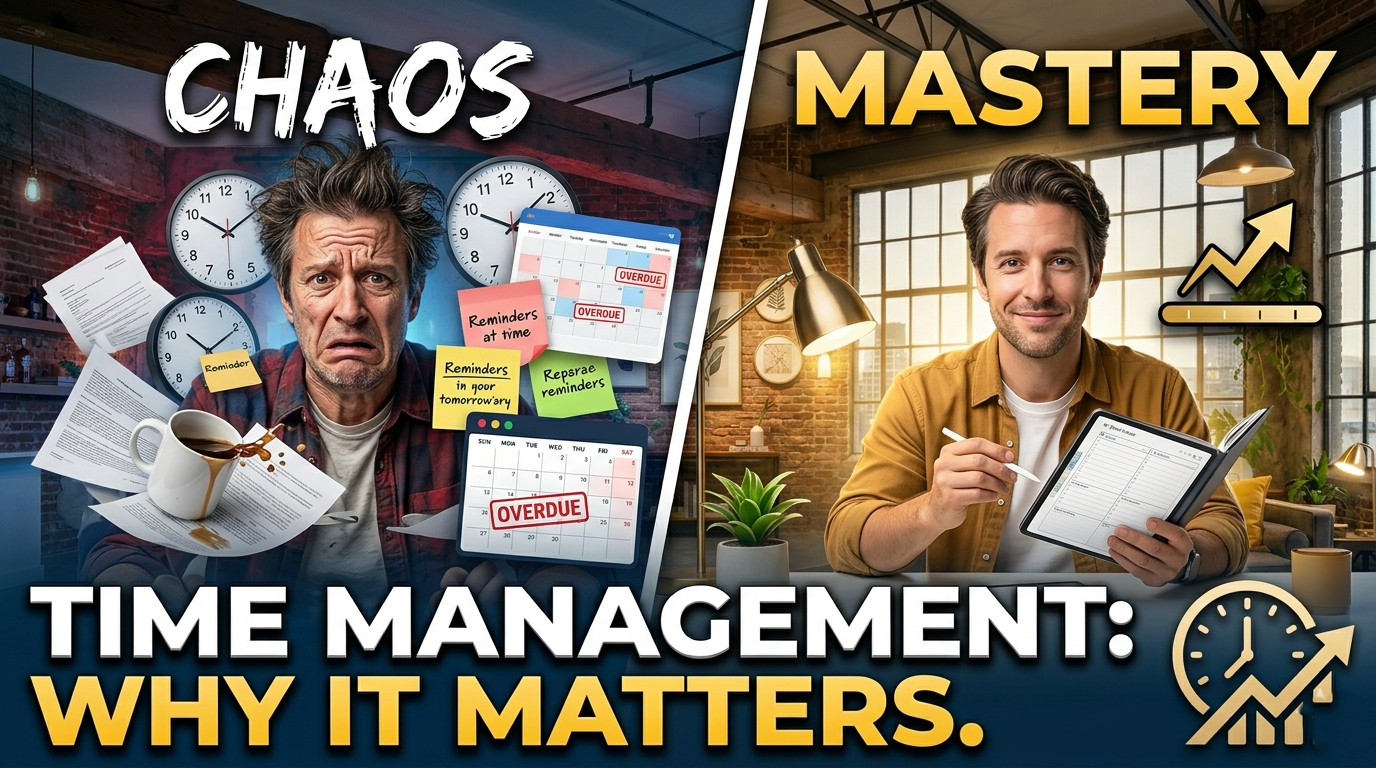
Time is the one resource every working adult has in equal measure, 24 hours a day, 168 hours a week. Yet the difference between those who thrive professionally and personally and those who feel perpetually overwhelmed often comes down to one thing: how intentionally that time is managed.
According to a McKinsey study, knowledge workers spend nearly 60% of their time on low-value coordination tasks, emails, meetings, status updates, and only 40% on skilled tasks they were actually hired to perform. Poor time management doesn't just hurt productivity; it fuels burnout, increases stress, strains relationships, and erodes career growth.
This guide is designed to change that. Whether you are a corporate professional, freelancer, entrepreneur, parent juggling a career, or a recent graduate just starting out, the strategies in these pages are practical, proven, and immediately applicable.
1. Understanding Where Your Time Actually Goes
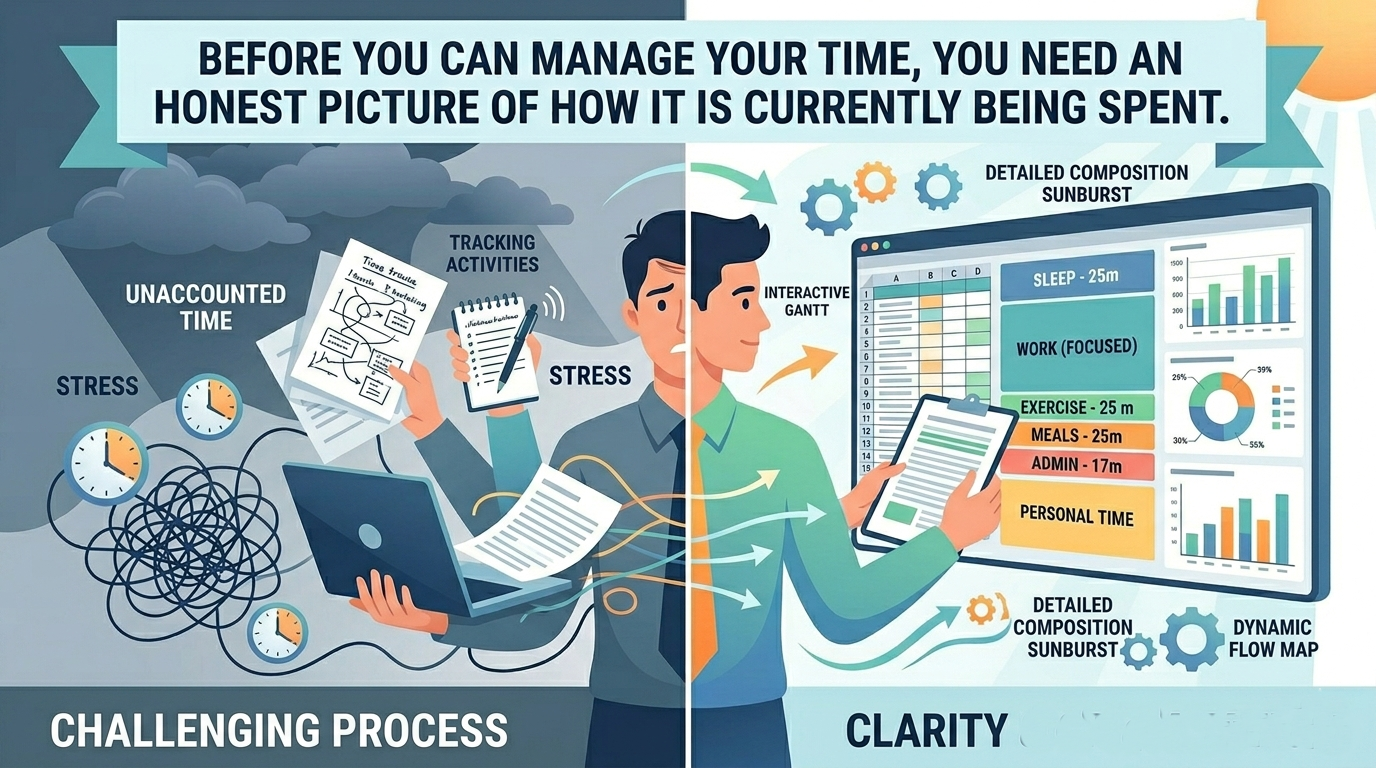
Before you can manage your time, you need an honest picture of how it is currently being spent. Most people dramatically overestimate how much focused work they complete each day.
1.1 Conduct a Time Audit
A time audit is simply tracking everything you do in 15–30 minute blocks over one to two weeks. The results are often sobering and revelatory.
- Use a spreadsheet, notebook, or apps like Toggl Track to log each activity.
- Categorize tasks as: Deep Work, Shallow Work, Meetings, Admin, Personal, or Wasted.
- Review patterns at the end of the week and identify your biggest time drains.
1.2 Identify Your Chronotype
Your chronotype is your natural biological inclination toward being a morning person or a night owl. Research by Dr. Michael Breus shows that working with your chronotype, not against it, can increase output by up to 30%.
- Lions (early risers): Best focus in the morning. Schedule deep work before noon.
- Bears (mid-day peak): Most productive mid-morning to early afternoon.
- Wolves (night owls): Creative peak hits in late afternoon and evening.
2. Goal Setting and Prioritization Frameworks
Effective time management begins with clarity on what actually matters. Without clear priorities, every task feels equally urgent, a recipe for perpetual busyness with little meaningful progress.
2.1 The Eisenhower Matrix
Developed by U.S. President Dwight D. Eisenhower and popularized by Stephen Covey, this framework sorts tasks into four quadrants:
| Quadrant | Urgent & Important | Not Urgent & Important | Urgent & Not Important |
| Action | Do First | Schedule | Delegate |
| Example | Crisis, deadline today | Planning, skill-building | Interruptions, some emails |
2.2 SMART Goal Setting
Every task worth doing deserves a SMART goal, Specific, Measurable, Achievable, Relevant, and Time-bound. Vague intentions like 'work on the report' produce vague results. Instead: 'Complete the first draft of the Q3 performance report by Thursday at 5 PM.'
2.3 The MIT Method (Most Important Tasks)
Each morning, identify your three Most Important Tasks, the tasks that, if completed today, would make the day a genuine success. Complete these before anything else.
3. Productivity Systems and Scheduling Techniques
3.1 Time Blocking
Time blocking means scheduling specific time slots in your calendar for specific types of work, rather than working from an open-ended to-do list. It is the method used by Bill Gates, Elon Musk, and Cal Newport.
- Block 2–4 hours of uninterrupted deep work each morning.
- Group similar tasks together (batching) to reduce context-switching costs.
- Leave buffer blocks between intensive sessions to handle overflow and recover focus.
3.2 The Pomodoro Technique
Developed by Francesco Cirillo in the late 1980s, the Pomodoro Technique uses timed intervals to maintain focus and prevent fatigue:
- Work for 25 minutes with complete focus (one Pomodoro).
- Take a 5-minute break.
- After four Pomodoros, take a longer break of 15–30 minutes.
- Tools: Pomofocus.io, Forest App, or a simple kitchen timer.
3.3 The 80/20 Rule (Pareto Principle)
The Pareto Principle states that roughly 80% of outcomes come from 20% of efforts. For working adults, this means identifying which tasks generate the most significant results and ruthlessly protecting time for them.
3.4 Eat the Frog
Mark Twain reportedly said: 'If it's your job to eat a frog, it's best to do it first thing in the morning.' Applied to productivity, this means tackling your most challenging or dreaded task first, before distractions, fatigue, or decision fatigue set in.
4. Managing Distractions and Protecting Focus
The modern workplace is an interruption machine. A study by UC Irvine found that it takes an average of 23 minutes and 15 seconds to fully regain focus after an interruption. Protecting your attention is not a luxury, it is a professional imperative.
4.1 Digital Distractions
- Turn off non-essential push notifications on your phone and computer.
- Use website blockers during deep work sessions (Freedom, Cold Turkey, or Stay Focused).
- Check email at set times (e.g., 9 AM, 1 PM, and 5 PM) rather than reactively throughout the day.
- Keep your phone face-down or in another room during focused work.
4.2 Environmental and Social Distractions
- Communicate your focus schedule to colleagues and family members.
- Use noise-cancelling headphones or focus music (lo-fi, classical, or binaural beats).
- Create a dedicated workspace that your brain associates exclusively with focused work.
- For open-plan offices: use a visual signal (headphones on, a do-not-disturb sign) to signal deep work time.
5. The Art of Delegation and Saying No
5.1 Effective Delegation
Delegation is not abandonment, it is strategic resource allocation. Many working adults hold onto tasks they could assign to others out of a sense of perfectionism or misplaced responsibility.
- Identify tasks that do not require your specific skill set or authority.
- Delegate with clear instructions, defined outcomes, and appropriate deadlines.
- Invest time upfront in training to save larger amounts of time downstream.
5.2 The Power of No
Every yes is an implicit no to something else. Learning to decline requests, meetings, and commitments that do not align with your priorities is one of the most powerful time management skills available.
- Use the phrase: 'I'm not able to take that on right now, but here's who might be able to help.'
- Apply the 'Hell yes or no' filter: if a request does not excite you, the answer is no.
- Protect non-negotiable blocks, exercise, family time, recovery, as firmly as work meetings.
6. Meetings: The Productivity Killer and How to Fix It
Professionals spend an average of 31 hours per month in unproductive meetings, according to a study by Atlassian. Reclaiming even a fraction of this time can dramatically improve output.
- Require a written agenda before accepting any meeting invitation.
- Default to 25- or 50-minute meetings (instead of 30 or 60) to create natural transition time.
- Conduct standing meetings for quick syncs, they naturally run shorter.
- End every meeting with documented action items, owners, and deadlines.
- Ask: 'Could this have been an email?' before scheduling.
7. Energy Management: The Missing Ingredient
Time management without energy management is incomplete. You can have all the time in the world and still produce poor work if you are physically exhausted, emotionally depleted, or mentally foggy.
7.1 Sleep as a Productivity Tool
- Adults need 7–9 hours of sleep per night. Sleep deprivation costs the US economy $411 billion annually in lost productivity (RAND Corporation).
- Maintain a consistent sleep schedule, even on weekends.
- Avoid screens 30–60 minutes before bed to protect melatonin production.
7.2 Exercise, Nutrition, and Recovery
- Regular exercise increases focus, reduces anxiety, and improves cognitive performance, even 20 minutes of brisk walking makes a measurable difference.
- Avoid high-sugar lunches that cause energy crashes in the early afternoon.
- Take strategic micro-breaks: a 5–10 minute walk, breathing exercise, or stretch restores mental energy.
8. Digital Tools and Apps for Time Management
The right tools reduce friction and make your system sustainable. Below is a curated selection across key categories:
| Category | Recommended Tools | Best For |
| Task Management | Todoist, Notion, TickTick, Asana | Organizing daily and project tasks |
| Calendar & Scheduling | Google Calendar, Fantastical, Calendly | Time blocking, meeting scheduling |
| Focus & Deep Work | Forest App, Focusmate, Brain.fm | Staying on task during work sessions |
| Time Tracking | Toggl Track, Clockify, RescueTime | Auditing how time is actually spent |
| Note-taking | Notion, Obsidian, Apple Notes | Capturing ideas and meeting notes |
| Email Management | Superhuman, SaneBox, Spark | Reducing email overwhelm |
9. Building and Sustaining Good Habits
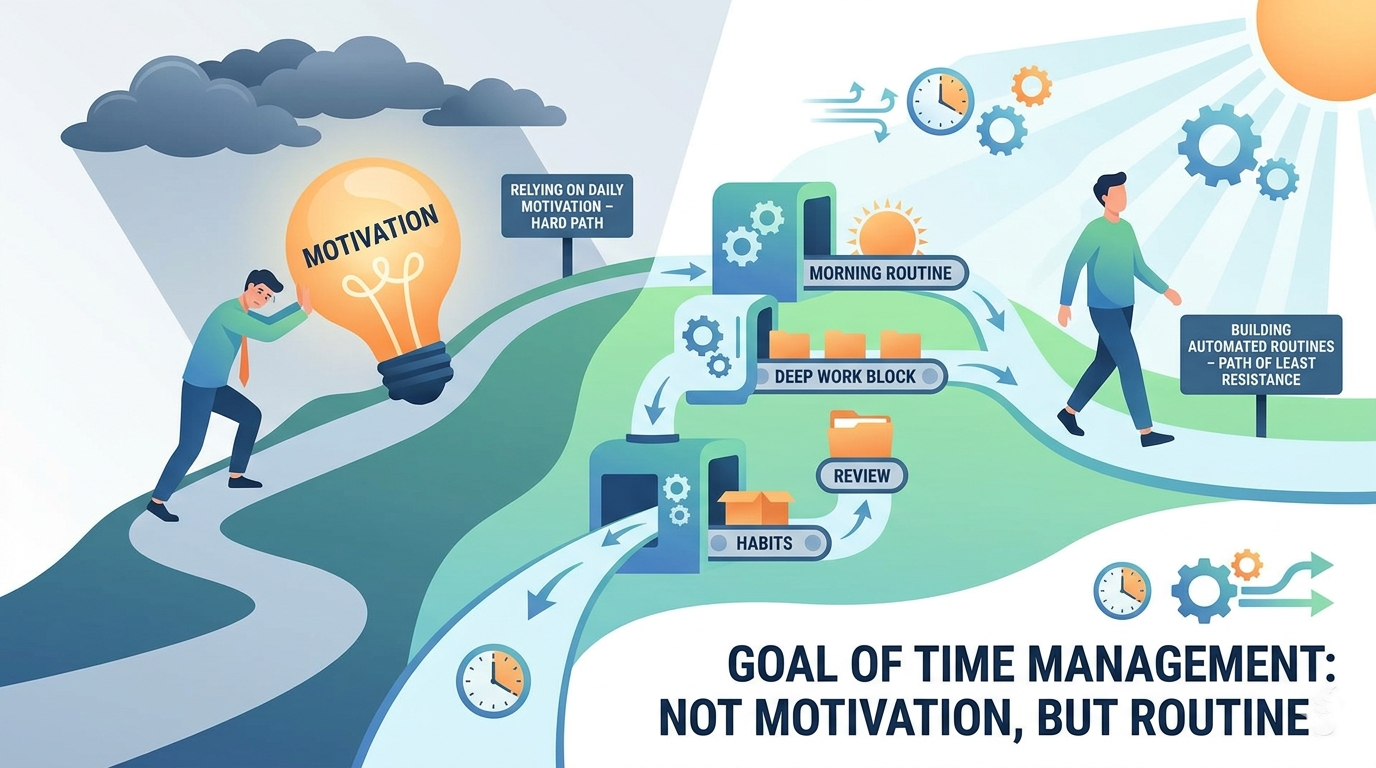
Systems beat willpower. The goal of time management is not to rely on daily motivation but to build automated routines that make productive behavior the path of least resistance.
9.1 The Morning Routine
A structured morning routine sets the psychological tone for the entire day. It does not need to be elaborate, consistency matters more than complexity.
- Avoid checking your phone for the first 30 minutes after waking.
- Review your MIT list and calendar before starting any reactive communication.
- Include a physical activity, however brief, to activate your body and mind.
9.2 The Evening Review
A 10–15 minute review at the end of each day dramatically improves next-day performance by reducing the cognitive load of planning in the morning.
- Review what you accomplished and what remains.
- Write tomorrow's MIT list tonight.
- Perform a mental 'shutdown ritual', close tabs, clear your desk, and formally end the workday.
10. Avoiding Burnout: Sustainable Productivity
Unsustainable productivity is not productivity at all, it is delayed collapse. The World Health Organization classifies burnout as an occupational phenomenon, characterized by exhaustion, cynicism, and reduced professional efficacy.
- Build genuine rest into your schedule, not as a reward, but as a requirement.
- Observe at least one full day each week as a rest day with no work tasks.
- Schedule vacations in advance and protect them from work encroachment.
- Monitor warning signs: chronic fatigue, irritability, declining quality of work, and disengagement.
- Seek support early. Talk to a manager, coach, therapist, or mentor before burnout becomes acute.
Quick Reference: Top 10 Time Management Tips at a Glance
1. Conduct a weekly time audit to understand where your hours actually go.
2. Identify your chronotype and schedule deep work during your peak energy hours.
3. Use the Eisenhower Matrix to separate urgent tasks from important ones.
4. Apply the Pomodoro Technique to maintain focus and prevent mental fatigue.
5. Time-block your calendar and protect deep work sessions fiercely.
6. Batch check emails and messages at scheduled intervals, not continuously.
7. Learn to say no to commitments that do not align with your core priorities.
8. End every day with a 10-minute review and write tomorrow's MIT list.
9. Protect your sleep, exercise, and recovery as non-negotiable productivity inputs.
10. Regularly reassess your system, the best system is the one you will actually use.
Conclusion
Time management is ultimately self-management. It is not about squeezing more into each day, it is about ensuring the hours you invest are aligned with the outcomes that matter most to you, professionally and personally.
No single strategy works for everyone. The most effective approach is to experiment thoughtfully, measure results honestly, and build a personalized system that fits your role, your industry, your family situation, and your goals.
Start with one change. Implement it consistently for two weeks. Then add another. Over time, these small shifts compound into a fundamentally different and more fulfilling relationship with your time.