
SECTION 1
When Your Image Is No Longer Your Own
She found them on a Friday evening. A link, sent anonymously to her work email, with a message that made her hands go cold. The images were of her face, unmistakably her face, attached to a body that was not hers, in explicit photographs she had never taken, in scenarios she had never been part of. They were fake. They were also, to anyone who didn't know better, entirely convincing.
In the hours that followed, she experienced something that deepfake victims consistently describe: a specific kind of violation that is difficult to name, part identity theft, part assault, part helplessness. The images were spreading. She did not know who had made them, who was sharing them, or what she was legally allowed to do. She was not sure the law had caught up with what was happening to her. She was not sure anyone would take it seriously.
"You did nothing wrong. What happened to you is real harm, even if the images are fake. And in 2026, the law is increasingly on your side." |
The scenario above is a composite of experiences reported by thousands of real people worldwide. AI-generated deepfakes, synthetic media created using artificial intelligence to superimpose, manipulate, or fabricate realistic-looking images, videos, and audio, have moved from a niche technological concern to one of the defining digital safety crises of our time. Reports of non-consensual AI-generated explicit imagery have surged dramatically. Teenagers are targeting classmates. Stalkers are targeting ex-partners. Anonymous harassers are targeting journalists, activists, and professionals.
This guide is for anyone who has been targeted, fears being targeted, or wants to understand the law, their rights, and their options. It is for parents trying to protect their children. It is for educators trying to understand what is happening in schools. It is for every person who has ever wondered: is this legal? What can I do? Where do I report it? You will find those answers here, along with the emotional reassurance that you are not alone, and that this is not something you should have to simply endure.

SECTION 2
What Are AI Deepfakes?
The term 'deepfake' combines 'deep learning' (a branch of artificial intelligence) and 'fake.' At its most basic, a deepfake is any piece of media, an image, video, or audio recording, that has been generated or manipulated using AI to create a realistic but fabricated representation of a real person.
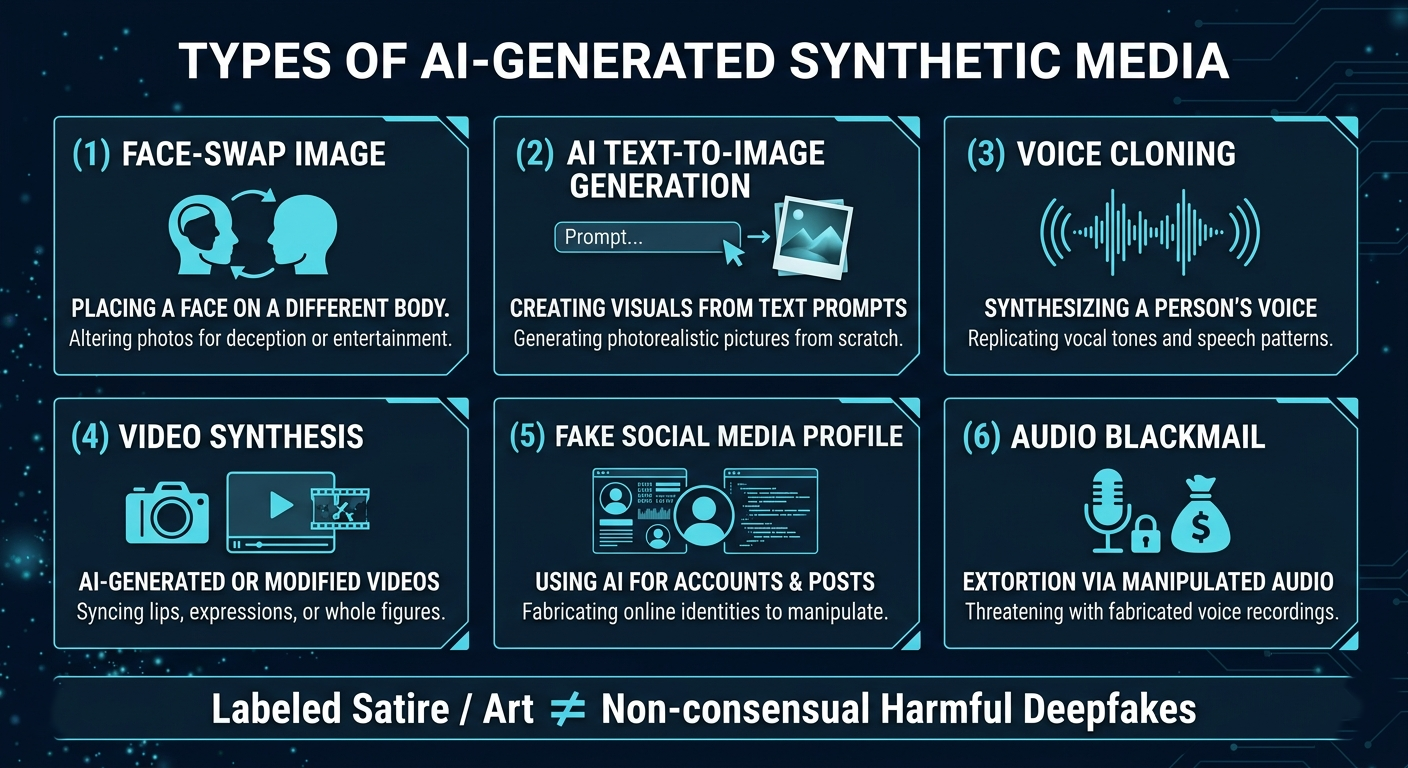
Types of AI-Generated Synthetic Media
Type | Description and Harm Potential |
|---|---|
| Face-Swap Images / Videos | AI maps a real person's face onto a different body in an image or video. In harassment contexts, this is most commonly used to place victims' faces into explicit sexual content without their consent. The output can be extremely convincing and nearly impossible to distinguish from a genuine photograph without technical analysis. |
| Text-to-Image Generation | Using only a name, a description, or a handful of photos scraped from social media, modern AI image generators can produce photorealistic synthetic images of real individuals in situations they were never in. In 2026, this technology is accessible to anyone with an internet connection. |
| AI Voice Cloning | A person's voice can be cloned using as little as 3–10 seconds of recorded audio. Synthetic voices can be made to say anything, used for impersonation scams, harassment calls, false incriminating audio, and emotional manipulation of victims' families or employers. |
| Video Synthesis (Full Body/Face) | AI can generate complete video footage of a person saying or doing things they never said or did. While high-quality full-video deepfakes still require some technical skill, the barrier is rapidly dropping. Used in disinformation, extortion, and reputation destruction campaigns. |
| AI Impersonation Accounts | AI-generated profile pictures, synthetic posts, and automated messaging can be used to create convincing fake social media identities impersonating real people, spreading false information, damaging relationships, and facilitating fraud. |
| Audio Deepfakes for Blackmail | Synthesized audio of a person apparently saying something incriminating, embarrassing, or explicit is sent to family, employers, or posted publicly, used as a tool of coercion, extortion, and reputational damage. |
It is crucial to distinguish between AI-generated media used for clearly labeled satire, artistic exploration, or entertainment, where the synthetic nature is transparent, and non-consensual, deceptive, harmful uses where real people are targeted without their knowledge or consent and where the goal is to deceive, harass, humiliate, or extort. The latter is the subject of this article.
|
SECTION 3
Why Deepfake Harassment Has Exploded in 2026
Deepfake harassment is not a new problem, but it has reached new scale, new speed, and new accessibility in 2026. Understanding why helps contextualize the legal and social response, and helps victims understand that they are part of a documented, growing crisis rather than isolated incidents.
Contributing Factor | How It Has Accelerated the Problem |
|---|---|
| Generative AI Democratization | AI image and video generation tools that once required significant technical expertise and computing power are now freely available as mobile apps and web services. Creating a convincing synthetic image of a real person now requires minimal skill and can be done in seconds. |
| Social Media Image Availability | Most adults have hundreds to thousands of publicly available images of themselves on social media platforms. These images feed AI training and generation, making anyone with a social media presence a potential target. |
| Anonymous Online Culture | The perceived anonymity of online harassment significantly lowers the psychological barrier to committing it. Many perpetrators believe, often correctly, given current enforcement limitations, that they will not face consequences. |
| Platform Moderation Failures | Despite policy updates, major platforms continue to struggle with rapid detection and removal of AI-generated harmful content. The volume of content uploaded every minute makes human and algorithmic review deeply insufficient. |
| Legal Lag Behind Technology | Laws have historically struggled to keep pace with technological change. Until recently, many jurisdictions lacked specific legislation addressing AI-generated non-consensual imagery, leaving victims in a legal gray area that perpetrators exploited. |
| Low Cost of Production | Creating a deepfake now costs effectively nothing. This has enabled scale of harassment that was impossible in the pre-AI era, a single perpetrator can target hundreds of people with virtually no resource constraint. |
| Normalization Through Spread | Content shared widely online creates a normalization effect, making harassment that would be recognized as unacceptable in person seem somehow less 'real' when mediated through digital platforms. |
SECTION 4
Who Is Most at Risk?
While virtually anyone with an online presence can be targeted, research, reporting, and legal data consistently identify certain groups as disproportionately affected by AI-generated deepfake harassment.
Group | Specific Risk Factors and Context |
|---|---|
| Women (all ages) | Studies consistently find that 90%+ of non-consensual deepfake content targets women. The motivations range from misogynistic harassment to intimate partner abuse to online stalking. Women in public-facing roles, social media, and professional life face heightened exposure. |
| Teenagers (13–18) | An alarming and growing proportion of deepfake harassment occurs in school environments, students creating and sharing AI-generated explicit images of classmates, particularly female classmates. The psychological harm on adolescent victims is severe and well-documented. |
| Social Media Influencers and Content Creators | Individuals who share large volumes of public images and video are both higher-visibility targets and provide more source material for AI generation. The parasocial nature of some online audiences creates specific risk dynamics. |
| Journalists, Activists, and Political Figures | Deepfakes are increasingly used as a tool of political intimidation and journalistic harassment, particularly targeting women in these roles who challenge powerful interests or speak publicly on controversial topics. |
| Everyday Social Media Users | Any person who has publicly posted photographs can become a target. Harassment often comes from ex-partners, acquaintances, or online strangers without any high-profile element, underscoring that this is not exclusively a 'celebrity problem.' |
| Professionals in Visible Roles | Teachers, doctors, lawyers, and business professionals have been targeted, with deepfakes used to damage professional reputations, create workplace harassment situations, or facilitate extortion. |
| LGBTQ+ Individuals | Members of the LGBTQ+ community face specific risks of being outed, sexualized, or subjected to targeted hate-motivated deepfake harassment, with particular vulnerability in jurisdictions where LGBTQ+ identities face legal or social stigma. |
| "Deepfake harassment is not random. It is overwhelmingly targeted, gendered, and designed to cause maximum harm to specific people in specific contexts. It is a form of gender-based violence in the digital age." |
SECTION 5
Is Deepfake Content Illegal in 2026?
This is the question most victims and potential victims urgently need answered, and the honest answer is: increasingly yes, but the specific laws that apply depend significantly on where you are, what type of content was created, and how it was used or distributed.
Legal protections for deepfake victims have expanded dramatically since the early 2020s, when most jurisdictions had no specific legislation addressing AI-generated non-consensual imagery. By 2026, a growing patchwork of federal, state, and international laws addresses various aspects of this problem, though gaps and inconsistencies remain.
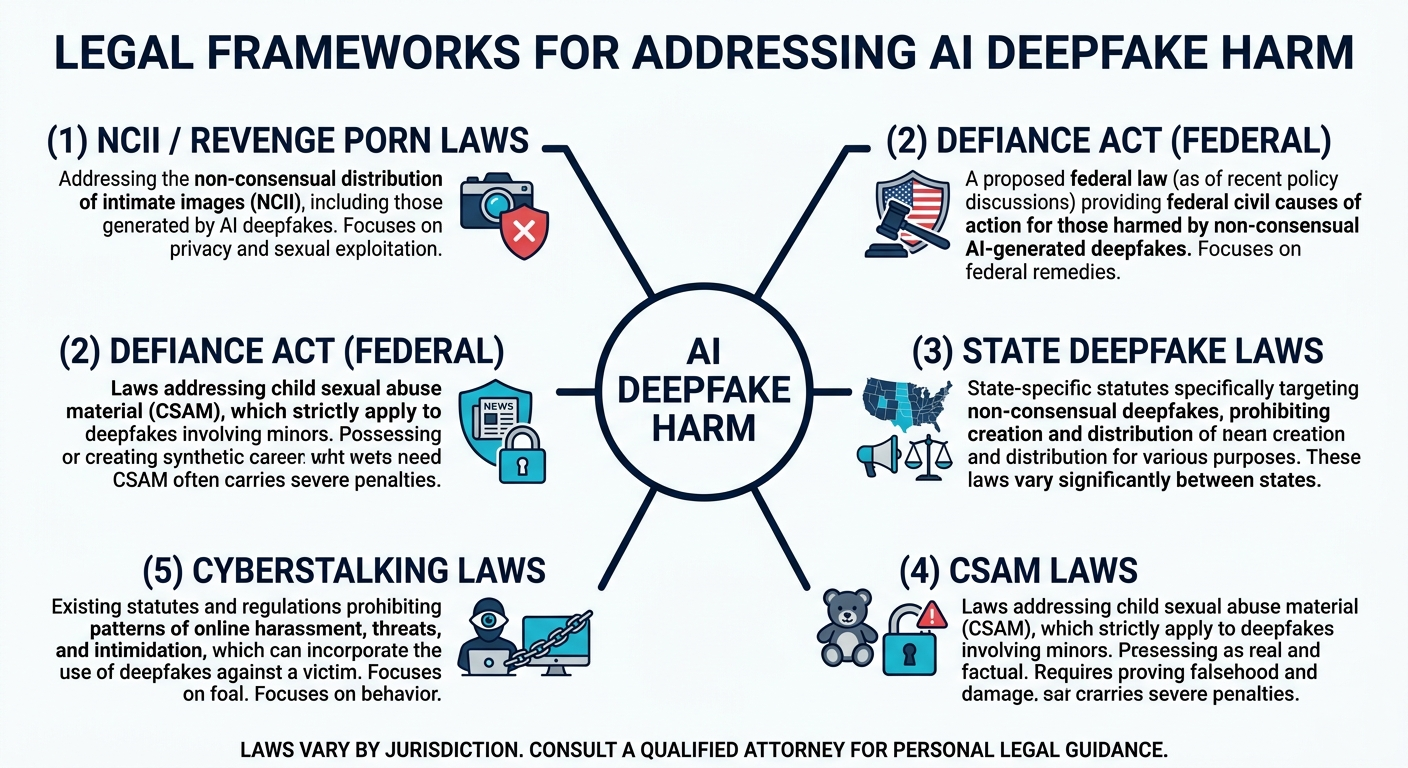
Legal Frameworks That May Apply
Legal Framework | How It Applies to Deepfake Harassment |
|---|---|
| Non-Consensual Intimate Image (NCII) Laws / 'Revenge Porn' Legislation | Many U.S. states and countries have expanded existing NCII laws to explicitly include AI-generated and synthetic imagery. As of 2026, over 40 U.S. states have some form of NCII law, and an increasing number explicitly cover AI-generated content. Federal NCII legislation was enacted in the U.S. in 2024 (the DEFIANCE Act), providing civil remedies for victims of non-consensual AI intimate imagery. |
| The DEFIANCE Act (U.S. Federal, 2024) | Specifically allows victims of non-consensual AI-generated intimate images to bring civil lawsuits against perpetrators and, in some cases, against platforms that knowingly host such content. This represents a significant expansion of federal victim rights in the AI image space. |
| State AI Deepfake Laws | A growing number of U.S. states have enacted laws specifically addressing deepfakes in contexts including: non-consensual intimate imagery, election-related deepfakes, and child sexual abuse material (CSAM). California, Texas, Virginia, Georgia, and others have been leaders in this area. |
| Defamation Law | Where a deepfake presents false statements of fact that damage a person's reputation (for example, a fabricated video suggesting criminal behavior), defamation law may apply — though the intersection of AI-generated content and defamation doctrine is still developing in courts. |
| Cyberstalking and Harassment Laws | Federal cyberstalking and harassment statutes, as well as state equivalents, may apply where deepfake content is used as part of a pattern of harassment, intimidation, or threatening behavior toward a specific individual. |
| Identity Theft / Impersonation Laws | Where a deepfake is used to impersonate someone for financial gain, fraud, or to damage their reputation in specific ways, identity theft and impersonation laws may provide additional legal remedies. |
| Child Sexual Abuse Material (CSAM) Laws | AI-generated sexual imagery of minors is treated the same as CSAM under federal law in the United States — a serious federal felony regardless of whether the content depicts a real or AI-generated child. Zero tolerance applies. |
| Platform Terms of Service / Removal Rights | Major social media platforms have terms of service prohibiting non-consensual intimate imagery and AI-generated harassment. While not criminal law, platform policies provide a mechanism for content removal — often faster than the legal process. |
IMPORTANT LEGAL DISCLAIMER
This article provides general educational information about legal trends and frameworks, it does not constitute legal advice.
Laws vary significantly between U.S. states, countries, and jurisdictions. What is explicitly illegal in one jurisdiction may still be in a legal gray area in another.
If you are a victim of deepfake harassment, consulting with a lawyer who specializes in cyber law, digital privacy, or harassment law in your jurisdiction is strongly recommended.
Do not rely solely on this article to make legal decisions. Organizations like the Cyber Civil Rights Initiative (CCRI) can help connect victims with qualified legal resources.
SECTION 6
What to Do Immediately If You're a Victim
If you have discovered that AI-generated images, videos, or audio of you are being circulated without your consent, the first and most important thing to understand is: your first hour matters. The steps you take in the immediate aftermath can significantly affect your ability to have content removed, preserve evidence for potential legal action, and protect yourself from further harm.
It is also entirely normal to feel panic, shock, and the urge to respond immediately and angrily. Resist the impulse to confront the perpetrator directly online — this rarely helps and can escalate the situation or compromise your position. Instead, work through the following steps as calmly as you are able.
IMMEDIATE RESPONSE CHECKLIST — DO THESE FIRST |
☐ Take a breath. Your feelings are valid. This is real harm and it can be addressed. |
☐ Do NOT confront the perpetrator publicly or privately before taking the steps below. |
☐ Screenshot everything: every post, every comment, every share, every profile. Use your phone or a screen capture tool, capture the full URL in every screenshot. |
☐ Record the URLs (web addresses) of every page where content appears, copy and save these in a document or notes app. |
☐ Note usernames, account names, display names, and any identifying information visible in the posts. |
☐ Note timestamps (date and time) of all content you document. |
☐ Do NOT delete any communications you have received from the perpetrator, these may be evidence. |
☐ If the content is on a platform, use the platform's reporting system immediately (see Section 7). |
☐ Contact a trusted person, a friend, family member, or professional. You should not navigate this alone. |
☐ If you are in immediate danger (blackmail, credible threats, known perpetrator), contact law enforcement. |
☐ Consider contacting the Cyber Civil Rights Initiative (CCRI) crisis helpline for immediate guidance. |
EVIDENCE PRESERVATION: WHAT COUNTS AND HOW TO DO IT |
Screenshots:Capture the full browser window showing URL, content, and timestamp. Do not crop. Take multiple screenshots. |
URL Preservation:Copy the exact URL from the browser address bar into a document for every piece of content. These become unavailable if content is removed. |
Download:Where possible and legally permitted in your jurisdiction, download copies of the offending content for evidence purposes. Consult a lawyer about proper evidence handling. |
Metadata:If you have access to the original files (e.g., something forwarded to you), do NOT open or edit them. Consult a digital forensics professional, metadata can help identify the source. |
Communication Records:Screenshot and preserve any messages, emails, or contacts related to the incident. |
Witness Documentation:Note the names of anyone who has seen or can confirm they witnessed the content. |
Storage:Store evidence in multiple secure locations (cloud backup AND local). Password-protect evidence files. |
SECTION 7
How to Report AI-Generated Harassment
Reporting is not always straightforward, and the multiplicity of systems (platform reporting, law enforcement, school reporting, legal action) can feel overwhelming when you are already distressed. This section maps the reporting landscape clearly so you know what each pathway does, what it achieves, and in what order to proceed.
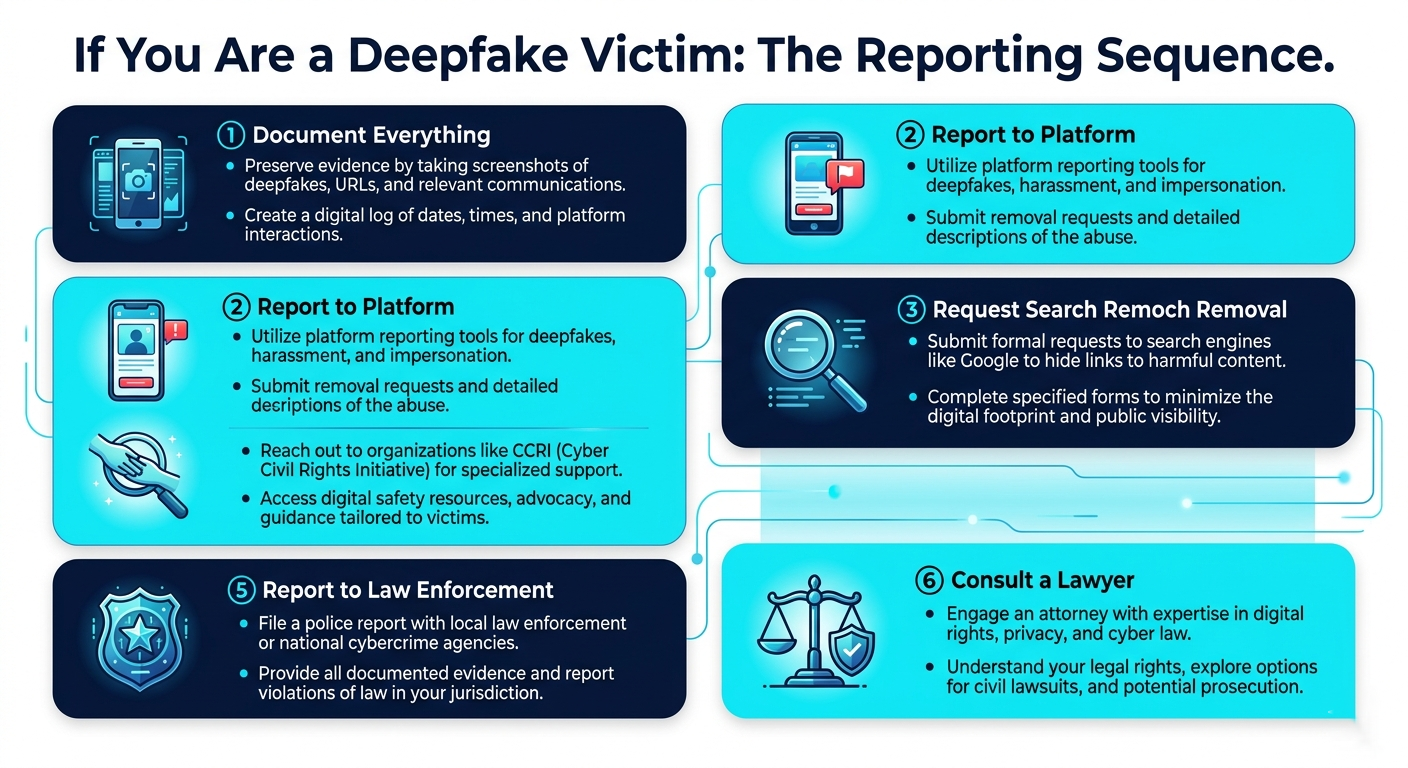
Reporting Pathways
Reporting Channel | What It Can Achieve | How to Access It |
| Platform Reporting (Meta, X/Twitter, TikTok, Instagram, Reddit, etc.) | Content removal; account suspension; sometimes escalation to platform safety teams. Fastest route for content takedown in many cases. | Use the 'Report' function on each individual post/account. Report specifically as 'Non-consensual intimate imagery' or 'AI-generated fake image' where options exist. Follow up if no action within 48 hours. Escalate to a dedicated trust & safety email if available. |
| Google / Bing / Search Engine Removal | Can de-index content from search results even if the source page is not removed. Particularly important for preventing search visibility. | Google's 'Remove Outdated Content' tool and specific removal request for non-consensual intimate imagery at g.co/removelinks. Bing has a similar process at bing.com/webmaster/tools. |
| StopNCII.org / NCMEC | Hashes your image so platforms can automatically detect and block reuploads without you having to repeatedly report. UK-based but internationally available. | Visit stopncii.org. No actual image is uploaded — a digital fingerprint (hash) is created and shared with participating platforms to prevent spread. |
| Law Enforcement | Criminal investigation, potential prosecution, civil protection orders. Necessary for credible threats, blackmail, known perpetrators, and when criminal law applies. | Report to local police, FBI (if federal crimes involved — IC3.gov), or your national cybercrime unit. Bring documented evidence. Ask to speak with a cybercrime unit officer if available. |
| Cyber Civil Rights Initiative (CCRI) | Free legal referrals, crisis counseling, guidance on evidence preservation, platform reporting assistance, and emotional support. | cybercivilrights.org / CCRI Crisis Helpline: 1-844-878-CCRI (2274). Available to victims in the U.S. and internationally. |
| School / University Reporting | Disciplinary action against student perpetrators; safeguarding intervention; pastoral support. | Report to designated safeguarding lead, school counselor, or Title IX coordinator (U.S. universities). Document the report in writing. Request a written acknowledgment of receipt. |
| Employer / HR Reporting | Workplace harassment investigation; perpetrator discipline; professional protection. | Report to HR in writing, citing specific harassment and impact on work. Request confidentiality where possible. Document all communications. |
| Civil Legal Action (Attorney) | Financial compensation, cease-and-desist orders, injunctions against further spread, identity of anonymous perpetrators through court orders. | Consult a civil litigation attorney specializing in cyber law or digital privacy. Many offer free initial consultations. CCRI and Cyber Civil Rights legal referral network can help identify qualified attorneys. |
SECTION 8
How to Protect Yourself Online
While the responsibility for deepfake harassment lies entirely with perpetrators — never with victims — there are practical steps that reduce your digital vulnerability and limit the material available for misuse. These are not 'solutions' to the problem of harassment, but rather digital hygiene practices that strengthen your online safety.
Digital Safety Practices
Practice | How It Reduces Risk and How to Implement It |
Review and Tighten Privacy Settings | Audit your privacy settings on all social media platforms at least every 6 months. Set photos and personal content to 'Friends Only' or private where possible. This does not guarantee safety but meaningfully limits public access to source images. |
Limit Public Image Availability | Consider reducing the number of high-resolution face images publicly visible online. Older platform accounts, defunct profiles, and forgotten uploads are common sources of images used in AI generation. Conduct a periodic search of your own name and images. |
Enable Two-Factor Authentication (2FA) on All Accounts | Account takeover is sometimes used to access private images or impersonate victims. 2FA significantly reduces this risk. Use an authenticator app (Google Authenticator, Authy) rather than SMS where possible. |
Use Strong, Unique Passwords + Password Manager | Credential stuffing attacks use leaked passwords from one platform to access others. A password manager (Bitwarden, 1Password) generates and stores unique passwords for every account. |
Set Up Google Alerts for Your Name | A free Google Alert for your full name, professional name, and email address provides early warning if your name appears in new online content — including potentially unauthorized material. |
Consider Digital Watermarking | For content creators and public figures who publish images professionally, invisible digital watermarks embedded in images can help prove original ownership and trace unauthorized use. |
Reverse Image Search Periodically | Google Reverse Image Search and tools like TinEye allow you to search for where your images appear online. Regular checks can alert you to unauthorized use of your photographs. |
Use a Privacy-Focused Browser and VPN | A VPN (Virtual Private Network) masks your IP address from websites and potential harassers. Combined with a privacy-focused browser, it reduces the digital footprint available to those who may be monitoring your online activity. |
Be Selective About Who Receives High-Resolution Images | Private intimate images shared with partners can become a source of deepfake material or non-consensual sharing in abusive situations. Consider the permanence of digital sharing carefully. |
Monitor Your Digital Reputation Professionally | Services like Google's 'Results About You,' DeleteMe, and similar data broker removal tools can reduce the amount of personal information publicly available about you — reducing the profile available to those seeking to target you. |
SECTION 9
The Emotional and Psychological Impact of Deepfake Harassment
The psychological harm caused by AI-generated non-consensual imagery and deepfake harassment is real, documented, and significant. Research with victims consistently reveals a recognizable pattern of trauma responses, and a set of compounding harms that extend well beyond the immediate shock of discovery.
Psychological Impact | How It Manifests and Why It Matters |
|---|---|
| Acute Shock and Disorientation | The discovery of non-consensual deepfake content typically produces acute stress responses: physical symptoms of shock, racing heart, inability to think clearly. This is a normal neurological response to perceived threat and identity violation. |
| Profound Loss of Control | Victims consistently describe the feeling that their identity, their body, their image, and their narrative have been taken away from them without consent. This loss of agency over one's own representation is deeply distressing and psychologically destabilizing. |
| Hypervigilance and Anxiety | After an incident, many victims experience persistent anxiety, hypervigilance about online presence, fear of being recognized in public, and constant monitoring of platforms for new content. This can become a form of trauma-related hypervigilance that significantly affects daily functioning. |
| Workplace and Professional Harm | When deepfake content reaches colleagues, employers, clients, or professional networks, victims face real professional consequences, from damaged reputations to job loss to withdrawal from public professional life. The professional harm is frequently as significant as the personal harm. |
| Social Withdrawal and Isolation | Many victims significantly reduce or eliminate their online presence after an incident, withdrawing from social media, professional networking, and online community engagement. This enforced digital withdrawal is itself a harm, as it removes access to community, professional opportunity, and social connection. |
| Relationship Strain | The experience of deepfake victimization affects intimate relationships, friendships, and family dynamics, particularly where partners, family members, or friends see the content or where the victim must manage others' reactions alongside their own distress. |
| Secondary Shame Response | Despite being entirely the victim, many people experience irrational shame about the situation, the product of cultural conditioning, victim-blaming environments, or the deep personal nature of the violation. This secondary shame can prevent victims from reporting or seeking help. |
YOU ARE NOT ALONE — AND YOUR FEELINGS ARE VALID |
What you are experiencing is a recognized form of harm. Researchers and clinicians describe deepfake victimization as producing trauma responses equivalent to sexual harassment, stalking, and in some cases, sexual assault. |
Your distress is proportionate. Anyone would be distressed by what you are experiencing. |
You are not responsible for what happened to you. The perpetrator is responsible. Full stop. |
Seeking emotional support, from a trusted person, a therapist, or a support organization, is a sign of strength and self-care, not weakness. |
If you are in immediate emotional crisis, please contact a crisis line or mental health professional. |
SECTION 10
Parents, Teenagers & School Safety
One of the most alarming trends in the deepfake crisis of 2025–2026 has been the rapid spread of AI-generated non-consensual imagery in school environments. Reports of students, predominantly male students targeting female classmates, using AI image generation tools to create fake explicit images have emerged from schools across the United States, United Kingdom, Australia, Spain, and beyond. The victims are teenagers. Many are middle and high school students.
What Parents Need to Know
AI image generation is freely available to anyone with a smartphone or computer.
No technical skill is required. Your teenager's classmates have access to the same tools as adults.
Non-consensual AI imagery of minors is legally child sexual abuse material (CSAM) in the United States and many other countries, regardless of whether it depicts a real child or an AI-generated representation.
Those who create or distribute it face serious federal charges.
Victims are most likely to tell a peer or sibling before telling a parent or teacher.
Creating an environment of non-judgmental openness with your teenager increases the likelihood they will come to you.
If your teenager is a victim:
Believe them, stay calm, do not blame them, contact school administration and if appropriate, law enforcement. Preserve evidence before reporting to school, schools sometimes act hastily and evidence can be lost.
If your teenager may be a perpetrator:
Take it seriously. This is not a 'boys will be boys' situation. Federal law applies. Consult a family attorney immediately.
Conversation Starters for Parents
- 'I read something about AI and fake photos online. Do you know what deepfakes are? Have you ever seen anything like that?'
- 'Have any of your friends or classmates experienced anything like this?'
- 'What would you do if something like that happened to you or someone you knew?'
- 'I want you to know that if anything like that ever happened to you, you could always tell me. You would not be in trouble.'
School Responsibilities
Schools have a legal and ethical obligation to address deepfake harassment within their communities. Under Title IX (U.S.), non-consensual sexual imagery targeting students on the basis of sex constitutes a form of sexual harassment that schools are required to address. Schools should have, and many now are developing, specific AI misuse policies that address synthetic image creation. If your school does not, advocate for one.

SECTION 11
Common Myths About Deepfake Laws
Misinformation about deepfake legality is widespread, and it causes real harm, because victims who believe 'nothing can be done' often do not seek the help and legal recourse that is increasingly available to them.
Myth | The Reality in 2026 |
| 'Nothing can be done, deepfakes are too hard to trace and law enforcement won't act' | This was more accurate three years ago. Today, more laws exist, more platforms have active removal systems, organizations like CCRI provide direct legal support, and civil remedies (lawsuits) provide a pathway even when criminal prosecution is difficult. Victims who report consistently do achieve content removal, and some achieve legal accountability. |
| 'It's only illegal if money changes hands (blackmail / extortion)' | False. Non-consensual distribution of intimate imagery, real or AI-generated, is illegal in most U.S. states regardless of whether financial gain was involved. The violation is the distribution without consent, not the financial element. |
| 'AI-generated images aren't real harm because no real photograph was taken' | Courts, legislators, and clinical researchers all reject this. The harm to reputation, employment, relationships, and mental health is fully real. The fact that the image was synthesized rather than photographed does not reduce the harm to the victim. |
| 'Victims should just ignore it and it will go away' | Research shows that ignoring non-consensual imagery typically allows it to spread further. Evidence-preserving, prompt reporting to platforms consistently achieves better removal outcomes than waiting. Early action makes a measurable difference. |
| 'If you've posted photos online publicly, you have no legal protection' | False. Consent to share public images for normal viewing does not constitute consent to have those images incorporated into sexual or harassing synthetic content. Public images remain subject to legal protections. |
| 'Only famous people get deepfaked' | The majority of deepfake harassment victims are ordinary, non-famous individuals targeted by ex-partners, acquaintances, online strangers, or classmates. Any person with publicly available photographs is a potential target. |
| 'Platforms never do anything' | Platform responses are inconsistent and often frustratingly slow — but major platforms now have explicit policies against non-consensual intimate imagery including AI-generated versions, dedicated reporting channels, and in some cases proactive detection systems. Reporting does result in removal, particularly for content on major platforms. |
SECTION 12
Realistic Victim Scenarios and Stories
The following composite scenarios are drawn from the types of cases reported to advocacy organizations, law enforcement, and in published journalism. They are illustrative, not accounts of specific individuals, and outcomes reflect what is genuinely possible through the reporting and legal pathways described in this guide.
Scenario 1: Maya, 23 — Student Targeted by Anonymous ActorMaya was in her third year of university when a friend sent her a message: explicit AI-generated images bearing her face were circulating in a group chat. She was mortified, shaking, unable to concentrate. Her first instinct was to delete her social media entirely. Instead, she called the CCRI crisis helpline, who walked her through evidence preservation in real time. She screenshotted everything before the posts were removed. She reported to the platform using the non-consensual intimate imagery report option — the content was removed within 14 hours. She also reported to her university's Title IX coordinator, who opened a formal investigation. The university identified the source account as belonging to a former classmate. She consulted an attorney, who filed a civil suit under her state's newly enacted AI deepfake law. The case settled. Maya was not 'fixed' by any of this — the trauma was real. But she was not powerless. The system worked, imperfectly but meaningfully, because she reported. |
Scenario 2: David, 34 — Professional Facing Reputation AttackDavid was a healthcare professional who had spoken publicly at a conference on a politically contentious health policy issue. Weeks later, fabricated audio — a convincing AI clone of his voice — began circulating in online forums, making him appear to say things he had never said and that were professionally devastating. Colleagues began sending him screenshots. He contacted an attorney immediately, who issued formal takedown demands to the platforms hosting the audio, citing defamation and impersonation law. Several platforms complied. His employer supported him through the process after he provided clear documentation of the fabrication. A digital forensics specialist produced a technical report confirming the audio was AI-generated, which he shared with his professional association. The source of the audio was never conclusively identified — but the content was removed from the major platforms within three weeks, limiting the spread significantly. |
Scenario 3: A High School, Autumn 2025Fifteen-year-old students at a suburban high school discovered that AI-generated explicit images of at least a dozen female students had been created and shared among male classmates using a publicly available AI image app. Several victims found out through other students. None initially told a parent or teacher. One parent, informed by her daughter, contacted the school principal and simultaneously reported to the FBI's Internet Crime Complaint Center (IC3). The school engaged its Title IX coordinator and a crisis counselor. The district's attorney confirmed that under federal law, the images constituted CSAM — a federal felony. Law enforcement investigated. The school implemented an emergency AI misuse policy. Several students faced disciplinary proceedings. The case underscored why parental education and school policy both matter — and why the legal stakes of this behavior are not abstract. |
Scenario 4: Priya, 29 — Creator Who Got Content RemovedPriya was a content creator with 180,000 Instagram followers when AI-generated images of her began appearing on an adult content platform. She documented everything, reported to Instagram (which removed reposts quickly), submitted a hash fingerprint to StopNCII.org to prevent reuploads, and used Google's removal tool to request de-indexing. She issued a public statement on her platform making clear the images were AI-generated and non-consensual. Within three weeks, the primary sources had been removed from the major sites she had identified. She was transparent with her audience throughout — and found that openness reduced rather than amplified the harm. 'The shame would have destroyed me,' she said. 'Speaking about it publicly took that weapon away from whoever did this.' |

SECTION 13
How Laws Are Changing Around the World
The global legal response to AI deepfake harassment is accelerating, though unevenly. Understanding the international landscape is important particularly for victims in jurisdictions where protection has historically been weaker, and for anyone wanting to understand the direction of travel.
Jurisdiction / Region | Legal Developments as of 2026 |
| United States (Federal) | The DEFIANCE Act (2024) provides federal civil remedies for victims of non-consensual AI intimate imagery. The TAKE IT DOWN Act (2024) requires platforms to remove non-consensual intimate imagery including AI-generated content within 48 hours of notification. Federal CSAM law covers AI-generated child sexual imagery with zero tolerance. |
| United States (State Level) | Over 40 states have NCII laws as of 2026; an increasing number explicitly include AI-generated content. California, Texas, Virginia, Georgia, Illinois, and New York have been particularly active in expanding AI-specific legislation. State laws vary significantly in scope, penalties, and civil remedies. |
| United Kingdom | The Online Safety Act (2023, fully implemented 2025) includes explicit provisions addressing non-consensual intimate imagery including deepfakes. The Criminal Justice Bill has proposed criminalizing the creation (not just distribution) of non-consensual intimate deepfakes, a significant expansion beyond distribution-only models. |
| European Union | The EU AI Act (2024, phased implementation) establishes a regulatory framework for AI systems including requirements for transparency and human oversight. GDPR provides privacy rights that can support removal requests. EU member states have varying national laws on non-consensual imagery. |
| Australia | Australia's Online Safety Act has been used to require platform removal of deepfake content. The government announced new legislation in 2025 specifically targeting AI-generated non-consensual intimate imagery, with both civil and criminal provisions. |
| Canada | Canada's Criminal Code cyberbullying provisions and civil law frameworks provide some remedies. The government has signaled intent to update legislation specifically addressing AI-generated non-consensual imagery, though comprehensive federal legislation is still developing. |
| Republic of Korea | South Korea enacted specific legislation criminalizing the creation and distribution of AI-generated non-consensual intimate imagery in 2024, one of the more comprehensive national frameworks globally. Penalties include prison terms and fines. |
| India | The Information Technology Act provides some remedies for online harassment and non-consensual intimate imagery. AI-specific legislation is in development. Enforcement and awareness remain significant challenges. |
SECTION 14
The Future of AI Identity Protection
The same AI technology driving the deepfake crisis is also generating powerful tools for detection, protection, and accountability. While the cat-and-mouse dynamic between generation and detection technologies continues, 2026 represents a meaningful turning point in the development of AI-driven identity protection systems.
Technology / Development | What It Means for Victims and Protection |
| AI Deepfake Detection Tools | A new generation of AI detection systems, including tools built by Microsoft (Video Authenticator), Intel (FakeCatcher), and numerous academic and startup projects, can analyze images and videos for statistical markers of AI generation. While no detection tool is 100% reliable, the improving accuracy of these tools is strengthening the evidentiary capacity of victims and legal teams. Several of these tools are available for free or low cost. |
| Digital Watermarking and Content Credentials | The Content Authenticity Initiative (CAI), a coalition including Adobe, Microsoft, Sony, and major news organizations, has developed a technical standard called C2PA (Coalition for Content Provenance and Authenticity) that embeds verifiable metadata into images and videos at creation. This allows the authenticity and origin of content to be verified, and AI-generated content to be labeled as such by participating systems. Camera manufacturers, software platforms, and social networks are increasingly implementing C2PA. |
| Hash-Matching Systems (StopNCII, PhotoDNA) | Hash-matching technology creates a unique digital fingerprint of an image without storing the image itself. Networks like StopNCII distribute these fingerprints to participating platforms, enabling automatic detection and blocking of reuploads of the same content, even if the image has been slightly altered. This is currently one of the most effective tools for preventing viral spread of non-consensual imagery. |
| Platform AI Content Labeling Requirements | Under the EU AI Act and emerging U.S. state laws, AI-generated content must increasingly be labeled as such when published on major platforms. Meta, TikTok, YouTube, and others have implemented or announced AI content labeling requirements. While imperfect, mandatory labeling reduces the deceptive power of deepfakes and creates a legal accountability trail. |
| Identity Verification Technologies | Emerging digital identity verification systems, including decentralized identity (DID) frameworks and verified credential systems, may in the future allow individuals to more strongly assert and protect their digital identity, making impersonation harder to sustain undetected. |
| AI-Powered Reputation Monitoring | AI-driven reputation monitoring tools that continuously scan the web for unauthorized use of a person's likeness are becoming increasingly accessible, providing early warning systems that allow faster response to emerging deepfake incidents. |
SECTION 15
Conclusion: You Are Not Alone
The AI deepfake crisis is real. It is serious. And for the individuals caught in its path, the students, the professionals, the creators, the ordinary people who did nothing wrong, it can feel both devastating and impossible to address. This guide has been written to challenge both of those feelings.
You are not alone. Millions of people have faced versions of what you are facing. Organizations exist specifically to help you. Laws are increasingly on your side. Platforms, however imperfectly, have removal mechanisms you can use today. And the evidence you preserve now may matter enormously tomorrow.
You are not responsible for what was done to you. Creating, distributing, and sharing non-consensual AI-generated content is a deliberate act of harm. The legal systems of multiple countries are catching up with that reality, and increasingly providing meaningful tools for accountability and redress.
"Knowledge is the most powerful protection. Understanding your rights, knowing the reporting pathways, and reaching out for support are all acts of agency in a situation designed to make you feel powerless."
Report what you can. Document what you find. Seek support from those who understand what you are going through. And know that the direction of both law and technology is toward better protection, greater accountability, and more justice for victims than has ever existed before.
The image was fake. Your harm is real. And your rights are real too.
TAKE ACTION NOW — YOUR NEXT STEPS |
| 1. If you are a victim: Document everything. Report to the platform. |
| 2. Submit a hash to StopNCII.org to prevent reuploads across platforms. |
| 3. Request Google/Bing de-indexing of content from search results. |
| 4. Consult with a lawyer who specializes in cyber law or digital privacy. |
| 5. Seek emotional support — CCRI, Crisis Text Line, or a therapist. |
| 6. If a minor is involved: Report to law enforcement immediately. This is a federal crime. |
| 7. Tighten your privacy settings and review digital hygiene practices. |
| 8. Share this guide with someone who may need it, awareness is protection. |
FAQ
Frequently Asked Questions
Q: Is it a crime to create an AI deepfake of someone?
A: In a growing number of jurisdictions, yes, particularly for sexual or intimate content. In the United States, federal law criminalizes AI-generated child sexual abuse material. Many states have enacted laws criminalizing the creation and/or distribution of non-consensual AI intimate imagery of adults. The UK is in the process of criminalizing the creation (not just distribution) of such content. Globally, the trend is toward criminalization. However, laws vary by jurisdiction, the specific legality depends on where you are, what the content depicts, and how it is used. Consult a lawyer for guidance specific to your situation.
Q: Can I sue someone for making a deepfake of me?
A: Potentially yes, and the legal pathways for doing so have expanded significantly since the U.S. DEFIANCE Act (2024), which provides federal civil remedies for victims of non-consensual AI intimate imagery. At the state level, NCII laws in over 40 states provide civil remedies. Defamation law may also apply where the content makes false and damaging statements of fact. The practical challenge is often identifying the anonymous perpetrator, which may require court-ordered subpoenas compelling platforms to disclose account information. A lawyer specializing in cyber law can advise on the feasibility of civil action in your specific case.
Q: How do I get a deepfake image removed from the internet?
A: Report directly to the platform where the content appears using their non-consensual intimate imagery report mechanism. Submit a hash fingerprint to StopNCII.org to prevent reuploads. Use Google's and Bing's specific removal tools for non-consensual intimate imagery (g.co/removelinks for Google). If the hosting website is a dedicated adult content platform, most now have NCII removal policies, report directly. Consult the CCRI for guidance if you are struggling with removal. Note: removal from platforms does not always mean removal from all copies, some may persist on less regulated sites, which is why the hash-matching approach through StopNCII is particularly valuable.
Q: What if I don't know who made the deepfake?
A: Unknown/anonymous perpetrators are a common challenge in deepfake cases. Document everything you can, including platform usernames, post URLs, and any other available information. Report to the platform, platforms are sometimes required by courts to disclose account information in legal proceedings. A lawyer can advise on whether subpoenas or legal discovery processes could identify the perpetrator. Law enforcement can also investigate, though their capacity and prioritization varies. Do not attempt to conduct your own investigation, this can compromise legal proceedings and sometimes escalate the situation.
Q: Will reporting to the police actually help?
A: It depends significantly on jurisdiction, the specific nature of the content, the local cybercrime resources, and whether you have preserved good evidence. For cases involving minors, law enforcement is strongly recommended and legally obligated to respond to reports of CSAM. For adult cases, the response is more variable, but the trend is improving as more jurisdictions train cybercrime units and as more specific laws are enacted. Filing a police report also creates an official record that may be relevant in civil proceedings. In the U.S., the FBI's Internet Crime Complaint Center (IC3.gov) handles federal cybercrime reports and can escalate to relevant agencies.
Q: My teenager's classmate created deepfake images of my child. What do I do?
A: Act urgently. Under U.S. federal law (and the law of many other countries), AI-generated sexual imagery of minors is child sexual abuse material — a serious federal felony, regardless of whether a real child's photograph was the source. Do NOT delete or ignore the evidence. Preserve it carefully. Report to your local police immediately, and to the FBI's IC3.gov. Report to the school's principal and Title IX coordinator in writing. Contact the National Center for Missing & Exploited Children (NCMEC) CyberTipline at missingkids.org. Consult a family attorney. Seek counseling support for your child immediately.
Q: Can I protect myself from deepfakes before they happen?
A: No protection is absolute, but several practices meaningfully reduce risk: tightening social media privacy settings, reducing the number of high-resolution public images available of yourself, enabling strong account security (2FA, strong passwords), regularly monitoring your digital presence (reverse image searches, Google Alerts), and using StopNCII.org proactively if you are in a high-risk category. For content creators and public figures, digital watermarking and working with reputation monitoring services provide additional layers of protection. Digital hygiene does not eliminate risk, but it reduces the material available to perpetrators and enables faster detection.
Trusted Digital Safety & Legal Resources
Organisation / Resource | What They Offer |
| Cyber Civil Rights Initiative — CCRI (cybercivilrights.org) | Free crisis helpline (1-844-878-CCRI), legal referrals, platform reporting guides, emotional support, and policy advocacy for victims of non-consensual intimate imagery including AI-generated content. |
| StopNCII.org | Hash-fingerprint technology that prevents reuploads of non-consensual intimate imagery across participating platforms without requiring the victim to submit the actual image. |
| National Center for Missing & Exploited Children — CyberTipline (missingkids.org/gethelpnow/cybertipline) | For reporting online exploitation of minors including AI-generated CSAM. Federally mandated reporting partner for U.S. platforms. |
| FBI Internet Crime Complaint Center — IC3 (ic3.gov) | Online reporting portal for federal cybercrime complaints including non-consensual intimate imagery, deepfake-based extortion, and AI impersonation. |
| Google Content Removal Tool (g.co/removelinks) | Google's specific tool for requesting removal of non-consensual intimate imagery including AI-generated content from search results. |
| Electronic Frontier Foundation — EFF (eff.org) | Digital civil liberties organization providing legal resources, guides on privacy rights, and advocacy for online safety policy. |
| Crisis Text Line (Text HOME to 741741, U.S.) | Free 24/7 text-based crisis support for anyone in emotional distress, including victims of online harassment. |
| Thorn (thorn.org) | Nonprofit building technology to defend children from sexual abuse, including AI-generated CSAM. Resources for parents, educators, and survivors. |
| The Revenge Porn Helpline (revengepornhelpline.org.uk — UK) | Free support for victims in the UK seeking removal of non-consensual intimate imagery from online platforms. |
| Consumer Financial Protection Bureau / FTC IdentityTheft.gov | For AI impersonation-based identity theft and financial fraud — reporting portal and recovery resources. |
IMPORTANT LEGAL DISCLAIMER: This article provides general educational information about legal frameworks, digital safety practices, and victim resources. It does not constitute legal advice and should not be relied upon as such. Laws regarding AI-generated content, non-consensual intimate imagery, and digital harassment vary significantly between jurisdictions and are evolving rapidly. If you are a victim or believe you may have legal claims, please consult a qualified attorney in your jurisdiction. The author and publisher expressly disclaim responsibility for any actions taken based solely on information in this article.