
The Silent Weight of Male Loneliness
It's 11 PM on a Tuesday night. You're scrolling through your phone, watching other people's highlight reels while sitting alone in your apartment. The TV's on, but you're not really watching. Your last meaningful conversation was... you can't actually remember. Maybe last week? Maybe longer.
You have 847 Instagram followers, 23 unread work emails, and a group chat that hasn't stopped pinging all day. But somehow, you feel completely alone.
You tell yourself you're fine. Busy, actually. Work's intense. Life's complicated. You'll connect with people when things calm down. Except things never really calm down, do they?
And you're exhausted, not just physically tired, but emotionally drained in a way you can't quite explain to anyone. Because who would you even tell?
If this feels familiar, you're not imagining it. And you're definitely not alone.

You're Not Broken. The System Is.
The male loneliness crisis isn't just a trending topic or mental health buzzword. It's a quiet epidemic affecting millions of men across every age group, profession, and background.
Research reveals a stark reality:
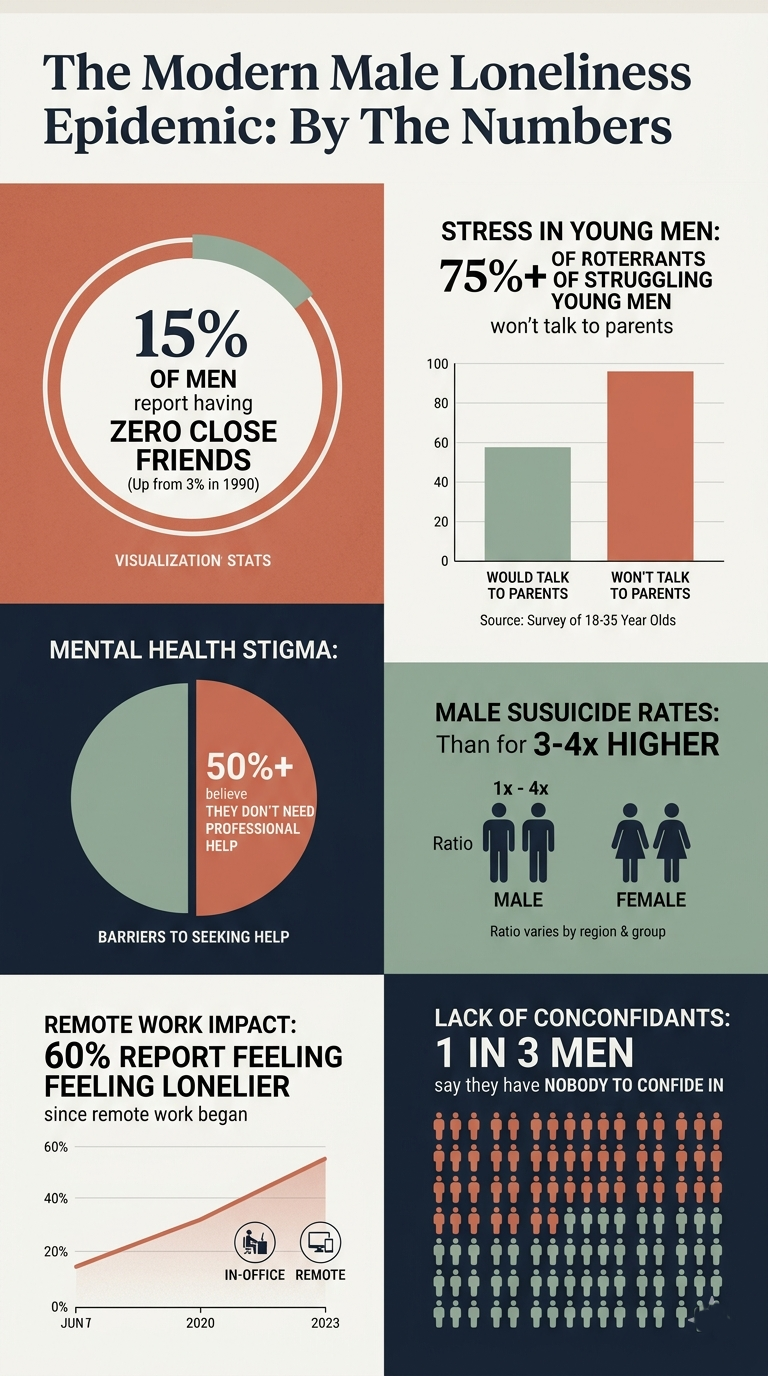
More than 75% of young men struggling with mental health issues won't confide in their parents
Over half believe they don't need professional help—even when they're suffering
Men are 3-4 times more likely to die by suicide than women in most Western countries
15% of men report having zero close friends—a number that's been steadily climbing
This isn't about weakness. It's not about being "too sensitive" or "not man enough." This is about living in a world that taught men to carry everything alone, then wondering why so many are collapsing under the weight.
"I didn't realize I was lonely until I noticed I hadn't spoken to anyone, really spoken, in over two weeks. I was texting people. I was on Zoom calls. But I wasn't connecting with anyone. I just felt... invisible."
— Marcus, 29, software developer
This article isn't going to tell you to "man up" or push toxic positivity disguised as wellness advice. Instead, we're going to explore why male loneliness has become such a pervasive issue, what it actually feels like from the inside, and—most importantly—what genuinely helps when you're ready to do something about it.
Because here's the truth they don't tell you: Feeling this way doesn't make you weak. It makes you human.
And there are real, practical things you can do to feel better, not someday, but starting today.
Why So Many Men Feel Isolated Today
Male loneliness didn't appear out of nowhere. It's the result of massive cultural, technological, and economic shifts that have quietly reshaped how men connect—or more accurately, how they don't.
The Perfect Storm of Disconnection
1. Social Media Created the Illusion of Connection
We're more "connected" than ever, right? Except we're not. We're broadcasting, not conversing. We're consuming content about other people's lives while barely living our own.
For men especially, social media often becomes a highlight reel comparison trap. Everyone else seems to have their career together, their relationships figured out, their friendships thriving. Meanwhile, you're sitting there wondering if something's fundamentally wrong with you.
The algorithm doesn't show you the guy who's also sitting alone in his apartment wondering the same thing. It shows you the vacation photos, the promotion announcements, the perfect moments—creating a distorted reality that makes your actual life feel inadequate.
2. Remote Work Killed Spontaneous Human Contact
The shift to remote and hybrid work changed everything. No more coffee machine conversations. No more casual Friday drinks. No more running into someone in the hallway and ending up talking for twenty minutes.
Yes, remote work offers flexibility and autonomy. But it also eliminated the accidental social scaffolding that used to exist in daily life—the low-stakes human interactions that didn't require effort but still made you feel less alone.
Now? You can go entire days speaking to no one face-to-face. You attend Zoom meetings where everyone's a floating head in a grid. You finish work and realize you've been physically alone for 10 hours straight.
3. Modern Masculinity Is Confusing as Hell
Let's be honest: nobody really knows what "being a man" means anymore. And that's not necessarily bad—but it is disorienting.
Traditional masculinity told men to be strong, stoic, providers, protectors. Don't show weakness. Don't burden others. Handle it yourself.
Modern conversations about masculinity tell men to be vulnerable, emotionally available, in touch with their feelings. Cry if you need to. Ask for help.
Both messages exist simultaneously, often contradicting each other. And men are left navigating this confusing middle ground where they're criticized for being emotionally closed off, but also judged if they open up "too much" or "in the wrong way."
The result? Many men just... shut down. It's easier to feel nothing than to constantly worry if you're feeling the "right" things in the "right" way.
4. Dating Culture Became Transactional and Exhausting
Dating apps promised to make connection easier. Instead, they turned human relationships into a brutal marketplace.
Endless swiping. Ghosting. Breadcrumbing. Conversations that go nowhere. People treating each other as options, not humans.
For many men, modern dating isn't just frustrating—it's deeply demoralizing. The constant rejection, the performative nature of online profiles, the feeling that you're being evaluated purely on metrics (height, income, photos) rather than who you actually are.
Even when relationships do form, they often feel fragile. People leave at the first sign of difficulty. Commitment feels risky. Emotional investment feels dangerous.
So many men just... stop trying. Not because they don't want connection, but because the process feels too exhausting and the outcomes too uncertain.
5. Financial Pressure Became Relentless
Let's talk about money. Because it's hard to invest in friendships and relationships when you're drowning in financial stress.
Rising costs of living. Stagnant wages. Student loan debt. The impossibility of buying a home. The pressure to "hustle" constantly just to stay afloat.
Many men internalize financial struggle as personal failure—especially when society still codes male value with being a provider. You can't afford to go out with friends. You feel embarrassed about your financial situation. You work longer hours trying to fix it, which leaves even less time for connection.
The stress becomes a vicious cycle: isolation increases, mental health declines, productivity drops, financial pressure intensifies, isolation deepens.
6. Community Structures Disappeared
Previous generations had built-in social structures: churches, unions, neighborhood associations, local sports leagues, service clubs.
These weren't just activities—they were communities. They created regular, predictable social contact. They gave men a sense of belonging and purpose beyond work and family.
Most of these institutions have collapsed or dramatically shrunk. And nothing has really replaced them.
Now, if you want community, you have to actively build it yourself—which is exponentially harder when you're already exhausted and isolated.
7. Hyper-Independence Became the Default
Somewhere along the way, asking for help became seen as weakness. Needing people became seen as dependency.
Men learned to pride themselves on self-sufficiency. "I don't need anyone." "I can handle it myself." "I'm fine."
Except humans aren't designed to function in isolation. We're social creatures. Independence is good; hyper-independence is a trauma response disguised as strength.
But admitting you need connection feels like admitting defeat. So men soldier on alone, convinced that self-reliance is the only acceptable path—even as it slowly destroys them from the inside.
8. Digital Overstimulation Replaced Real Presence
We're constantly consuming content. Podcasts, YouTube videos, Netflix series, Reddit threads, news feeds, TikToks, Twitch streams.
This constant digital input creates the illusion of company. You're never technically alone—there's always a voice in your ear, a video playing, someone else's thoughts filling your mind.
But it's a parasocial relationship. These people aren't in your life. They don't know you exist. The connection is entirely one-way.
And when you finally turn it all off? The silence is deafening. The loneliness hits harder because you've been avoiding feeling it for so long.
The Weight of Invisible Expectations
Here's what makes it worse: men are expected to just... deal with all of this. Silently. Without complaint.
You're supposed to be successful in your career, financially stable, physically fit, socially competent, emotionally available (but not too emotional), independent (but not isolated), strong (but not toxic), vulnerable (but not weak).
And you're supposed to figure all this out on your own, because asking for help means you're failing at being a man.
No wonder so many men feel like they're drowning.
The loneliness crisis among men isn't about individual failure. It's a systemic issue created by a world that removed the structures that used to support male connection while simultaneously making emotional isolation a badge of honor.
Understanding this doesn't instantly fix anything. But it does offer something important: perspective.
This isn't your fault. You're not uniquely broken. You're responding to impossible conditions in the most human way possible.
And recognizing that? That's actually the first step toward something better.
The Hidden Signs of Male Loneliness and Depression
Here's the tricky thing about male loneliness and depression: it rarely looks the way people expect.
It doesn't always look like someone crying in the dark or dramatically announcing they're struggling. More often, it looks like a guy who seems totally fine, maybe even successful, while quietly falling apart inside.
The Mask of Functionality
Men have become extraordinarily good at appearing functional while emotionally collapsing.
You show up to work. You respond to messages. You make jokes with coworkers. You maintain the surface-level performance of normalcy. But underneath? Everything feels heavy, gray, meaningless.
This is partly survival, you have bills to pay, responsibilities to meet, people depending on you. But it's also learned behavior. You've internalized the message that struggling isn't acceptable, so you compress it into something invisible.
The problem is that this compression doesn't make the feelings go away. It just makes them harder to recognize and address.
What Male Loneliness Actually Looks Like
If you're wondering whether what you're experiencing qualifies as loneliness or depression, here are the signs that actually show up in men's lives:
1. Irritability Becomes Your Default Mode
Everything annoys you. Small frustrations feel disproportionately overwhelming. You snap at people over minor things. Your patience has evaporated.
This isn't because you're an angry person. It's because unexpressed sadness, loneliness, and emotional exhaustion often manifest in men as irritability. It's the only socially acceptable emotion you're allowed to show.
When you can't say "I'm lonely and scared and don't know how to fix this," it comes out as anger instead.
2. You Feel Emotionally Numb
You're not sad, exactly. You're not happy either. You're just... nothing. Flat. Going through the motions.
Things that used to bring you joy—hobbies, music, food, sex—don't really register anymore. You're watching your own life from a distance, like an observer rather than a participant.
This emotional numbness is your brain's protective mechanism. When feelings become overwhelming, it shuts them all down. The problem is it shuts down the good ones too.
3. You're Overworking to Avoid Feeling
You pour yourself into work, not because you're passionate about it, but because it's a socially acceptable form of escape.
Working 60-70 hour weeks. Checking emails at midnight. Taking on extra projects. Telling yourself you're being productive when really, you're avoiding the silence that comes when you stop.
Work becomes an emotional anesthetic. As long as you're busy, you don't have to confront how lonely you actually are.
4. You've Withdrawn from Everyone
You used to make plans with friends. Now you cancel more often than you follow through.
It's not that you don't want to see people. It's that the effort feels insurmountable. Putting on the "I'm fine" performance is exhausting. Explaining why you've been distant feels impossible. Pretending to be present when you feel hollow inside is draining.
So you just... don't. You tell yourself you'll reach out next week. But next week becomes next month. And eventually, people stop asking.
5. Gaming, Scrolling, or Drinking Has Become Your Primary Coping Mechanism
There's nothing inherently wrong with gaming, social media, or having a drink. But when they become your primary way of managing difficult emotions, they shift from recreation to escapism.
You're gaming for 6+ hours straight not because you're enjoying it, but because it's the only thing that quiets your mind. You're scrolling endlessly not because the content is engaging, but because it fills the silence. You're drinking more frequently not to relax, but to numb.
These behaviors offer temporary relief without addressing the underlying issue—which means you need more and more of them to achieve the same effect.
6. Sleep Is Either Non-Existent or Excessive
You're either lying awake at 3 AM with racing thoughts you can't turn off, or you're sleeping 12+ hours because it's the only escape from feeling this way.
Sleep disruption is one of the clearest physical manifestations of emotional distress. Your body is trying to process stress it doesn't have other outlets for.
7. You're Chronically Exhausted Despite Doing "Nothing"
You haven't done anything particularly strenuous, but you feel absolutely drained. Getting out of bed feels like a monumental task. Basic self-care—showering, cooking, cleaning—feels overwhelming.
This isn't laziness. This is your nervous system in constant fight-or-flight mode, burning through energy trying to manage internal emotional chaos.
8. Physical Symptoms Are Showing Up
Tension headaches. Jaw clenching. Digestive issues. Chest tightness. Muscle pain. Random aches that doctors can't find a physical cause for.
Your body is holding the emotional stress your mind won't acknowledge. And it's starting to break down under the weight.
9. You're Constantly Comparing Yourself to Others
Everyone else seems to have it figured out. They have better jobs, better relationships, more friends, more success, more happiness.
You scroll through social media feeling increasingly inadequate. You attend social events feeling like an impostor. You measure your life against others' highlight reels and consistently find yourself lacking.
This comparison trap deepens isolation because it makes you feel fundamentally different from everyone else—like they have access to some instruction manual for life that you somehow missed.
10. Relationships Feel Transactional or Distant
Even when you're with people—a partner, family members, colleagues—you feel disconnected. Like there's glass between you and everyone else.
Conversations stay surface-level. You're performing connection rather than experiencing it. You say what you think people want to hear rather than what you're actually feeling.
And the gap between your internal experience and external presentation keeps widening, making you feel increasingly alone even in a crowded room.

The "High-Functioning" Depression Trap
This is where male loneliness gets particularly dangerous: you can be deeply struggling while still maintaining the appearance of having your life together.
You're not lying in bed unable to function. You're going to work, paying bills, responding to messages, maintaining basic hygiene. From the outside, everything looks fine.
This "high-functioning" depression makes it harder to recognize you need help because you're still meeting the minimum requirements of adult life. You tell yourself, "I'm not that bad. Other people have it worse."
But just because you're functioning doesn't mean you're okay.
"I had a good job, a nice apartment, a gym membership I actually used. On paper, my life looked great. But I was so lonely I would sometimes sit in my car in parking lots just to be around other people without having to interact with them."
— David, 34, marketing manager
When "Fine" Becomes a Lie You Tell Yourself
The most dangerous phrase in male mental health vocabulary is "I'm fine."
You've said it so many times it's become automatic. Someone asks how you're doing, and "I'm fine" comes out before you even process the question.
But here's the truth: if you're reading this article, relating to these descriptions, feeling a growing recognition of your own experience—you're probably not fine.
And that's okay.
Not being fine doesn't make you broken. It makes you human. And it means you're ready to start acknowledging what's actually happening instead of continuing to compress it into invisibility.
The signs are there. You've been seeing them. You've been feeling them.
The question isn't whether you're struggling. The question is: what are you going to do about it?
Why Many Men Struggle to Ask for Help
If you've been struggling for months—or years—without reaching out to anyone, you're not alone in that either.
There's a specific, complicated set of reasons why men find it nearly impossible to ask for help, even when they're drowning.
Understanding these barriers doesn't automatically dissolve them. But naming them makes them a little less powerful.
The Invisible Rules You Learned Early
Most men didn't explicitly decide to handle everything alone. They learned it.
You learned it when you cried as a kid and someone told you to "toughen up." You learned it when you showed vulnerability and got mocked for it. You learned it when you watched other men in your life—your father, uncles, teachers, coaches—never talk about their feelings.
You learned that emotional pain is something you're supposed to handle privately. That needing help is a form of weakness. That real men solve their own problems.
These messages get internalized so deeply they become unconscious. You don't actively think "I shouldn't ask for help." You just... don't. It doesn't even occur to you as an option.
The Shame That Keeps You Silent
Shame is the silent killer of male emotional health.
Not just embarrassment or guilt—shame. The deep, core belief that something is fundamentally wrong with you. That if people knew how you really felt, they would see you as less than. Damaged. Unworthy.
Shame tells you:
"Everyone else can handle this. Why can't you?"
"You're a grown man. Act like it."
"If you can't fix this yourself, you're pathetic."
"Admitting you're struggling is admitting you're a failure."
Shame thrives in isolation. The more you hide your struggles, the more shameful they feel, which makes you hide them more deeply. It's a self-reinforcing cycle that gets harder to break the longer it continues.
The Fear of Judgment
You imagine telling someone how you actually feel, and your brain immediately floods with worst-case scenarios:
They'll think you're weak
They'll lose respect for you
They'll minimize what you're going through ("everyone feels stressed sometimes")
They'll use it against you later
They'll tell other people
They'll see you differently forever
These fears aren't irrational. Sometimes people do respond badly. Sometimes vulnerability is met with judgment or dismissal.
But the fear of these outcomes often becomes more paralyzing than the outcomes themselves. You protect yourself from potential rejection by guaranteeing your own isolation.
The Burden Myth
Many men don't ask for help because they genuinely believe their struggles would burden others.
You tell yourself:
"Everyone has their own problems."
"I shouldn't dump this on someone else."
"They have enough to deal with."
"I don't want to bring the mood down."
This sounds considerate, even selfless. But it's often a form of self-abandonment disguised as consideration for others.
The truth is, most people in your life would want to know if you're struggling. They would want the opportunity to support you. By keeping them out, you're not protecting them, you're denying them the chance to show up for you.
And you're denying yourself the support you need.
The Masculinity Paradox
Modern men face an impossible double bind:
Be vulnerable and emotionally available, but not too much or in the wrong way, or you're "trauma-dumping" and being "emotionally needy."
Be strong and independent, but not so much that you're "emotionally unavailable" and "afraid of intimacy."
Ask for help, but only after you've proven you've tried everything yourself first.
Show emotion, but only the right emotions (thoughtful sadness is okay; desperate fear is not).
These contradictory expectations create a minefield where there's no clearly safe path forward. So many men just freeze, doing nothing, because every option feels like a potential mistake.
The "Real Problems" Fallacy
You minimize your own struggles by comparing them to others.
"People have real problems. I have a job, a roof over my head, food to eat. I'm not homeless. I'm not in a war zone. I'm not dying of disease. What right do I have to complain about feeling lonely?"
But suffering isn't a competition. You don't need to qualify for some objective threshold of "bad enough" before your feelings matter.
Your struggles are real whether or not someone else has it worse. Your loneliness is valid whether or not it meets some external standard of suffering.
The Trust Deficit
Maybe you've tried opening up before, and it went badly.
You told someone how you were feeling, and they:
Changed the subject immediately
Offered unhelpful platitudes ("just think positive!")
Made it about themselves
Ghosted you afterward
Seemed uncomfortable and checked out
Those experiences create a trust deficit. You learn that vulnerability is risky, that people don't actually want to hear the truth, that it's safer to keep everything inside.
One bad experience can make you close off for years.
The Therapy Stigma
Despite growing acceptance of mental health treatment, many men still see therapy as something for people who are "really broken."
Therapy is for people who can't handle life on their own. Therapy is for women. Therapy is self-indulgent. Therapy means admitting defeat. Therapy is a luxury you can't afford. Therapy won't actually help anyway.
These beliefs—often absorbed from family, culture, or media—create another barrier to getting the support that could genuinely help.
The Emotional Illiteracy Problem
Here's a hard truth: many men struggle to ask for help partly because they don't have the language to describe what they're experiencing.
You've learned to suppress emotions for so long that you've lost the ability to identify and name them. You know something feels wrong, but you can't articulate what it is.
"How are you feeling?" becomes an impossible question because you genuinely don't know. You weren't taught emotional vocabulary. You weren't given permission to develop emotional self-awareness.
So even when you want to reach out, you don't know what to say.
The Fear of Permanent Change
There's also this: asking for help feels like crossing a threshold you can't uncross.
If you admit you're struggling, you can't go back to pretending everything's fine. You'll have to actually deal with it. You'll have to make changes. You'll have to confront things you've been avoiding.
Sometimes staying in familiar suffering feels safer than risking the unknown territory of actually getting better.
[PULL QUOTE]
"I spent two years convincing myself I didn't need help. I wasn't 'depressed enough' for therapy. I wasn't 'lonely enough' to burden my friends. I wasn't 'broken enough' to make changes. The bar I set for deserving support was impossibly high—higher than I would ever set for anyone else. I was drowning, but I was drowning quietly, because that felt like the only acceptable way to do it."
— Anonymous survey response, male loneliness research study
The Breaking Point
Here's what eventually happens for many men: they don't ask for help until they hit a breaking point.
A panic attack at work. A relationship ending. A health scare. A moment where the internal system they've been desperately maintaining just... collapses.
And then help isn't a choice—it's an emergency.
The goal isn't to wait until you reach that point. The goal is to recognize that asking for help before you're in crisis is a sign of wisdom, not weakness.
You don't have to be at rock bottom to deserve support. You don't have to prove how bad things are before reaching out.
You're allowed to ask for help just because you're struggling. That's reason enough.
The Psychology of Male Friendship: Why Adult Male Friendships Fade
Let's talk about something that doesn't get discussed enough: the slow, quiet death of male friendships in adulthood.
You probably had close friends in high school or college. People you talked to every day, stayed up late with, shared everything with. You assumed those friendships would last forever.
And then... they didn't.
Not because of dramatic falling-outs or betrayals. Just because of distance, and time, and life getting complicated. And somehow, you never managed to replace what you lost.
Now you might have "friends" in the abstract sense, people you know, people you're friendly with, but nobody you're actually close to. Nobody you could call at 2 AM if you needed to. Nobody who really knows what's going on in your life.
This isn't a personal failure. This is a widespread phenomenon affecting millions of men. And there are specific psychological and social reasons why it happens.
The Activity-Based Friendship Model
Men typically form friendships through shared activities rather than emotional intimacy.
You bond over playing basketball, working on cars, gaming together, watching sports, going to the gym. The friendship exists in the context of the activity.
This model works great when the activity provides regular, consistent contact. But when life circumstances change, you move cities, change jobs, have kids, get busy, the activity stops. And when the activity stops, the friendship often stops too.
Because you never built emotional infrastructure beyond the shared activity. You never developed the habit of talking about real things. So when the external structure disappears, there's nothing holding the friendship together.
Surface-Level Everything
Even when men spend time together, conversations often stay relentlessly surface-level.
Sports. Work. Cars. Technology. Movies. Politics (in abstract terms). Jokes. Banter.
What you rarely discuss:
How you're actually feeling
What you're worried about
Whether you're lonely
If your relationship is struggling
Whether you feel lost
If you're scared about the future
This surface-level socializing can feel like connection in the moment. But it doesn't create the kind of friendship that sustains you through difficult times.
You can spend hours with someone and still feel completely alone afterward because nothing real was shared.
The Vulnerability Deficit
Deep friendship requires vulnerability. It requires sharing parts of yourself that feel uncertain, messy, or imperfect.
But men have learned to equate vulnerability with weakness. So you present only the polished, competent version of yourself. You filter out anything that might seem like struggling.
The problem is, intimacy can't exist without vulnerability. When you only show people your highlights, they never get to know the real you. And you never get to experience being known and accepted for who you actually are.
This creates a paradox: you can be surrounded by people who like you, and still feel fundamentally alone, because nobody actually knows you.
The Scarcity of Emotional Scaffolding
Women, generally speaking, have more robust social scaffolding for maintaining friendships.
They're socialized to check in with each other, ask how people are doing, maintain emotional connection across distance, have vulnerable conversations, offer and request support.
Men typically aren't. Male friendships often exist in a kind of default mode where nobody reaches out unless there's a specific reason. Nobody checks in just to see how you're doing. Nobody asks the deeper questions.
This means male friendships can go months—or years—without meaningful contact, and nobody thinks that's unusual. It's just how it is.
Except that pattern creates enormous loneliness over time.
The Competition Undercurrent
Male socialization often includes a competitive element that can subtly undermine friendship.
Who's more successful? Who makes more money? Who's in better shape? Who has a better relationship? Who's more accomplished?
Even when this competition isn't explicit, it exists as background radiation. And it makes vulnerability feel risky.
If you admit you're struggling, you're admitting weakness in the competition. You're exposing a vulnerability that could theoretically be used against you.
So you keep things light, keep things positive, keep up the appearance that you're winning—or at least not losing.
The Friendship Fade-Out
Here's how male friendships typically die:
You stop hanging out as frequently because life gets busy. The gaps between seeing each other get longer. Weeks become months. Months become years.
You still consider each other friends, technically. You follow each other on social media. You might text happy birthday. You say "we should get together sometime" but never actually make plans.
Eventually, so much time passes that reaching out feels awkward. You don't know what's happening in each other's lives anymore. The shared context that used to exist has disappeared.
And one day you realize: this person you were once so close to is now essentially a stranger. Not because of conflict. Just because of entropy.

The Relocation Effect
Modern life often requires geographic mobility. You move for education, career opportunities, relationships.
Each move disrupts your social network. And while women tend to actively rebuild social connections in new locations, men often... don't.
You tell yourself you'll make friends organically. But without the built-in social structures of school or college, "organic" friendship formation rarely happens.
You end up knowing coworkers (but not being genuinely close to them) and maybe your partner's friends (but they're not really your friends). Your actual friend count: zero.
The Relationship Absorption Pattern
When men enter serious romantic relationships, their friendships often take a backseat.
Your partner becomes your primary (often only) source of emotional intimacy. You invest most of your social energy in the relationship. Your friends fall away—not intentionally, but through gradual neglect.
This creates two problems:
First, it puts enormous pressure on the romantic relationship to meet all your emotional needs—a weight no single relationship can healthily carry.
Second, if the relationship ends, you're suddenly alone with no support network. You've lost both your primary relationship and your friendships. You're starting from zero.
The "Too Busy" Trap
"I'm too busy for friendships" is one of the most common refrains among lonely men.
Work is demanding. If you have kids, they consume enormous time and energy. There are household responsibilities, errands, maintenance tasks. Free time is scarce and precious.
But here's the uncomfortable truth: "too busy" often means "I'm not prioritizing this."
You make time for what matters to you. You find hours for Netflix, social media scrolling, gaming. You find time for things that feel necessary.
The problem is that friendship doesn't feel necessary until its absence becomes unbearable. It feels optional, expendable, something you can get to "later" when life calms down.
Except life never calms down. And meanwhile, loneliness accumulates.
Why This Matters More Than You Think
The absence of close male friendships isn't just about feeling lonely on weekends.
Research consistently shows that social isolation has profound health impacts:
Increased risk of depression and anxiety
Higher rates of cardiovascular disease
Weakened immune function
Increased inflammation
Shorter lifespan (comparable to smoking 15 cigarettes a day)
Friendship isn't a luxury. It's a fundamental human need. And the chronic absence of it is slowly, quietly devastating your mental and physical health.
The Path Forward Exists
The good news is that none of this is permanent or inevitable.
Male friendships can be rebuilt. New friendships can be formed. The patterns that led to isolation can be changed.
It requires intentionality. It requires vulnerability. It requires effort.
But it's absolutely possible. And we'll explore exactly how in the sections ahead.
What Actually Helps Men Feel Better
Let's cut through the noise and talk about what genuinely helps when you're struggling with loneliness, isolation, and deteriorating mental health.
Not generic wellness advice you've heard a thousand times. Not toxic positivity masquerading as support. Not oversimplified "just do these three things" formulas.
Real, evidence-based, psychologically grounded strategies that men who've been through this have found genuinely helpful.
The Foundation: Physical Health as Mental Health Infrastructure
Your brain is part of your body. When your body is dysregulated, your mental health suffers. This isn't about aesthetics or performance—it's about creating biological conditions that support emotional wellbeing.
Movement (Not Just Exercise)
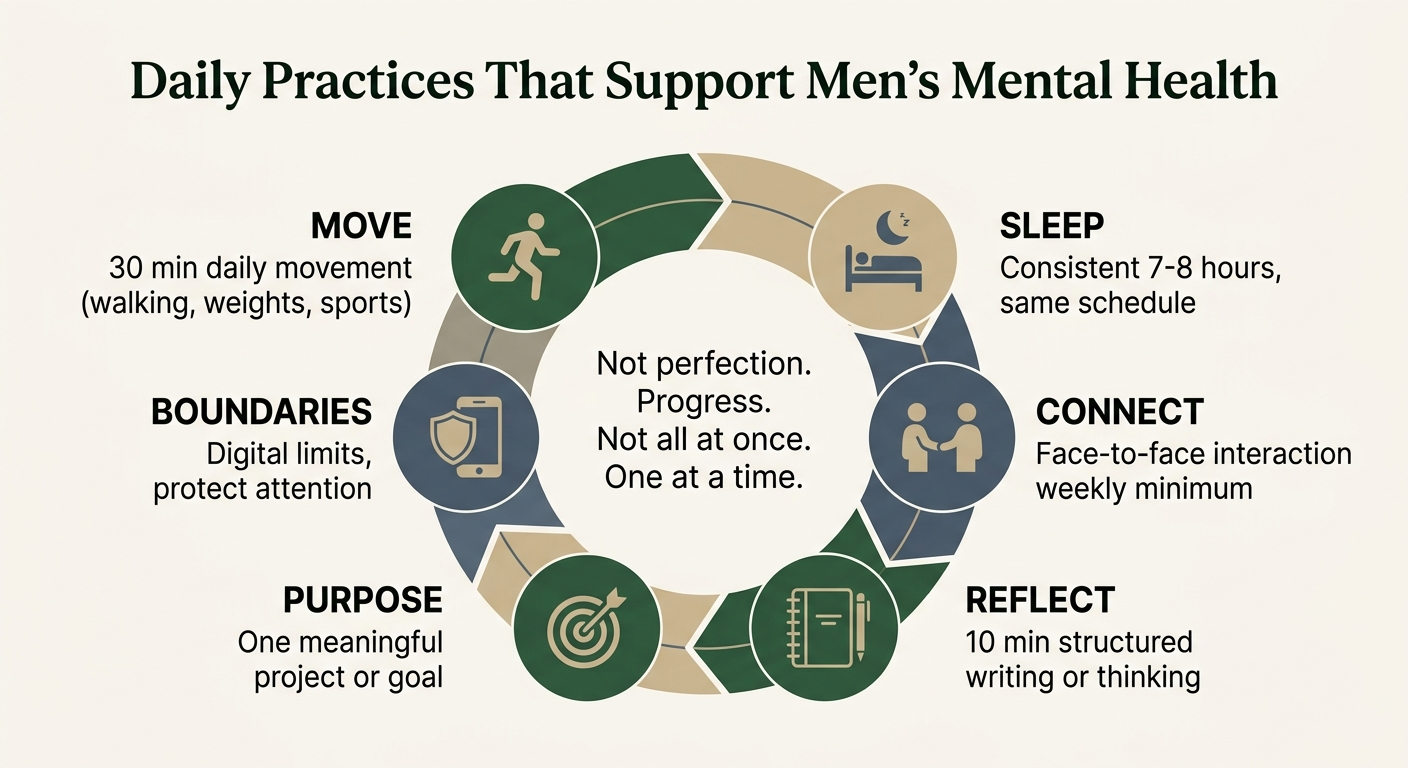
You don't need to become a gym rat or run marathons. You need to move your body regularly in ways that don't feel punishing.
Why it helps:
Physical movement regulates stress hormones (cortisol, adrenaline)
Exercise increases endorphins and dopamine
It interrupts rumination patterns
It gives you a sense of agency over something in your life
It provides structure and routine
What this actually looks like:
30-minute walks outside, preferably in nature or neighborhoods (not just treadmills)
Lifting weights 3x/week (doesn't need to be complicated—basic compound movements work)
Recreational sports leagues where the social component matters as much as the activity
Yoga or stretching if your body is holding chronic tension
Anything that gets you out of your apartment and moving
The key is consistency over intensity. A moderate routine you actually maintain beats an aggressive plan you abandon in two weeks.
Sleep Architecture
Sleep disruption both causes and results from mental health struggles. Fixing sleep won't solve everything, but it creates a foundation for everything else.
What actually helps:
Consistent sleep schedule (same bedtime/wake time, even weekends)
No screens 1 hour before bed (yes, really)
Cool, dark room (blackout curtains, temperature around 65-68°F)
No alcohol within 3 hours of sleep (it disrupts sleep quality even if it helps you fall asleep)
If intrusive thoughts prevent sleep: keep a notepad by the bed to write them down and release them
If you've tried everything and still struggle, talk to a doctor. Sleep disorders are treatable, and quality sleep is non-negotiable for mental health.
Nutrition That Doesn't Require Perfection
You don't need to become a clean-eating fanatic. You need to stop actively sabotaging your brain chemistry.
What matters:
Consistent meal timing (blood sugar crashes destabilize mood)
Adequate protein (supports neurotransmitter production)
Reducing ultra-processed foods (they're engineered for overconsumption, not nourishment)
Staying hydrated (dehydration amplifies anxiety and fatigue)
Limiting caffeine to mornings (caffeine in afternoons disrupts sleep)
This doesn't mean never eating pizza or drinking beer. It means those aren't your primary fuel sources.
Environmental Design: Make Your Space Work For You
Your environment shapes your mental state more than you realize. Small changes create surprisingly large impacts.
What to adjust:
Lighting: Get daylight-spectrum bulbs. Dim, yellow lighting increases depressive symptoms. Bright, natural-spectrum light improves mood and energy.
Cleanliness: You don't need a perfectly organized space, but chronic clutter creates low-level stress. Spend 10 minutes a day maintaining baseline order.
Nature access: If possible, keep a plant alive. Or put a bird feeder outside your window. Small connections to living things reduce isolation.
Sensory environment: Notice what actually makes you feel calm (certain music, specific temperatures, particular scents) and intentionally create those conditions.
Tech boundaries: Create phone-free zones (bedroom, dinner table). Use app timers. Make your default environment slightly less digitally saturated.
Social Connection: The Non-Negotiable Element
You cannot think your way out of loneliness. Loneliness is a social problem that requires social solutions.
Face-to-Face Contact (Yes, It Has to Be Face-to-Face)
Digital communication doesn't satisfy the human need for in-person connection. Video calls are better than nothing, but they're not equivalent to physical presence.
Why it matters:
In-person interaction regulates your nervous system in ways digital contact cannot
Physical proximity releases oxytocin (bonding hormone)
Reading full-body nonverbal communication reduces social anxiety over time
Shared physical space creates different quality of memory and connection
What this looks like:
Coffee with one person, once a week
Joining any group activity where you see the same people regularly
Reaching out to one old friend you've lost touch with
Saying yes to social invitations even when you don't feel like it (within reason)
You don't need a massive social circle. Research suggests 3-5 close connections are sufficient for mental health. But they need to be real.
Consistency Over Intensity
Seeing someone regularly for coffee is more valuable than an occasional epic hangout. Your brain responds to reliable, repeated connection.
This is why joining a weekly class, league, or group is so effective—it removes the friction of constantly planning and provides predictable social contact.
Therapy: Not What You Think It Is
Let's address the elephant in the room: therapy.
If your immediate reaction is "therapy isn't for me," consider that this reaction might be exactly why you need it.
What Therapy Actually Is
It's not lying on a couch talking about your childhood for years. It's not someone telling you your problems aren't real. It's not paying someone to be your friend.
Therapy is working with someone trained in psychology to:
Identify patterns you can't see yourself
Develop practical tools for managing difficult emotions
Process experiences you've been carrying alone
Challenge distorted thinking that's keeping you stuck
Create actionable plans for meaningful change
Good therapy is collaborative, practical, and focused on giving you tools you can use independently.
Finding the Right Therapist
Not all therapists are good. Not all good therapists are good for you. Finding the right fit matters.
What to look for:
Someone who specializes in men's mental health or has experience with your specific issues
Someone whose approach resonates (CBT, ACT, psychodynamic, etc., research different modalities)
Someone you feel comfortable with (if you don't feel safe being honest, they're not the right fit)
It's okay to try 2-3 therapists before finding one that works. This is normal and encouraged.
Alternatives and Complements to Traditional Therapy
If traditional therapy isn't accessible or doesn't fit:
Men's support groups (in-person or online) provide community and shared experience
Coaching (life coaching, career coaching) focuses on forward movement rather than processing past trauma
Online therapy platforms (BetterHelp, Talkspace) offer more flexibility and often lower cost
Crisis text lines (741741) for immediate support when you're in acute distress
Structured Self-Reflection: Journaling Without the Cringe
Many men reject journaling because it feels performative or self-indulgent. But structured reflection is one of the most effective tools for emotional regulation.
What Actually Works for Men
Not "dear diary" entries. Not gratitude lists that feel hollow when you're struggling.
Try these instead:
The Evening Data Dump:
What happened today (facts)
How I felt about it (emotions)
What I'm worried about (concerns)
What I can control vs. what I can't (agency)
Just brain-to-paper transfer. No need to make it profound.
The Problem-Solving Format:
What's the problem?
What have I tried?
What are three other approaches?
What's the smallest next step?
This leverages male problem-solving orientation while still processing emotions.
The Pattern Recognition Log:
When did I feel worst this week?
What were the circumstances?
What pattern do I notice?
Over time, you'll see clear correlations (sleep deprivation → irritability, isolation → anxiety) that you can then address systematically.
Purpose and Structure: The Underrated Essentials
Humans need purpose and structure to function optimally. When life feels meaningless and chaotic, mental health deteriorates.
Creating Micro-Purposes
You don't need to find your grand life purpose to feel better. You need things that give individual days meaning.
This could be:
A project you're building (coding, woodworking, writing, learning a skill)
A fitness goal you're working toward
Helping someone else with something you're good at
Learning something difficult that requires sustained effort
The content matters less than having something you're working toward that isn't just survival.
Routine as Foundation
Depression and anxiety thrive in chaos. Routine creates psychological stability.
Essential routines:
Consistent wake time
Morning routine that doesn't start with phone scrolling
Work boundaries (if possible)
Evening wind-down routine
Weekly anchor activities
This doesn't mean rigid scheduling of every minute. It means creating predictable rhythms your nervous system can rely on.
Digital Hygiene: Reclaiming Your Attention
The attention economy is designed to keep you engaged, not to support your wellbeing. Passive consumption of content is destroying your ability to be present.
What to Actually Do
Audit your inputs: What are you consuming daily? Is it making you feel better or worse? Be ruthlessly honest.
Set boundaries:
No phone first hour after waking or last hour before sleep
Turn off non-essential notifications
Use app timers (iOS Screen Time, Android Digital Wellbeing)
Delete apps you compulsively check
Curate your social media feeds aggressively (unfollow, mute, block liberally)
Replace passive consumption with active engagement:
Instead of scrolling: read a book, cook something, go outside, call someone, make something with your hands
Your attention is your most valuable resource. Protect it.
The Compound Effect: Small Consistent Actions
None of these strategies work instantly. Mental health recovery is not linear. You won't wake up tomorrow feeling completely different.
But small, consistent actions compound over time.
Moving your body + improving sleep + reducing digital overstimulation + seeing people face-to-face + structured reflection = measurable improvement over weeks and months.
The goal isn't perfection. The goal is incremental, sustainable progress.
What Doesn't Help (But Gets Recommended Anyway)
Let's be clear about what doesn't work:
Toxic positivity: "Just be grateful!" "Think positive!" "Good vibes only!" — This invalidates real struggles and creates shame for experiencing difficult emotions.
Willpower narratives: "Just stop being lazy!" "Discipline equals freedom!" — Bootstrapping your way out of clinical depression doesn't work. You can't discipline your way out of a neurochemical imbalance.
Comparison-based motivation: "Other people have it worse!" — Your pain is valid regardless of others' experiences.
Substance-based coping: Alcohol, weed, excessive caffeine — temporary relief that worsens underlying issues.
Digital pseudo-connection: Replacing real relationships with online interactions — Supplements but doesn't substitute physical presence.
Waiting for external circumstances to change: "I'll be happy when I get promoted/find a relationship/make more money" — External circumstances have smaller impact on wellbeing than internal practices.
The Honest Timeline
How long does it take to feel better?
Immediate relief (1-3 days): Better sleep, reduced screen time, physical movement start regulating nervous system.
Early changes (1-2 weeks): Routine feels more sustainable. Physical symptoms (headaches, tension, fatigue) may improve.
Noticeable shift (4-6 weeks): Mood stabilizes. Emotional regulation improves. Connection feels less effortful.
Meaningful progress (3-6 months): New patterns feel natural. Social connections deepen. Sense of purpose strengthens.
Long-term transformation (6-12+ months): Life looks and feels meaningfully different. Resilience increases. Struggles still happen but recovery is faster.
This isn't linear. There will be setbacks. That's normal, not failure.
The question isn't whether you'll struggle again. The question is: are you building tools and connections that help you navigate struggle differently?
How Men Can Rebuild Meaningful Friendships
Let's get practical about the thing that feels most awkward and impossible: actually making and maintaining close friendships as an adult man.
This isn't easy. If it were, you wouldn't be reading this article. But it is possible. And there are specific, actionable approaches that work.
Starting Point: Accept That It Will Feel Awkward
First, release the expectation that rebuilding friendships should feel natural and effortless.
It won't.
You're going against years of conditioning and habit. You're developing skills you never learned. You're being vulnerable in ways you've actively avoided.
It's going to feel uncomfortable. That's not a sign you're doing it wrong. That's a sign you're doing something new.
Reconnecting with People You've Lost Touch With
You probably have people in your life you used to be closer to, high school friends, college roommates, former coworkers, people you drifted away from.
Reaching back out feels impossibly awkward. "It's been three years. What do I even say?"
The Actual Message That Works
Don't overthink it. Send something simple and honest:
"Hey man, I know it's been a while. I was thinking about [specific shared memory] the other day and wanted to reach out. How have you been?"
Or even simpler:
"Been too long. Want to grab coffee/beer sometime?"
Most people respond positively to genuine reconnection attempts. The worst that happens is they don't respond—in which case you're exactly where you started, having lost nothing.
Managing the Conversation
When you do meet up, you don't need to immediately dive into deep emotional territory. Start with catching up on the basics:
What they've been up to
What's changed in their life
What they're working on or interested in
Let the conversation develop naturally. If it feels right to go deeper, you can. If it stays surface-level, that's also fine for a first reconnection.
The goal is re-establishing contact, not fixing everything in one conversation.
Making New Friends from Scratch
This is harder than reconnecting, but it follows predictable patterns.
The Repeated Proximity Principle
Friendship forms through repeated, consistent exposure in low-pressure environments.
You don't make close friends by having one intense conversation with someone at a party. You make close friends by seeing the same people regularly over time in contexts where you can interact naturally.
This is why joining groups, classes, or teams works. You're creating the conditions for repeated proximity.
Where Adult Men Actually Meet Friends
Activity-based groups:
Recreational sports leagues (softball, basketball, soccer, ultimate frisbee)
Martial arts or boxing gyms (built-in community, shared challenge)
Climbing gyms (heavily social environment)
Running clubs or cycling groups
Board game cafes or D&D groups
Maker spaces or woodworking shops
Skill-based learning:
Cooking classes
Language learning groups
Music lessons or open jam sessions
Car repair workshops
Coding bootcamps or meetups
Community involvement:
Volunteer organizations (Habitat for Humanity, food banks, environmental groups)
Neighborhood associations
Community gardens
Local political campaigns or causes you care about
Professional/career-adjacent:
Industry meetups
Professional development groups
Coworking spaces with community elements
Alumni associations
The key: Pick something you're actually interested in, not what you think you "should" do. Forced participation doesn't create genuine connection.
Making the First Move (Without Being Weird)
You've been going to [activity] for a few weeks. You've had casual interactions with someone. How do you move from acquaintance to actual friendship?
The low-stakes invitation:
After a class/game/meeting: "Some of us are grabbing food/drinks after this. You should come."
Or: "I'm checking out [related thing] this weekend. Want to come?"
Or even: "We should hang out outside of this sometime. Want to grab lunch this week?"
Most men appreciate directness. They're often feeling the same awkwardness and are relieved when someone else takes the initiative.
Building Consistency
One-off hangouts don't create friendship. Consistency does.
The Weekly Anchor Strategy
Establish one recurring activity with one or more people:
Weekly basketball
Standing Thursday dinner
Monthly poker game
Sunday morning coffee
The consistency removes decision fatigue (you're not constantly planning), creates reliable connection, and allows relationships to deepen through repeated exposure.
Showing Up Even When You Don't Feel Like It
Here's the hard part: when you're depressed or exhausted, you won't feel like being social.
Your brain will tell you to cancel, stay home, isolate. And sometimes that's the right call—you genuinely need rest.
But more often, it's the depression talking. And the times you least feel like showing up are often the times you most need to.
Set a rule: Unless you're physically ill or in crisis, you show up. You can leave early if needed, but you show up.
This discipline is crucial because waiting until you "feel like it" means you'll never go.
Deepening Friendships: Moving Beyond Surface Level
You're seeing people regularly. Conversations are friendly but stay mostly surface-level. How do you create actual closeness?
The Gradual Vulnerability Approach
You don't need to trauma-dump. You need to gradually share more real parts of your experience.
Start small:
Mention something you're actually worried about
Admit when you don't have everything figured out
Share a genuine struggle (doesn't have to be your deepest pain)
Ask for advice about something real
Pay attention to how they respond. If they:
Share something similarly vulnerable back
Take it seriously and engage thoughtfully
Follow up about it later
...that's a green light to continue opening up incrementally.
If they:
Change the subject immediately
Make jokes to deflect
Seem uncomfortable and withdraw
...they might not be ready for that level of friendship, and that's okay. Not everyone will be your close friend.
The Permission-Giving Effect
When you share vulnerability, you give others permission to do the same.
Many men are desperate to have real conversations but don't know how to initiate them. By going first, you open the door.
You'll be surprised how often someone responds with: "Man, I've been feeling the same way. I thought it was just me."
Questions That Create Real Conversation
Instead of "How's work?" try:
"What's been challenging lately?"
"What are you working on that you're excited about?"
"What's on your mind these days?"
Instead of "How are you?" try:
"How are you actually doing?"
"What's been hard recently?"
The slight reframing signals you're open to a real answer, not just a reflexive "fine."
Maintaining Friendships Across Distance
Life happens. People move. Circumstances change. But friendships can survive distance with intentional maintenance.
What Actually Works for Long-Distance Friendship
Regular check-ins: Set recurring calendar reminders to reach out. First Sunday of every month, send a text. Without structure, months slip by unnoticed.
Voice/video over text: 15-minute phone calls create more connection than weeks of occasional texting.
Planned visits: Put dates on the calendar, even if they're months out. "We should get together sometime" never happens. "I'm booking a flight for October 15th" does.
Shared digital activities: Online gaming, watching shows simultaneously while on video chat, book clubs, anything that creates shared experience despite distance.
Async updates: Voice memos, photo updates, Marco Polo app—things that maintain connection without requiring simultaneous availability.
Handling Common Friendship Obstacles
"I Don't Have Time"
You make time for what you prioritize. If friendship genuinely matters to you, you'll find 2-3 hours per week. That's less time than most people spend on social media.
It's not about having time. It's about making time.
"I'm Too Exhausted to Be Social"
Choose lower-energy social activities. You don't have to go to loud bars or big parties.
Walking together requires minimal energy. Grabbing coffee is low-pressure. Sitting in someone's living room watching a game doesn't demand much.
Match the social activity to your actual energy level.
"What If They Don't Want to Be My Friend?"
Some people won't. That's okay. You're not trying to be friends with everyone. You're trying to find a few people where there's mutual fit.
Rejection isn't a reflection of your worth. It's just incompatibility. Keep reaching out until you find people who reciprocate.
"I Don't Know How to Keep Conversation Going"
Friendship isn't about being entertaining or interesting. It's about being present and curious.
Ask questions. Listen genuinely. Share what's real for you. That's sufficient.
If conversations consistently feel forced and effortful, that's useful information—this might not be the right friendship match. And that's fine.
The Friendship Investment Paradox
Here's the truth: rebuilding friendships requires investing time and energy when you feel like you have neither.
It requires vulnerability when you feel emotionally raw. It requires showing up when you'd rather hide. It requires risking rejection when your self-esteem is already low.
It feels unfair. And it is.
But the alternative, continuing in isolation, is worse.
The investment is front-loaded. It's hardest at the beginning. But once you have even 2-3 genuine friendships, they become a source of energy rather than a drain.
They become the thing that sustains you through everything else.
[PULL QUOTE]
"I spent a year forcing myself to show up to a weekly climbing gym session even when I desperately wanted to stay home. For months, I barely talked to anyone. But I kept showing up. Eventually, someone invited me to grab food after. Then someone else asked if I wanted to climb outside on weekends. Now, a year and a half later, these people are my closest friends. But none of it would have happened if I hadn't kept showing up during those first painful months when it felt pointless."
— Ryan, 33, graphic designer
The Long Game
Meaningful friendships don't form overnight. They develop over months and years of consistent, genuine interaction.
You're not trying to speedrun intimacy. You're trying to create conditions where friendship can gradually develop.
Show up. Be real (in progressive increments). Invite people into your life. Accept invitations into theirs. Repeat.
That's the formula. It's simple, but not easy.
And it works.
Mental Health Tools and Resources for Men
Let's talk about specific, practical resources—not generic recommendations, but tools men are actually using successfully.
Therapy Platforms and Counseling Services
BetterHelp (betterhelp.com)
Online therapy platform with video, phone, and messaging options
More affordable than traditional therapy ($60-90/week)
Can specifically filter for therapists experienced in men's mental health
Flexible scheduling works well for busy schedules
Best for: Men who want therapy but have scheduling constraints or prefer digital interface
Talkspace (talkspace.com)
Similar to BetterHelp with text, video, and audio options
Psychiatry services available for medication management
Insurance accepted by some plans
Best for: Men who prefer asynchronous communication with therapist
OpenPath Collective (openpathcollective.org)
Directory of therapists offering $30-80 sessions
In-person and online options
One-time $65 membership fee, then reduced-rate sessions
Best for: Men on tight budgets who still want quality therapy
ManTherapy.org
Mental health resources specifically designed for men
Uses humor and relatable content to reduce stigma
Self-assessment tools, crisis resources
Best for: Men hesitant about traditional therapy who need an entry point
Men's mental health specialists: Search Psychology Today therapist directory (psychologytoday.com/us/therapists) and filter for:
Gender: Male (if you prefer male therapist)
Issues: Men's issues, depression, anxiety, relationship issues
Modalities: CBT (Cognitive Behavioral Therapy) or ACT (Acceptance and Commitment Therapy) are particularly effective for men
Man Therapy Heads Up Checklist
Online self-assessment tool at mantherapy.org
Helps identify if you might benefit from professional help
Non-judgmental, straightforward approach
Mental Wellness Apps and Digital Tools
Headspace (headspace.com)
Meditation and mindfulness app
Specific courses for stress, anxiety, sleep
"SOS" exercises for acute anxiety moments
Best for: Men new to meditation who want structured guidance
Calm (calm.com)
Meditation, sleep stories, breathing exercises
Less clinical feeling than some alternatives
Extensive sleep content for insomnia struggles
Best for: Men struggling with sleep and racing thoughts
Stoic (stoicapp.com)
Mental fitness app based on Stoic philosophy
Journaling prompts, philosophical frameworks
Appeals to men who resonate with logic-based emotional processing
Best for: Men who prefer philosophy-oriented approaches
Finch (finchcare.com)
Self-care app disguised as caring for a virtual pet
Daily check-ins, mood tracking, goal setting
Low-pressure, non-judgmental interface
Best for: Men who find traditional wellness apps too earnest
Habitica (habitica.com)
Gamifies habit building and task completion
RPG-style progress system
Social accountability features
Best for: Men motivated by games and achievement systems
Woebot (woebothealth.com)
AI-powered mental health chatbot using CBT techniques
Available 24/7 for check-ins and support
Evidence-based approach, no human judgment
Best for: Men who want therapeutic tools without human interaction
Journaling and Self-Reflection Tools
Day One (dayoneapp.com)
Digital journal with prompts and templates
Secure, private, searchable
Photo integration, geolocation memories
Best for: Men who prefer digital over paper journaling
Physical journals designed for men:
The Five Minute Journal (intelligent
change.com) - Simple structured format: gratitude, intentions, reflections
Manly Journal Co. - No fluff, straightforward prompts
Standard notebook - Honestly, a blank Moleskine or composition book works fine
Structured reflection prompts: Instead of aimless writing, try these frameworks:
End of day:
What went well today?
What was challenging?
What did I learn?
What will I do differently tomorrow?
Weekly review:
Wins this week (however small)
Struggles and what they revealed
Patterns I'm noticing
One thing to focus on next week
Support Groups and Communities
Books That Actually Help
Not self-help fluff—books men find genuinely useful:
"The Body Keeps the Score" by Bessel van der Kolk
Trauma and nervous system science
Explains why you feel the way you do
Evidence-based approaches to healing
"Lost Connections" by Johann Hari
Explores root causes of depression and anxiety
Challenges medication-only approach
Focuses on social and environmental factors
"Man's Search for Meaning" by Viktor Frankl
Finding purpose through suffering
Philosophy grounded in real experience
Short, powerful, not preachy
"Atomic Habits" by James Clear
Practical behavior change strategies
Systems-based approach
Immediately actionable
"How to Do the Work" by Dr. Nicole LePera
Nervous system regulation
Breaking unconscious patterns
Self-healing frameworks
Productivity and Organization Tools
Todoist or Things 3
Task management that reduces mental clutter
Externalizing tasks reduces anxiety
Helps create structure when life feels chaotic
Notion or Obsidian
Personal knowledge management
Organizing thoughts and projects
Reduces feeling of mental overload
RescueTime
Tracks how you spend digital time
Reveals patterns you might not notice
Helps set boundaries on draining activities
Financial Wellness Tools
(Financial stress massively impacts mental health)
YNAB (You Need A Budget) (youneedabudget.com)
Proactive budgeting system
Reduces financial anxiety through visibility and planning
Educational resources included
Mint or Personal Capital
Free financial tracking
Aggregates accounts for full picture
Reduces money-related stress through organization
Substance Use Support
SMART Recovery (smartrecovery.org)
Science-based addiction recovery
Alternative to 12-step programs
Online and in-person meetings
Alcoholics Anonymous (aa.org)
If you resonate with 12-step approach
Extensive meeting network
Proven long-term effectiveness for many
Tempest (jointempest.com)
Alcohol-specific support community
Modern, secular approach
Online program and community
How Partners and Families Can Support Men Better
If you're reading this because someone you care about is struggling—a partner, son, brother, friend, father—this section is for you.
Watching someone you love struggle with loneliness, depression, or emotional isolation is painful. You want to help. But you might not know how. Or your previous attempts didn't land the way you hoped.
Here's what actually helps, and what often makes things worse.
Understanding the Male Experience of Asking for Help
First, understand this: for most men, admitting they're struggling feels like admitting fundamental failure.
It's not logical. It's deeply internalized conditioning. And it creates an enormous barrier between their suffering and their willingness to reach out.
When a man finally opens up to you, recognize that he's overcoming years of messaging that says:
Real men handle things themselves
Needing help is weakness
Emotional struggle means something's wrong with him
Being vulnerable is dangerous
Your response in that moment matters enormously. It can either reinforce those fears or begin to break them down.
How to Create Emotional Safety
Listen Without Trying to Fix
This is the hardest part for many people, especially other men: when someone shares they're struggling, your instinct is to solve it.
Don't.
Most of the time, he doesn't need solutions. He needs to feel heard.
What this looks like:
Instead of: "Have you tried [solution]?"
Try: "That sounds really hard. Tell me more about what that's been like."
Instead of: "You should [advice]."
Try: "What do you think might help?" (Let him arrive at solutions himself)
Instead of: "At least [silver lining]."
Try: "I'm sorry you're going through this."
Your job isn't to make the feelings go away. Your job is to create space for them to exist without judgment.
Don't Minimize or Compare
Avoid:
"Everyone feels stressed sometimes."
"Other people have it worse."
"You just need to think more positively."
"I don't see what you're so worried about."
"You're being too sensitive."
These statements, even well-intentioned, communicate that his feelings aren't valid or reasonable.
Instead:
"What you're feeling makes sense."
"I can see why this is hard for you."
"Your feelings are valid."
You don't have to agree with his interpretation of events to validate that his emotional experience is real.
Ask Open-Ended Questions (But Don't Interrogate)
Helpful questions:
"How long have you been feeling this way?"
"What's been the hardest part?"
"Is there anything specific that triggered this?"
"What would support look like for you right now?"
"Have you talked to anyone else about this?"
Not helpful:
Rapid-fire questions that feel like an investigation
Questions that put him on the defensive ("Why didn't you tell me sooner?")
Questions that imply criticism ("Don't you think you're overreacting?")
Give him space to answer. Silence is okay. Let him think. Don't rush to fill pauses.
Express Concern Without Judgment
Effective:
"I've noticed you seem more withdrawn lately. I'm worried about you. What's going on?"
"You haven't seemed like yourself. Are you okay? And I mean actually okay, not just 'fine.'"
"I care about you and I want to know how you're really doing."
Ineffective:
"What's wrong with you lately?"
"You've been really irritable. You need to fix that."
"Everyone's noticed you're acting weird."
Frame concern as care, not criticism.
Recognizing Warning Signs
Sometimes men won't directly tell you they're struggling. You have to read between the lines.
Watch for:
Behavioral changes: Sleeping significantly more or less, appetite changes, withdrawal from activities they used to enjoy
Emotional shifts: Increased irritability, flat affect, emotional numbness, disproportionate reactions to small frustrations
Social withdrawal: Canceling plans repeatedly, avoiding friends and family, not responding to messages
Work changes: Overworking to the point of exhaustion, or sudden decline in performance
Substance use increases: Drinking more frequently, using substances to cope
Physical symptoms: Unexplained aches, frequent illness, chronic fatigue
Risky behavior: Reckless driving, unnecessary risks, carelessness about safety
Hopelessness statements: "What's the point?" "Nothing matters anyway." "Everyone would be better off without me."
If you're seeing multiple signs, don't wait for him to bring it up. Initiate the conversation.
How to Start the Conversation
Choose a private, low-pressure setting. Not in public. Not when he's stressed or rushed. Not during an argument.
Good times:
During a walk (side-by-side conversation feels less intense than face-to-face)
While doing an activity together (driving, cooking, working on something)
At home when you have dedicated time and privacy
Start gently:
"I want to talk to you about something I've been noticing. I've been worried about you. You've seemed [specific observations: more withdrawn, more stressed, less yourself]. What's going on?"
Then wait. Let him respond. Don't fill the silence.
If he deflects ("I'm fine"), gently persist:
"I hear you saying you're fine, but I'm seeing [specific examples]. You don't have to tell me everything right now, but I want you to know I'm here when you're ready to talk."
This opens the door without forcing him through it.
What Partners Can Do Specifically
If you're in a romantic relationship with someone struggling:
Don't Make It About You (Initially)
His depression isn't about you, even if it affects you. Yes, his withdrawal might feel like rejection. His irritability might hurt. His lack of engagement might be frustrating.
Those feelings are valid. But in the immediate moment of his disclosure, center his experience, not your reaction to it.
Save your processing for your own support system (therapist, friend, family member). With him, focus on understanding and support.
Encourage Help-Seeking Without Ultimatums
You can express that you think professional help would be beneficial:
"I think talking to a therapist could really help with what you're going through. Would you be open to that?"
If he's resistant, you can share concern:
"I'm worried that carrying this alone is too heavy. I want you to have support beyond just me. What if we looked at some options together?"
Offer to help research therapists, make the first appointment, even come to an initial session if it would help.
But avoid ultimatums unless his behavior is dangerous:
Not helpful: "If you don't get therapy, I'm leaving."
Helpful: "I love you, and I also can't be your only support. I need you to get professional help because I want us both to have what we need."
Maintain Your Own Wellbeing
You can't pour from an empty cup. Supporting someone with mental health struggles is draining.
Make sure you're:
Maintaining your own social connections
Seeing your own therapist if needed
Setting boundaries when you need them
Taking breaks to recharge
This isn't selfish. It's necessary. You're more helpful when you're resourced.
Small Acts of Care Matter
You don't need grand gestures. Small consistent actions communicate love and support:
Making his favorite meal
Initiating low-key activities (watching a movie together, going for a walk)
Physical touch if he's receptive (hand-holding, hugs, sitting close)
Handling tasks he's overwhelmed by (if he needs and wants that support)
Just being present in the same room without pressure to talk
Stay Connected to Physical Intimacy (With Compassion)
Depression often kills libido. This can be hard for partners. But pressuring him about it makes it worse.
Maintain non-sexual physical connection: cuddling, kissing, touching, physical affection that doesn't have performance expectations.
When he's ready for sexual intimacy, it will return. In the meantime, the connection you maintain is what carries you through.
What Parents Can Do
If your adult son is struggling:
Resist the Urge to "Fix" Him
He's not broken. He's struggling. There's a difference.
Your role isn't to solve his problems. It's to provide support while he finds his own path forward.
Respect His Autonomy
He's an adult. Even if you disagree with his choices, respect his agency.
Offer support. Make suggestions. Express concern. But don't infantilize him or take over.
Keep Communication Open Without Pressure
Regular, low-pressure check-ins:
"How are things going?"
"Anything you want to talk about?"
"Just wanted to say hi and see how you're doing."
If he's not ready to talk, that's okay. The consistent presence matters.
Offer Practical Support
Sometimes what helps most is practical assistance:
Financial support if you're able and it's appropriate
Help finding resources (therapist recommendations, support groups)
Occasional care packages or gestures that show you're thinking of him
What Friends Can Do
If your friend is struggling:
Don't Wait for Him to Reach Out
He probably won't. Depression and isolation create inertia. You have to be the one to initiate.
"Hey, I know you've been going through a rough time. Want to [specific activity] this weekend?"
Specific invitations are better than vague "let me know if you need anything."
Show Up Consistently
Don't disappear when he's struggling. That's when he needs friendship most.
Even if he cancels plans, keep inviting. Even if conversations feel harder, keep reaching out.
Consistency communicates: "I'm not going anywhere."
Normal Activities Matter
You don't have to have deep emotional conversations every time. Sometimes what helps most is just doing normal stuff together.
Watch sports. Play games. Work on cars. Cook food. Exist in the same space.
The message is: "You're still you, and I still want to spend time with you."
Check In Specifically About Mental Health
"How are you actually doing?" hits different than "How's it going?"
And if he deflects, you can gently push: "I'm asking because I care about you and I've been worried. You don't have to tell me everything, but I want you to know I'm here."
When to Escalate Concern
If you're seeing signs of immediate danger—suicidal ideation, self-harm, substance abuse spiraling, complete breakdown of function—more direct intervention is needed.
In crisis:
Call helpline (Suicide and Crisis Lifeline)
Take him to emergency room if he's in immediate danger
Don't leave him alone if you're concerned about safety
Remove access to means if suicide risk is present
Just before crisis:
Express serious concern directly: "I'm really worried about you. I think you need to talk to a professional right now. Can I help you make that happen?"
Involve other trusted people in his life if appropriate
Consider whether intervention with medical professional is needed
The Long Game of Support
Supporting someone through loneliness and depression is a marathon, not a sprint.
There will be progress and setbacks. Days where he seems better, and days where he's worse. Moments where he's receptive, and times where he shuts down.
Your role is to remain a steady presence. To show up consistently. To hold hope when he can't hold it himself.
You can't save him. He has to do the work himself.
But you can walk alongside him while he does.
And that matters more than you know.
[PULL QUOTE]
"My wife didn't try to fix me. She didn't give me solutions. She just said, 'I see you're hurting and I'm here.' She kept showing up even when I withdrew. She made it safe to be a mess. That's what started to change things—not her fixing me, but her staying."
— James, 41, father of two
Real Stories: Men Finding Their Way Back
Sometimes the most powerful thing is knowing you're not alone in this—that other men have felt exactly what you're feeling and found their way through.
These are composite stories based on real experiences shared by men in therapy, support groups, and mental health research. Details have been changed for privacy, but the emotional truth remains.
Marcus: The Remote Worker Who Disappeared Into Isolation
Age 29, Software Developer
Marcus moved to a new city for a remote job right before the pandemic. Perfect timing, he thought—good salary, flexibility, new start.
Eighteen months later, he realized he hadn't had a meaningful in-person conversation in weeks. Maybe months.
His days blurred together: wake up, laptop, meetings with camera off, laptop, sleep. He ordered all his food. He saw his therapist on Zoom (when he bothered to attend sessions). He texted his family generic updates.
On paper, he was successful. In reality, he was disappearing.
"I thought I was fine because I was being productive," Marcus says. "I didn't realize I was slowly eroding into nothing."
The breaking point came during a video call with his parents. His mom asked if he was eating enough. He looked at himself in the camera preview—unshaven, eyes hollow, face gaunt—and barely recognized himself.
That night, he sat in his apartment and felt the crushing weight of complete isolation. No one knew him anymore. He didn't even know himself.
What helped:
Marcus started small. He forced himself to go to a coffee shop to work instead of staying home. Just being around other humans—even without talking to them—broke the isolation cycle slightly.
He joined a climbing gym specifically because it was social. He was terrible at climbing. But people were friendly. After three months of just showing up, someone invited him to a climbing trip. He said yes.
"I didn't suddenly have a massive friend group," Marcus explains. "But I had a few people I saw regularly. That was enough to remind me I still existed as a person."
He also switched to in-person therapy. The commitment of driving to appointments, sitting in a physical room with another human—it anchored him back in reality.
Two years later, Marcus has a small group of friends from climbing, sees his therapist weekly, and deliberately builds face-to-face interaction into his week. He still works remotely, but he's built scaffolding around it to prevent the same collapse.
"I'll probably always have to be intentional about connection," he says. "It doesn't happen automatically for me. But I know now that I can't function without it."

David: The Divorced Father Starting Over
Age 37, High School Teacher
David's divorce wasn't dramatic. It was just... over. Fifteen years together, two kids, and one day they both realized they'd become roommates who shared parenting duties.
The divorce was amicable. The loneliness after was devastating.
His entire adult identity had been built around being a husband and father. His social life existed through couple friends who gradually stopped inviting him to things after the split. His kids were with him only part-time. The rest of the time, his house felt cavernous and empty.
"I'd be fine when the kids were there," David remembers. "But the moment I dropped them off, this wave of emptiness would hit. I'd go home and just... sit there. Not knowing what to do with myself."
He threw himself into work, staying late to avoid going home to silence. He drank more than he used to. He scrolled endlessly through dating apps, looking for something—connection? Distraction? Validation that he was still a person someone might want?
The dates were universally disappointing. Surface conversations with strangers who didn't know him and didn't particularly care to. He realized he wasn't looking for romance. He was looking for friendship. For people who gave a damn about his life.
What helped:
David's therapist suggested he needed to rebuild a social life independent of romantic relationships. He resisted at first—it felt pathetic, like admitting he couldn't make friends naturally.
Eventually, he joined a recreational basketball league. He hadn't played since college, but he'd always loved it.
The first few games were awkward. He was rusty. His body didn't move the way it used to. But gradually, the rhythm came back. More importantly, the social rhythm came back.
Post-game beers became a regular thing. Somebody organized a pickup game on weekends. Someone else invited him to a fantasy football league.
"These weren't deep friendships immediately," David says. "But they were consistent. I saw these people every week. We had something to talk about. Slowly, conversations went deeper."
One of the guys was also divorced. They started having longer conversations about the weirdness of starting over in your late 30s. Having someone who understood that particular loneliness made it feel less suffocating.
David also started a practice his therapist recommended: when his kids were with him, he was fully present. When they weren't, he had designated activities—basketball, gym, reading, meal prep—to create structure instead of just waiting for them to come back.
"I had to build a life that existed whether my kids were there or not," he explains. "Not because I love them less, but because I needed to be a whole person—for them and for me."
Three years post-divorce, David still has hard nights. But he has friends he can call. He has activities he genuinely enjoys. He has a version of himself that exists beyond being someone's ex-husband or someone's dad.
"I'm not the same person I was before," he says. "But I'm okay with who I'm becoming."
Jason: The Young Professional Drowning in Comparison
Age 24, Entry-Level Marketing Associate
Jason graduated college and moved to a major city full of optimism. He had a job, an apartment (shared with three roommates), and the sense that his life was about to start.
Instead, he spent two years feeling like everyone around him was succeeding while he was barely treading water.
His college friends seemed to be thriving—posting about promotions, relationships, cool experiences. His coworkers seemed effortlessly competent while he felt like he was constantly faking it. Dating apps made him feel completely inadequate.
He developed a habit of scrolling Instagram late at night, comparing his messy studio apartment to other people's aesthetic lives, his entry-level salary to others' apparent success, his loneliness to their seemingly full social calendars.
"I felt like everyone got some instruction manual for adulthood that I never received," Jason remembers. "Everyone else seemed to know what they were doing. I felt like an impostor everywhere I went."
The anxiety became constant. He'd lie awake at 3 AM spiraling about his career, his lack of direction, his inability to meet anyone, his suspicion that something was fundamentally wrong with him.
He started calling in sick to work. Not because he was physically ill, but because the performance of competence felt unbearable. He stopped going to social events because he felt like he had nothing to contribute. He was 24 and felt like he'd already failed at life.
What helped:
Jason's mom noticed his texts had become shorter and less frequent. She called, and instead of his usual "I'm fine," he broke down and admitted he was struggling.
She didn't judge. She didn't tell him to toughen up. She asked if he'd be open to talking to someone professional. He was surprised to find he was desperate to.
His therapist helped him identify that he was experiencing comparison anxiety, exacerbated by social media and the transition stress of early adulthood.
The first intervention: delete Instagram and TikTok from his phone for 30 days.
Jason resisted. Those apps were how he stayed connected. But his therapist pointed out: "Connected to what? To other people's highlight reels? To content designed to make you feel inadequate so you keep scrolling?"
He deleted them.
The first week was uncomfortable. He reached for his phone constantly and found nothing to scroll. But gradually, the constant low-level anxiety started to lift.
He started noticing his actual life instead of comparing it to fictional versions of others' lives. He realized his roommates were also struggling and faking competence. He had real conversations with coworkers instead of assuming they had it all figured out.
He joined a recreational volleyball league—his therapist's assignment to find one social activity unrelated to work or self-improvement.
"At first I was skeptical," Jason admits. "But it worked because nobody there cared about my career or productivity or optimization. We just played volleyball and got food after. It was the first time in months I felt like I could just exist without performing."
His therapist also helped him reframe his expectations. "You're 24," she told him. "You're not supposed to have it all figured out. Most people in their 40s don't have it figured out. The performance of having it together is not the same as actually having it together."
That perspective shift helped Jason extend himself the compassion he'd been withholding.
Two years later, Jason still sees his therapist monthly. He hasn't reinstalled Instagram. He plays volleyball every week and has made friends he actually hangs out with outside of games.
"I still struggle with comparison sometimes," he says. "But now I catch myself doing it and can redirect. I'm learning to define success on my own terms instead of by metrics that were never actually mine."
Tom: The Long Road from Rock Bottom
Age 42, Former Construction Manager
Tom's story doesn't start with loneliness. It starts with a workplace injury that ended his career, chronic pain, prescription opioids, and a downward spiral into addiction that cost him his marriage, his relationship with his kids, and nearly his life.
By the time he was 38, Tom was living alone in a studio apartment, estranged from his family, unemployed, and using substances to numb pain—both physical and emotional.
"I wasn't trying to die," Tom says. "But I also wasn't trying to live. I was just... existing. Barely."
He had no friends. The people he'd called friends when he was using weren't actually friends—they were fellow users. When he tried to get clean, they disappeared.
His family had given up trying to help after years of broken promises and relapses. He didn't blame them.
He was profoundly, devastatingly alone.
The turning point:
Tom ended up in the hospital after an overdose. Not intentional, but not entirely accidental either. A social worker connected him with a residential treatment program.
For the first time in years, Tom was surrounded by people who understood what he was going through. The group therapy sessions broke through his isolation—hearing other men share struggles similar to his made him feel less uniquely broken.
Treatment wasn't magic. It was hard, uncomfortable work. But it gave him structure, community, and—for the first time in a long time—hope that things could be different.
After completing the program, Tom moved into a sober living house. He got a job in retail—nothing glamorous, but honest work. He started attending AA meetings regularly, not just because he was supposed to, but because he needed the connection.
Slowly, painstakingly, he rebuilt a life.
Where he is now:
Four years into recovery, Tom sponsors two other men in AA. He's reconnected with his kids—carefully, slowly, with realistic expectations. He volunteers at the treatment center that helped him.
"The loneliness was almost harder to overcome than the addiction," Tom admits. "Because you can white-knuckle sobriety for a while. But you can't white-knuckle connection. You have to actually be vulnerable and show up consistently and trust people again."
He's built a small circle of friends through AA and volunteer work. They check in on each other. They show up when someone's struggling. They celebrate milestones together.
"I lost everything," Tom says. "My career, my family, years of my life. I can't get that back. But I have something now I didn't have before: genuine connection. People who know the worst parts of me and still show up. That's worth more than anything I lost."
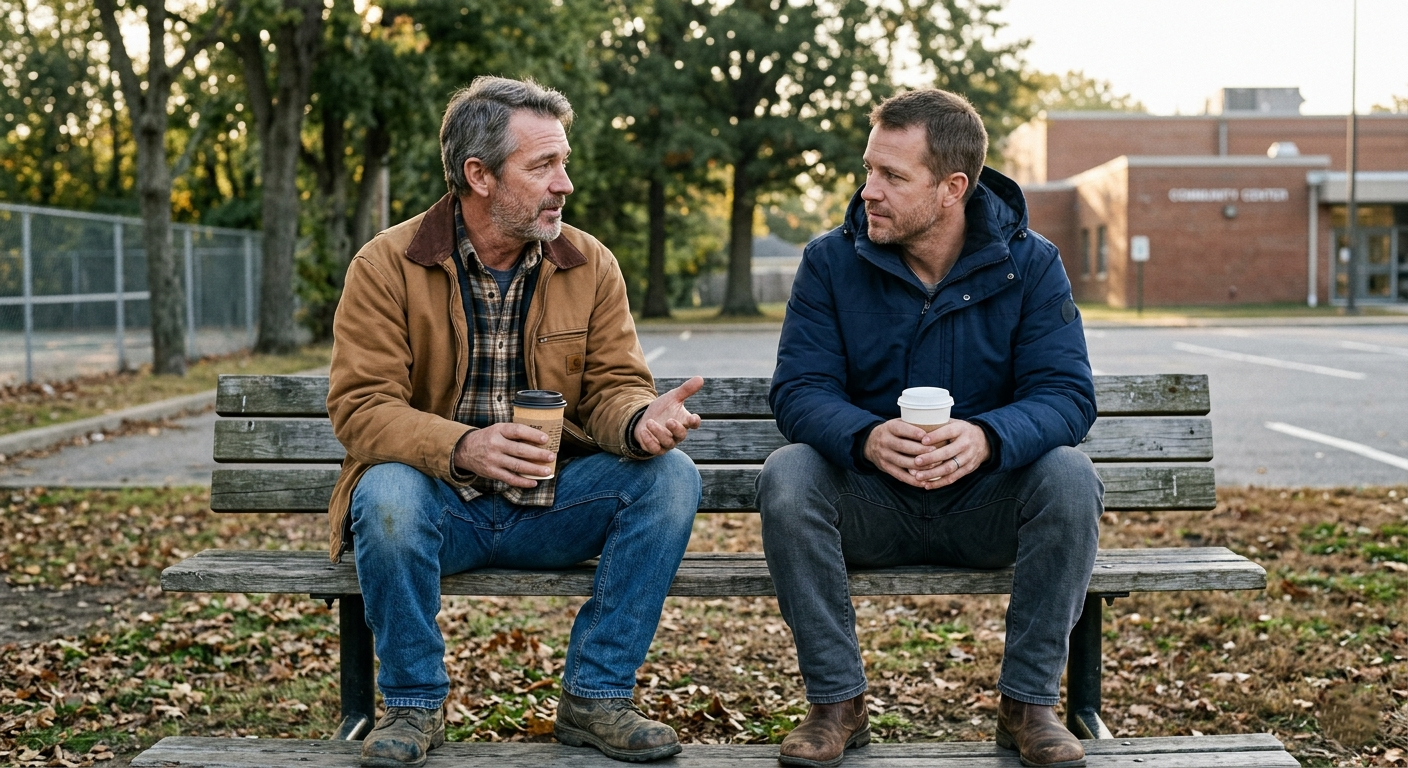
The Common Thread
These stories are different in specifics but share something essential:
None of these men were weak. None of them were uniquely broken. All of them were struggling with isolation in a world that makes connection increasingly difficult.
And all of them found their way back through the same basic elements:
Professional support (therapy, treatment programs)
Consistent social activity (sports leagues, groups, meetings)
Vulnerability (admitting they were struggling, asking for help)
Structure (routine, purpose, regular commitments)
Time (recovery measured in months and years, not days)
Your path won't look exactly like theirs. Your struggles are your own. Your timeline is your own.
But the fundamental truth remains: You can feel better. Connection is possible. You don't have to carry this alone.
Other men have walked this path. You can too.
The Difference Between Loneliness and Solitude
Not all aloneness is created equal. Understanding the difference between loneliness and solitude is crucial for navigating your relationship with being alone.
Loneliness: The Painful Disconnection
Loneliness is:
Feeling isolated even when surrounded by people
The painful awareness that you're disconnected from meaningful relationships
Wanting connection but feeling unable to achieve it
The sense that nobody truly knows or understands you
Accompanied by emptiness, anxiety, sadness, or restlessness
Loneliness is suffering. It's involuntary. It's the feeling that something essential is missing.
You can be lonely in a crowded room. You can be lonely in a relationship. You can be lonely while constantly surrounded by people.
Loneliness isn't about physical proximity to others—it's about emotional connection. Or the lack of it.
Solitude: The Restorative Aloneness
Solitude is:
Intentional time alone that feels nourishing rather than depleting
The ability to be comfortable in your own company
Space for reflection, creativity, rest
Choosing to be alone without feeling abandoned or rejected
Often accompanied by peace, clarity, or contentment
Solitude is healing. It's voluntary. It's the recognition that you need space from external demands.
You can be in solitude and feel connected to yourself, to your thoughts, to your sense of meaning. You're alone, but you're not lonely.
How to Tell the Difference
After time alone, ask yourself:
Do you feel:
Refreshed and re-energized? (Solitude)
Depleted and more anxious? (Loneliness)
Do you:
Crave connection more desperately than before? (Loneliness)
Feel ready to engage with people from a more grounded place? (Solitude)
Does being alone feel:
Like relief from overwhelming stimulation? (Solitude)
Like escape from feared rejection? (Loneliness)
Solitude restores you. Loneliness depletes you.
When Solitude Becomes Isolation
Healthy solitude can slide into harmful isolation if:
You're avoiding people out of fear rather than choosing space intentionally
Days turn into weeks without meaningful human contact
You use solitude as permanent escape rather than temporary restoration
Your alone time is consumed by rumination, anxiety, or numbing behaviors
You've lost interest in connection altogether
The key indicator: How do you feel when you emerge?
If solitude leaves you feeling more capable of engaging with the world, it's healthy. If it leaves you more withdrawn, more anxious, more convinced you should stay isolated, it's crossed into loneliness.
Developing a Healthy Relationship with Solitude
For men especially, learning to be comfortable alone—without being lonely—is an essential skill.
Practices that support healthy solitude:
Reflective activities:
Reading (fiction, philosophy, biography)
Journaling or writing
Walking in nature without headphones
Meditation or contemplative practice
Creative pursuits (music, art, building, cooking)
Physical restoration:
Solo exercise (running, swimming, hiking, yoga)
Rest without guilt
Sleep without distraction
Mental space:
Turning off devices and sitting with your own thoughts
Allowing boredom (it's where creativity lives)
Processing emotions without immediately numbing or distracting
The difference: These activities engage you. They're active forms of solitude, not passive escape.
The Escape vs. Restoration Question
Ask yourself honestly: Am I seeking solitude to restore myself, or to escape connection I'm afraid of?
Restoration looks like:
Planned, boundaried alone time
Feeling more grounded after
Returning to social engagement with more energy
Escape looks like:
Canceling plans repeatedly to avoid people
Feeling more anxious and depleted after
Increasing isolation rather than cycling between alone time and connection
Be honest with yourself about which you're experiencing.
Building Capacity for Both Connection and Solitude
Healthy adults need both.
You need meaningful connection with others. And you need comfortable aloneness with yourself.
The goal isn't to be constantly surrounded by people. That's exhausting and unsustainable.
The goal isn't to be completely independent and self-sufficient. That's isolation disguised as strength.
The goal is flexibility: the ability to connect deeply when you need connection, and to be alone peacefully when you need solitude.
This requires:
A baseline of connection you can return to (friends, community, support system)
Regular practices of solitude that restore rather than deplete you
Self-awareness about which you need in any given moment
When You're Not Sure What You Need
If you're struggling to distinguish whether you need connection or solitude:
Try this experiment:
Spend deliberate time with people (even if you don't feel like it)
Notice how you feel after
Then spend deliberate time in restorative solitude
Notice how you feel after
Your nervous system will tell you what you needed. If connection left you feeling more regulated, you needed it. If solitude left you feeling more grounded, you needed it.
Most often when you're struggling with loneliness, what you need is connection—even though every part of you wants to isolate.
Depression and anxiety lie. They tell you isolation is safer. They convince you connection will be draining or disappointing.
But usually, the opposite is true.
The Permission to Need Both
You're allowed to need time alone without being labeled antisocial. And you're allowed to need connection without being labeled dependent.
Both are human needs. Both are valid. Both require intentional cultivation.
The difference between loneliness and solitude comes down to this:
Loneliness is suffering disconnection you didn't choose.
Solitude is choosing restoration you need.
Learn to recognize which you're experiencing. And respond accordingly.
Warning Signs That Professional Help May Be Needed
Most loneliness and depression exists on a spectrum. You can address it through self-care, social connection, lifestyle changes, and support from friends and family.
But sometimes, what you're experiencing crosses a threshold where professional intervention isn't just helpful—it's necessary.
Knowing when you've crossed that threshold can be difficult. Depression distorts your thinking. It convinces you that you're fine when you're not, or that you're beyond help when you aren't.
Here are the concrete warning signs that indicate you need professional support now, not eventually.
Immediate Crisis Indicators
If you're experiencing any of these, seek help immediately:
1. Suicidal Thoughts or Plans
Not just vague "I wish I didn't exist" thoughts, but:
Specific plans for how you would do it
Researching methods
Giving away possessions
Saying goodbye to people in ways that feel final
Feeling like people would be better off without you
Sensing of calm after making a decision (a particularly dangerous sign)
Action: Call hepline (Suicide and Crisis Lifeline), go to an emergency room, or call someone who can stay with you until you can access professional help.
This is not weakness. This is survival. And you deserve to survive this.
2. Self-Harm Behaviors
Cutting, burning, or otherwise intentionally injuring yourself
Engaging in reckless, dangerous behaviors with disregard for your safety
Substance use that's escalating to dangerous levels
Even if you don't intend to die, these behaviors indicate you're in psychological crisis and need immediate professional intervention.
3. Complete Functional Breakdown
Unable to get out of bed for days
Not eating or unable to keep food down
Cannot perform basic hygiene
Missing work for multiple days with no explanation
Inability to care for dependents
When you literally cannot function at the most basic level, this is beyond self-help territory.
Serious Concern Indicators
These signs suggest you need professional help soon (within days to weeks):
4. Persistent, Unshakeable Hopelessness
Everyone has bad days or weeks. But if you've felt hopeless for several weeks straight, and nothing—no amount of sleep, exercise, social contact, or distraction—makes it better, that's clinical depression.
Signs:
Certainty that nothing will ever improve
Inability to imagine a future that doesn't feel unbearable
Feeling that trying to feel better is pointless
Loss of all motivation or purpose
5. Severe Anxiety or Panic
Panic attacks that interfere with daily functioning
Constant, unshakeable sense of dread
Physical symptoms (chest pain, difficulty breathing, dizziness) that medical evaluation has ruled out physical causes
Inability to leave your home due to anxiety
Intrusive thoughts you can't control
6. Substance Use as Primary Coping Mechanism
Drinking or using drugs daily to manage emotions
Needing substances to sleep or function
Increased tolerance (needing more to achieve the same effect)
Withdrawal symptoms when you try to stop
Hiding your use from others
Continued use despite negative consequences
Substance use disorder requires professional treatment. It rarely resolves through willpower alone.
7. Dramatic Personality or Behavior Changes
People who know you well are expressing serious concern because you don't seem like yourself:
Extreme irritability or rage disproportionate to circumstances
Paranoia or distrust that wasn't there before
Reckless behavior completely out of character
Extreme mood swings
Dissociation (feeling disconnected from reality or yourself)
8. Inability to Experience Pleasure
Complete anhedonia, the clinical inability to feel pleasure from anything:
Things you used to love bring nothing
Food has no taste
Music sounds like noise
Sex has no appeal
Accomplishments feel meaningless
Nothing makes you feel anything positive
This isn't just depression. This is your brain's reward system shutting down. It requires professional intervention.
9. Intrusive, Uncontrollable Thoughts
Obsessive rumination you can't stop
Disturbing thoughts that scare you
Compulsive behaviors you feel driven to perform
Thoughts that feel foreign to who you are but you can't dismiss
This may indicate OCD, trauma responses, or other conditions that respond well to specific therapeutic interventions.
10. Physical Symptoms Without Medical Cause
Chronic pain doctors can't explain
Severe digestive issues with no identified cause
Persistent headaches or migraines
Extreme fatigue despite adequate sleep
Significant weight loss or gain
Rapid heart rate, chest tightness, shortness of breath (after cardiac causes ruled out)
When your body is manifesting psychological distress as physical symptoms, that's your nervous system in crisis.
The "Struggling But Functional" Gray Area
Many men exist in this difficult middle space: not in immediate crisis, but clearly not okay.
You're going to work. You're paying bills. You're maintaining baseline function. But:
You're emotionally numb or constantly on edge
You have no energy or enthusiasm for anything
Relationships are suffering
You're barely holding it together
You fantasize about escape (running away, quitting everything, disappearing)
You feel like you're just going through the motions of life
This still warrants professional help. You don't have to wait until you're in crisis to deserve support.
The Self-Assessment Question
Ask yourself honestly:
"Have I been struggling with this for more than two weeks, and is it getting worse or staying the same despite my attempts to address it?"
If yes, professional help is appropriate.
Depression and anxiety disorders are medical conditions. They don't resolve through willpower. They require intervention—whether therapy, medication, or both.
Types of Professional Help
Therapy:
Psychologists, Licensed Professional Counselors (LPC), Licensed Clinical Social Workers (LCSW)
Specializations: CBT, DBT, EMDR (for trauma), psychodynamic, ACT
Best for: Learning coping skills, processing experiences, identifying patterns, behavioral change
Psychiatry:
Medical doctors (MD) who can prescribe medication
Best for: Medication evaluation and management, especially if symptoms are severe or haven't responded to therapy alone
Combined approach:
Therapist for talk therapy + psychiatrist for medication management
Often most effective for moderate to severe depression or anxiety
Intensive Outpatient Programs (IOP):
Several hours of therapy multiple days per week while living at home
Best for: Serious mental health struggles that need more support than weekly therapy but don't require hospitalization
Residential Treatment:
Inpatient programs where you live at facility
Best for: Severe depression, active addiction, when you're a danger to yourself
Overcoming Barriers to Getting Help
"I can't afford it":
Many therapists offer sliding scale fees
Community mental health centers provide low-cost services
Online therapy platforms are often cheaper than in-person
Some employers offer Employee Assistance Programs (EAP) with free sessions
Teaching hospitals often have training clinics with reduced rates
"I don't have time":
You make time for what's necessary. This is necessary.
Many therapists offer evening or weekend appointments
Online therapy provides more scheduling flexibility
One hour per week is a small investment in your life
"What if it doesn't help?":
Not all therapists are the right fit. If the first doesn't work, try another.
Therapy has decades of research supporting its effectiveness
Doing nothing guarantees nothing changes
"I should be able to handle this myself":
You wouldn't try to set your own broken leg. Mental health is health.
Seeking help is strength, not weakness
Professional support gives you tools to eventually handle things yourself more effectively
"People will judge me":
Your mental health provider is bound by confidentiality
You don't have to tell anyone you're in therapy if you don't want to
The people who matter will support you; the people who judge you don't matter
How to Actually Make It Happen
Search Psychology Today therapist directory or ask your primary care doctor for referrals
Call 2-3 therapists and ask for brief phone consultations (most offer these free)
Ask about: their experience with men's mental health, their approach, their availability, their fees
Schedule a first appointment even if you're anxious about it
Attend even if you want to cancel (which you will)
Give it 3-4 sessions before deciding if it's the right fit
What to Expect in First Therapy Session
No judgment, just information gathering
Therapist will ask about what brought you in, your history, current symptoms
You won't have to reveal everything immediately
You'll discuss goals for therapy and treatment approach
It should feel collaborative, not interrogative
If it feels wrong, that's okay. Try someone else.
When Someone Else Is Insisting You Need Help
If multiple people in your life are expressing serious concern about you—your partner, family, close friends, coworkers—take it seriously.
Depression distorts your perception. You might not recognize how bad things are. But the people who love you can see what you can't.
If they're worried enough to risk upsetting you by suggesting professional help, that's significant.
Consider: What would it hurt to at least talk to someone professional?
The Reality About Treatment
Treatment won't:
Fix everything immediately
Make you a different person
Erase all struggle from your life
Treatment will:
Give you tools to manage symptoms effectively
Help you understand patterns keeping you stuck
Reduce the intensity and frequency of difficult episodes
Make life more bearable, then eventually, better
Recovery isn't linear. There will be setbacks. But with professional support, you can build genuine, sustainable progress.
The Most Important Thing
If you're reading this section and thinking, "Maybe I do need help," then you probably do.
Trust that instinct.
You don't have to be in absolute crisis to deserve support. You don't have to hit rock bottom before reaching out.
You're allowed to get help just because you're struggling. That's reason enough.
Step-by-Step Recovery and Reconnection Framework
You've read about what helps, what the signs are, what resources exist. But you might still be thinking: "Okay, but what do I actually do? Where do I start?"
This framework provides a realistic, actionable roadmap. It's designed to be started immediately, with small steps that build momentum over time.
Not all steps will apply to everyone. Take what's relevant to your situation and leave the rest.
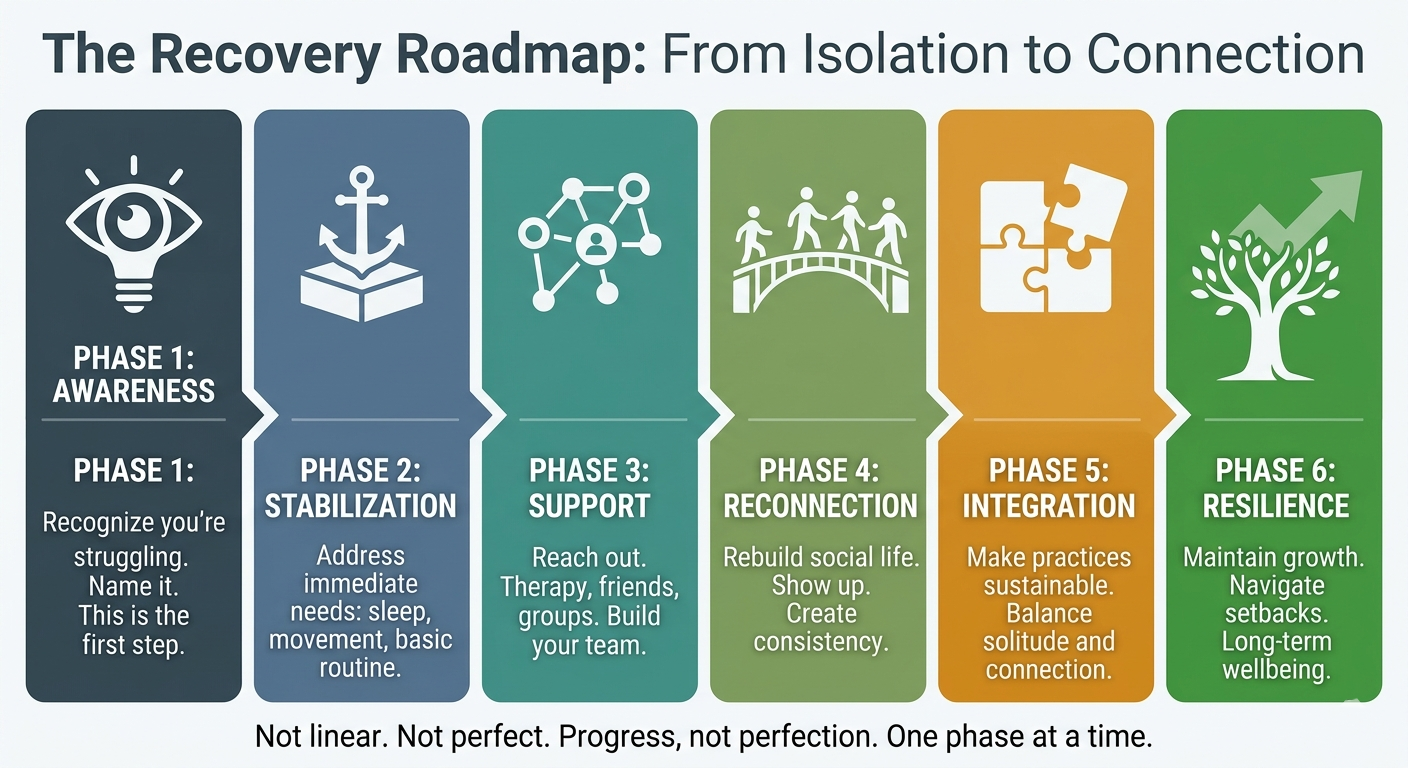
Phase 1: Awareness (Days 1-7)
Goal: Acknowledge what you're experiencing without judgment
Step 1: Name It
Stop telling yourself you're fine. Acknowledge reality:
"I'm lonely."
"I'm depressed."
"I'm isolated and it's affecting me."
"I need help."
Write it down. Say it out loud to yourself. The act of naming breaks the spell of denial.
Step 2: Document Your Baseline
Before you change anything, understand where you are:
Quick assessment:
How many meaningful conversations have you had this week?
When was the last time you spent time with someone face-to-face?
How's your sleep? (Hours, quality)
How's your physical health? (Energy, pain, appetite)
What's your daily routine? (Wake time, work, evening, bed)
What are you avoiding?
Write honest answers. This is your starting point.
Step 3: Identify Your Immediate Needs
What's most urgent right now?
Do you need crisis support? (If yes: call 988, go to ER, call someone who can stay with you)
Do you need to see a doctor? (Physical symptoms, medication evaluation)
Do you need to tell someone you're struggling? (Partner, parent, friend)
Make a list of 1-3 most pressing needs. Don't try to solve them yet—just identify them.
Step 4: Make One Phone Call
Before the week is done, make one call:
Schedule doctor's appointment
Call a therapist for consultation
Call a friend or family member and tell them honestly that you're struggling
Call a crisis line if you need immediate support
One call. That's your only goal for Phase 1.
Phase 2: Stabilization (Weeks 1-2)
Goal: Create foundation of basic functioning
Step 5: Fix Your Sleep
Nothing else works if you're not sleeping.
Immediate actions:
Choose a consistent bedtime (same time every night, even weekends)
Choose a consistent wake time
No screens 1 hour before bed
Make bedroom cool, dark, quiet
No caffeine after 2 PM
No alcohol within 3 hours of sleep
Commit to this for two weeks before judging if it's working.
Step 6: Move Your Body Daily
You don't need to love it. You just need to do it.
Minimum viable movement:
20-30 minute walk outside every day
Or 20 minutes of any exercise you can tolerate
Same time daily (makes it a habit, not a decision)
Put it in your calendar. Treat it like a non-negotiable appointment.
Step 7: Create a Basic Daily Structure
Write down a simple daily routine:
Morning:
Wake at [time]
[Morning routine]
[Movement/exercise]
Work day:
[Work hours]
[Lunch break - away from desk]
[End of work ritual]
Evening:
[Dinner]
[Activity that isn't screens]
[Wind-down routine]
[Bed at time]
Keep it simple. The goal is predictability, not perfection.
Step 8: Reduce Digital Overwhelm
This week:
Delete one social media app that makes you feel worse (you can always reinstall later)
Set app time limits on your phone
Turn off non-essential notifications
Designate one hour before bed as phone-free
Notice how you feel after a week of reduced digital noise.
Phase 3: Support (Weeks 2-4)
Goal: Establish professional and peer support
Step 9: Start Therapy
If you haven't already:
Schedule first therapy appointment this week
If you're on a waitlist, get on multiple waitlists
If cost is a barrier, research sliding scale options, community mental health, or online platforms
Attend first session even if you're anxious
Give therapy at least 3-4 sessions before deciding if this therapist is right.
Step 10: Tell One Person the Truth
Choose one person in your life and have an honest conversation:
"I've been struggling with [loneliness/depression/isolation]. I'm working on it, but I wanted you to know because I need support."
This doesn't have to be your deepest pain. It just has to be true.
Notice: Most people respond with relief that you're being real with them.
Step 11: Join One Group
Research and join one weekly activity:
Sports league
Climbing gym
Running club
Men's group
Volunteer organization
Class (cooking, language, martial arts)
Support group
Commit to attending for at least 4 weeks before deciding if it's right.
The first few times will be awkward. Go anyway.
Step 12: Create an Emergency Plan
If you hit a crisis moment, what will you do?
Write down:
Crisis hotline number (988)
2-3 people you can call
Activities that have helped before (walk outside, shower, call someone, watch specific show)
Reminder to yourself: "This feeling is temporary. I've survived 100% of my hardest days so far."
Keep this list in your phone.
Phase 4: Reconnection (Weeks 4-8)
Goal: Rebuild social connections and community
Step 13: Reach Out to 3 People
This month, reach out to three people you've lost touch with:
Simple message: "Hey, been thinking about you. Want to grab coffee/lunch/beer sometime?"
Send it before you overthink it.
Not everyone will respond. Some will. That's enough.
Step 14: Say Yes to 2 Social Invitations
Even if you don't feel like it. Even if you'd rather stay home.
Accept two invitations this month. Show up. Stay for at least an hour.
You can leave early if you need to. But you have to show up.
Step 15: Initiate One Plan
Don't just wait to be invited. Invite someone to something:
Coffee
Lunch
Game
Hike
Movie
Specific invitation with specific time works better than vague "let's hang out sometime."
Step 16: Show Up to Your Weekly Activity Consistently
The group/class/league you joined in Step 11? Keep going. Even when you don't feel like it.
Consistency creates familiarity. Familiarity creates connection. Connection takes time.
Don't judge results after two sessions. Give it two months.
Phase 5: Integration (Weeks 8-12)
Goal: Make new practices sustainable and balanced
Step 17: Evaluate What's Working
Look back at the past 8 weeks:
What changes have made you feel measurably better?
What have you been doing consistently?
What still feels forced or unsustainable?
What needs adjustment?
Keep what's working. Modify or drop what isn't.
Step 18: Build a Sustainable Social Rhythm
Create a realistic weekly social pattern:
Example:
Monday: Therapy (or journaling if you don't have therapy)
Wednesday: Sports league / group activity
Friday or Saturday: Something social (friend hangout, date, event)
Sunday: Alone time for restoration
Adjust to fit your needs, but create predictable rhythm.
Step 19: Deepen One Friendship
Choose one person from your weekly activity or someone you reconnected with.
Intentionally deepen that friendship:
Ask to hang out outside the usual context
Have a more personal conversation
Share something real about what you're going through
Be consistent in reaching out
You don't need ten close friends. You need 2-3 genuine connections.
Step 20: Establish Healthy Solitude Practices
Balance connection with restoration:
Choose 2-3 restorative alone activities:
Reading
Walking in nature
Cooking
Creating something
Journaling
Schedule these intentionally. They're not escape from people, they're restoration so you can engage with people from a fuller place.
Phase 6: Resilience (Weeks 12+)
Goal: Long-term maintenance and navigating setbacks
Step 21: Build Your Setback Plan
You will have bad days/weeks. Plan for them now:
When I start to slip back into isolation, I will:
[Specific action - example: text my friend John]
[Specific action - example: go to my weekly group even if I don't want to]
[Specific action - example: call my therapist for extra session]
Having a plan reduces decision paralysis when you're struggling.
Step 22: Create Maintenance Routines
What minimal practices keep you stable?
Your non-negotiables might be:
Sleep schedule
Daily movement
One weekly social activity
Therapy (weekly or bi-weekly)
Limited screen time
These are your baseline. When life gets chaotic, these stay.
Step 23: Give Back
When you're stable enough, help someone else:
Share your experience with someone struggling
Mentor someone earlier in recovery
Volunteer
Show up for friends going through hard times
Helping others reinforces your own progress and creates purpose.
Step 24: Reflect on Progress
Every month, write down:
What's better than 3 months ago?
What am I proud of?
What still needs work?
What did I learn this month?
Progress isn't linear. But when you look back over months, you'll see change you couldn't see day-to-day.
The Realistic Timeline
Week 1-2: You're building foundation. You won't feel dramatically better yet. That's normal.
Week 3-4: You might notice small improvements in sleep, energy, or mood stability.
Week 6-8: Social connections are beginning to form. Loneliness might ease slightly.
Week 12: You have some consistent practices. Life feels slightly more manageable.
Month 6: Meaningful progress is visible. You have tools. You have people. Setbacks still happen but recovery is faster.
Month 12+: New patterns feel more natural. You've built resilience. You're not "cured" but you're meaningfully better.
What Success Actually Looks Like
Success isn't:
Never feeling lonely again
Being happy all the time
Having a massive social circle
Never struggling
Success is:
Having 2-3 people you genuinely connect with
Knowing how to reach out when you're struggling
Having practices that help you regulate
Feeling like life is worth living
Being able to navigate hard times without completely collapsing
[QUOTE]
"A year ago, I spent every evening alone in my apartment, convinced I was fine while slowly disappearing. Today, I play basketball every Wednesday, see my therapist every other week, have coffee with a friend most Saturdays, and actually look forward to things. I still have hard days. But I'm not drowning anymore. I know how to swim."
— Anonymous recovery story
The Single Most Important Thing
If you remember nothing else from this framework, remember this:
Small, consistent actions compound over time into meaningful change.
You don't have to do everything at once. You don't have to be perfect.
You just have to start. And keep starting, even when you don't want to.
One phone call. One walk. One honest conversation. One weekly activity.
That's how recovery happens. Not through grand transformation, but through small steps taken repeatedly.
You can do this.
And you don't have to do it alone.
Conclusion: There Is a Way Forward
If you've read this far, you're not just passively consuming content. You're looking for something, understanding, validation, hope, a path forward.
Here's what you need to know:
You're Not Broken
The loneliness you're experiencing isn't a character flaw. It's not weakness. It's not failure.
You're a human being responding to conditions that make connection increasingly difficult, remote work, social media comparison, eroded community structures, cultural messages that tell men to handle everything alone.
Your struggle makes sense. The system is broken, not you.
What You're Feeling Is Real
Your loneliness is valid. Your exhaustion is valid. Your sense that something fundamental is missing from your life—that's real.
You're not being dramatic. You're not overreacting. You're not too sensitive.
You're experiencing something millions of men are experiencing. And it deserves to be taken seriously.
You Don't Have to Stay Here
This feeling, this heavy, gray, disconnected existence, is not permanent.
You can feel better. Connection is possible. Life can become more than just surviving until the weekend.
It won't happen overnight. It won't be easy. But it is absolutely possible.
The Path Exists
You don't have to figure everything out right now. You don't have to have a perfect plan.
You just need to take one small step:
Make one phone call
Send one message
Join one group
Schedule one appointment
Have one honest conversation
Just one. And then another. And then another.
That's how this works. Not through massive transformation, but through small, consistent actions that compound over time.
You're Not Alone in This
Right now, there are thousands of men reading these words, feeling the same thing you're feeling, wondering if they're the only ones struggling.
You're not.
There are men in therapy working through this. There are men in support groups sharing these exact experiences. There are men rebuilding friendships, reaching out, showing up, doing the uncomfortable work of connection.
You're part of something bigger than yourself. This isn't just your individual struggle, it's a collective crisis. And that means you're not facing it alone.
The People Who Matter Will Understand
You might be afraid that opening up will make people see you differently. That showing vulnerability will cost you respect or connection.
Sometimes people don't understand. Some people aren't ready for emotional honesty.
But the people worth having in your life, the people who genuinely care about you, will respond with understanding, not judgment.
They might be relieved. They might share that they've been struggling too. They might thank you for being honest.
The right people will show up for you. And the people who don't? They were never going to be there anyway.
This Won't Be Linear
Some days will be better. Some will be worse. You'll have weeks where you feel like you're making progress, and weeks where you feel like you're back at square one.
That's not failure. That's recovery.
Progress isn't a straight line upward. It's a messy, winding path with setbacks and detours and moments where you question if anything is actually changing.
But if you keep showing up—keep going to therapy, keep reaching out, keep attending the weekly group, keep taking care of yourself—you will look back in six months and see change you couldn't see day-to-day.
You Deserve Support
You don't have to earn the right to feel better. You don't have to prove your suffering is "bad enough" before seeking help.
You deserve support just because you're struggling. That's it. That's the only qualification.
You deserve friendship. You deserve connection. You deserve to feel like your life has meaning and purpose.
Not because you've achieved anything. Not because you've suffered enough. Just because you're human.
The Work Is Worth It
Yes, this is hard. Rebuilding your life after isolation is uncomfortable and exhausting and scary.
Reaching out feels vulnerable. Therapy feels exposing. Showing up to social activities when you'd rather hide feels like forcing yourself through fire.
But the alternative—staying where you are, continuing to deteriorate in isolation—is harder.
The discomfort of growth is temporary. The pain of staying stuck is permanent.
Choose temporary discomfort. Choose growth. Choose the possibility of something better.
What Happens Next Is Up to You
This article can't fix your life. No article can.
But it can show you that change is possible. It can give you tools. It can help you understand you're not alone.
What you do with that information is your choice.
You can close this tab and go back to scrolling. You can save this for "later" and never return to it. You can read it, feel momentarily hopeful, and change nothing.
Or you can choose differently.
You can make one phone call. Schedule one appointment. Send one message. Join one group.
You can start.
Not perfectly. Not with complete confidence. But you can start.
A Letter to Your Future Self
Imagine yourself six months from now.
You've been going to therapy. You've been showing up to the weekly group, even when you didn't want to. You've reached out to old friends. You've been moving your body, sleeping consistently, limiting the digital noise that was drowning you.
You still have hard days. But you also have people to call. You have practices that help. You have a life that feels like it's worth living.
That version of you is looking back at this moment—this exact moment—and thanking you for making a different choice.
For not staying in the isolation. For taking the first step, even though it felt impossible.
That future self exists. But only if you start building them today.
The Invitation
You've spent so long handling everything alone. Convinced that self-sufficiency is strength. That needing people is weakness.
What if you tried something different?
What if you let yourself need connection? What if you allowed yourself to be known? What if you stopped performing competence and started admitting struggle?
What if you chose vulnerability over isolation?
The door is open. The path exists. People are waiting to walk it with you.
All you have to do is take the first step.
One Last Thing
If you're sitting there thinking: "This is all great, but I don't know if I have the energy to do any of it"—I hear you.
Start smaller than you think you need to.
Not ten steps. One.
Not a complete transformation. A single phone call.
Not fixing everything. Just doing one thing differently tomorrow than you did today.
That's enough.
You're enough.
And you don't have to do this alone anymore.
The male loneliness crisis is real. Your struggle is real. And so is the possibility of recovery.
Choose to believe in that possibility. Choose to take one small step. Choose connection over isolation.
You deserve better than this. And better is possible.
Start today.
Frequently Asked Questions
Q: How do I know if I'm just introverted or actually lonely?
A: Introversion is about how you recharge (alone time restores you). Loneliness is about emotional disconnection that causes suffering. You can be introverted and not lonely if you have meaningful connections you can return to when you need them. You're lonely if the lack of connection feels painful, if you want connection but can't achieve it, or if isolation is causing distress rather than restoration.
Q: I've tried therapy before and it didn't help. Should I try again?
A: Yes, but with a different approach. Not all therapists are good, and not all good therapists are good for you. If previous therapy didn't work, consider: Was it the wrong therapist? The wrong modality? The wrong timing? Were you fully engaged? Try a different therapist, different therapeutic approach (CBT vs. psychodynamic vs. ACT), or try again when you're more ready to engage. Therapy works, but fit matters enormously.
Q: How do I make friends as an adult man without it being weird?
A: Join activity-based groups (sports, hobbies, volunteering) where you see the same people repeatedly. After a few sessions, invite someone to grab food/coffee after. Be direct: "We should hang out outside of this sometime." Most men appreciate the directness and are often feeling the same awkwardness. What feels weird to you feels normal to others in the same situation.
Q: What if I reach out to people and they don't respond or seem uninterested?
A: Not everyone will reciprocate, and that's okay. Some people are dealing with their own struggles, some aren't looking for deeper friendship, some are just bad at responding. It's not a reflection of your worth—it's just incompatibility. Keep reaching out to different people until you find those who do reciprocate. You're looking for quality connections, not quantity.
Q: I'm married/in a relationship but still feel lonely. Does that mean something's wrong with my relationship?
A: Not necessarily. Romantic relationships can't meet all your social and emotional needs. You need friendships, community, and connections outside your partnership. Many people feel lonely in relationships because they've made their partner their only source of connection. This is actually a sign you need to build friendships and social life independent of your relationship, which will ultimately make your relationship healthier too.
Q: How long does it actually take to feel better?
A: You might notice small improvements in 2-4 weeks (better sleep, slightly more energy). Meaningful emotional shifts typically take 6-12 weeks of consistent effort. Substantial life change—new friendships, stable routine, genuine improvement in mental health—usually takes 6-12 months. Recovery isn't linear, and timelines vary, but if you're consistently taking steps forward, you will see progress within a few months.
Q: What if I don't have time or energy for a weekly activity?
A: You make time for what you prioritize. If connection matters to you (and it should), you'll find 2-3 hours per week. You likely spend more than that on social media or streaming. It's not about having time—it's about choosing to use time differently. If energy is the issue, choose lower-energy activities (walking group, board games, casual meetups) instead of high-intensity options.
Q: Is it normal to feel worse before feeling better?
A: Yes. When you start addressing loneliness and depression, you're often confronting feelings you've been avoiding. Therapy can bring up difficult emotions. New social situations create anxiety. Change is uncomfortable even when it's positive. This temporary increase in discomfort is normal and often indicates you're doing meaningful work. If it persists beyond a few weeks or becomes overwhelming, discuss with your therapist.
Q: What if medication is suggested? Does that mean I'm really broken?
A: No. Medication addresses neurochemical imbalances in your brain. If your brain isn't producing adequate serotonin, dopamine, or norepinephrine, no amount of willpower will fix that—just like you can't willpower your way out of diabetes. Medication can provide chemical support while you build behavioral and social changes. Many people use medication temporarily; some use it long-term. It's a tool, not a failure.
Q: I'm afraid if I start opening up, I won't be able to stop and I'll overwhelm people. How do I avoid that?
A: Start small. Share one thing you're struggling with, not your entire emotional history. Pay attention to how people respond. If they engage and reciprocate, you can gradually share more. If they seem uncomfortable, pull back. You don't have to dump everything at once. Vulnerability is a gradual process, not a one-time purge. Therapy is the place for the heavy processing; friendships can handle incremental sharing.
Q: What if I've been isolated for years? Is it too late?
A: It's never too late. People rebuild their lives after decades of isolation. It will take longer than if you'd addressed it sooner, but connection is always possible. You're not "too far gone" or "too damaged" to recover. You'll need patience with yourself and probably professional support, but men who've been isolated for years have successfully rebuilt social lives and found meaningful connection. You can too.
Q: How do I deal with the shame of admitting I'm lonely?
A: Reframe loneliness not as personal failure but as a response to impossible conditions. Millions of men are experiencing this. You're not uniquely broken—you're responding to systemic issues. Share this article with people you trust. You'll likely find they relate more than you expect. Shame thrives in silence; it loses power when you speak it out loud. The people worth having in your life won't judge you—they'll respect your honesty.
Additional Resources
Therapy and Counseling
Psychology Today Therapist Directory - psychologytoday.com/us/therapists
BetterHelp - betterhelp.com (online therapy)
Talkspace - talkspace.com (online therapy)
Open Path Collective - openpathcollective.org (affordable therapy)
Men's Mental Health Resources
Man Therapy - mantherapy.org
Movember Foundation - movember.com (men's health initiatives)
NAMI Men's Resources - nami.org
Support Groups and Communities
Evryman - evryman.com (men's groups and retreats)
ManKind Project - mankindproject.org (men's development)
SMART Recovery - smartrecovery.org (addiction recovery)
Men's Sheds - menssheds.org (community workshops)
Mental Wellness Apps
Headspace - headspace.com
Calm - calm.com
Stoic - stoicapp.com
Woebot - woebothealth.com
Books
"The Body Keeps the Score" by Bessel van der Kolk
"Lost Connections" by Johann Hari
"Man's Search for Meaning" by Viktor Frankl
"Atomic Habits" by James Clear
Articles and Research
American Psychological Association - Men's Mental Health resources
Harvard Men's Health Watch
National Institute of Mental Health - Men and Mental Health
Medical and Mental Health Disclaimer
This article is provided for informational and educational purposes only. It is not intended to be, and should not be interpreted as, professional medical advice, diagnosis, or treatment for any mental health condition.
Please note the following:
- Not a Substitute for Professional Care: The information, strategies, and resources provided in this article are not a replacement for professional mental health care, therapy, psychiatric treatment, or medical advice. If you are experiencing mental health difficulties, please consult with a qualified healthcare provider, licensed therapist, psychiatrist, or counselor.
- Individual Circumstances Vary: Every person's mental health situation is unique. What works for one individual may not work for another. The strategies and suggestions presented here are general in nature and may not be appropriate for your specific circumstances.
- Crisis Situations: If you are experiencing a mental health crisis, having thoughts of suicide or self-harm, or are in immediate danger, please seek emergency help immediately:
- Go to your nearest emergency room
- Contact emergency services in your country
- No Doctor-Patient Relationship: Reading this article does not create a therapist-client, doctor-patient, or any other professional relationship. The author and publisher are not responsible for any actions taken based on the information provided.
- Consult Healthcare Providers: Before making significant changes to your mental health care, lifestyle, exercise routine, sleep patterns, or if you are considering therapy or medication, please consult with appropriate healthcare professionals who can assess your individual situation.
- Accuracy of Information: While every effort has been made to ensure the accuracy of the information presented, mental health research and treatment approaches continue to evolve. Statistics, research findings, and treatment recommendations may change over time.
- Third-Party Resources: This article contains references to third-party resources, services, apps, and organizations. These are provided for informational purposes only and do not constitute endorsements. The author and publisher are not responsible for the content, quality, or outcomes of third-party services.
- Personal Experiences: Stories and examples shared in this article are composite accounts based on common experiences and have been modified to protect privacy. They are illustrative in nature and should not be interpreted as guaranteed outcomes.