1. The Label You Can't Quite Read
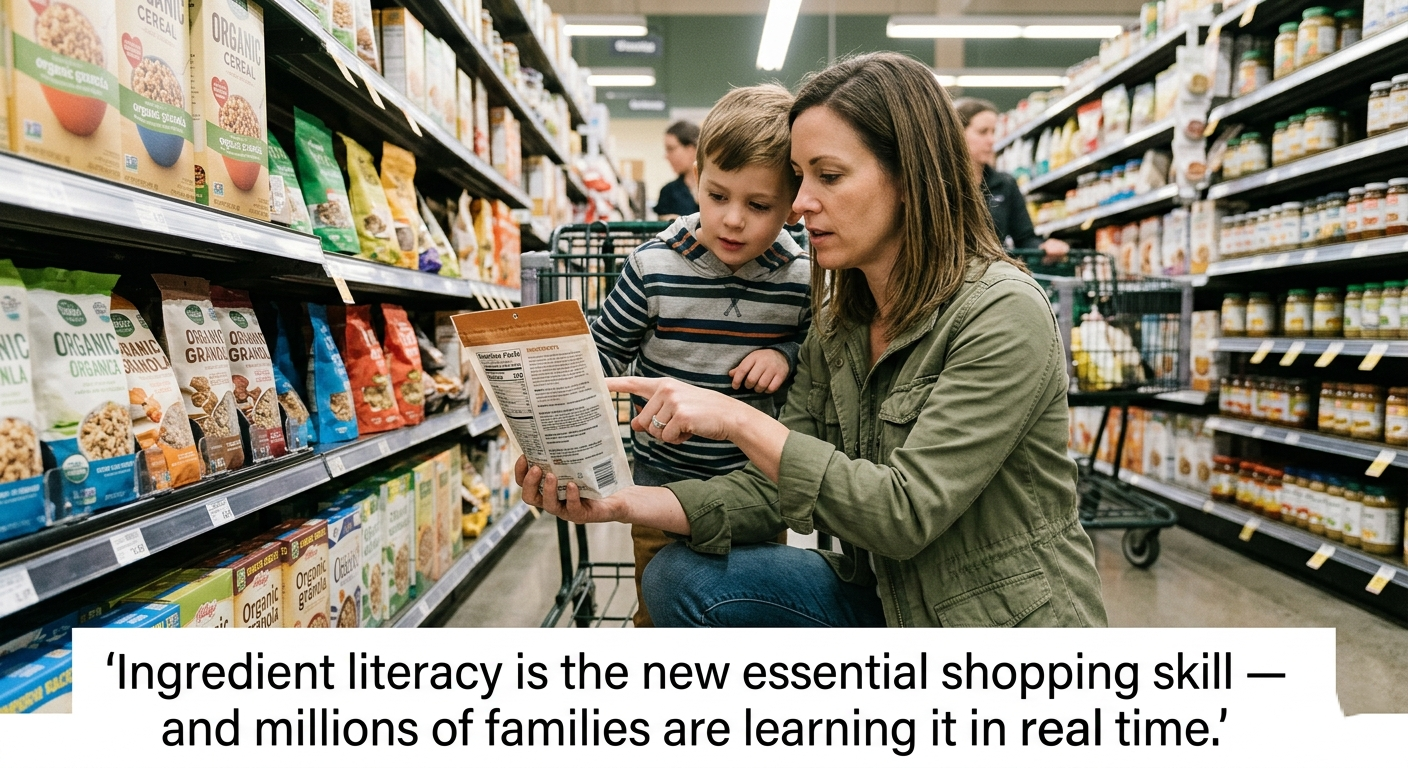
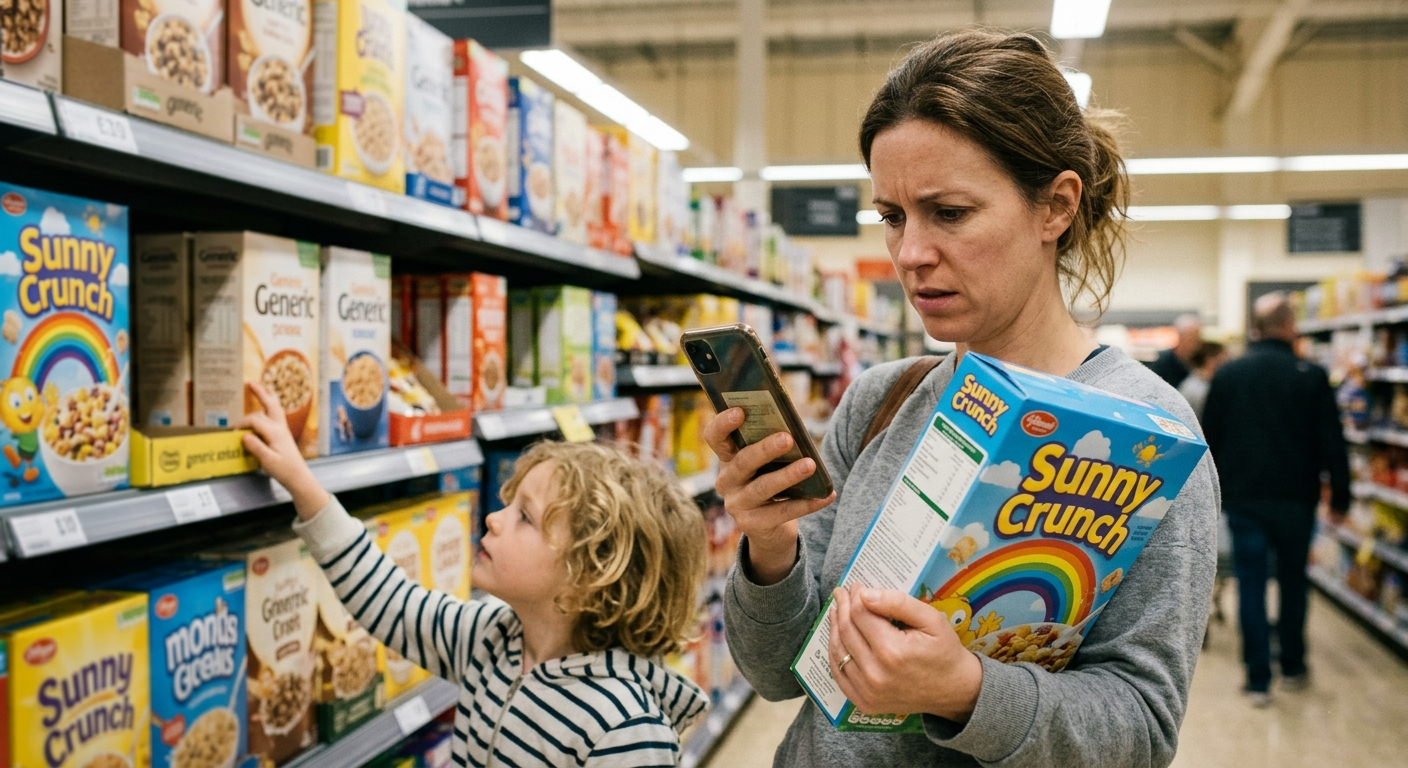
You are standing in the cereal aisle. Again. Your child wants the one with the cartoon character on the box, the bright red and orange one with the marshmallow shapes. You flip it over and scan the ingredient list: corn flour, sugar, modified starch, Red 40, Yellow 5, Blue 1. You remember seeing a headline last week about food dyes being banned. Or was it that they were under review? Or maybe that was just in California?
You put the box back. Then pick it up again. Then wonder if you are overreacting. Then wonder if everyone else in this aisle knows something you do not. You leave with either the same cereal, a different one you are not sure is better, or nothing at all, and arrive home no clearer than you were before.
This experience is playing out in grocery stores across the United States and beyond, as consumers attempt to navigate a food-labelling landscape that is genuinely shifting. The FDA has taken regulatory action on certain food dyes. Multiple states have introduced or passed their own restrictions. The word 'ban' has appeared in dozens of headlines. And the information available to ordinary shoppers ranges from precise and helpful to vague, alarmist, or simply wrong.
This guide cuts through the confusion. Here is what has actually happened, what it means for the food on your table, and — most practically — what to do about it at the grocery store.
No fearmongering. No agenda. Just the facts, and a practical shopping roadmap you can actually use.
2. What Is Happening With Food Dye Regulations in 2026?
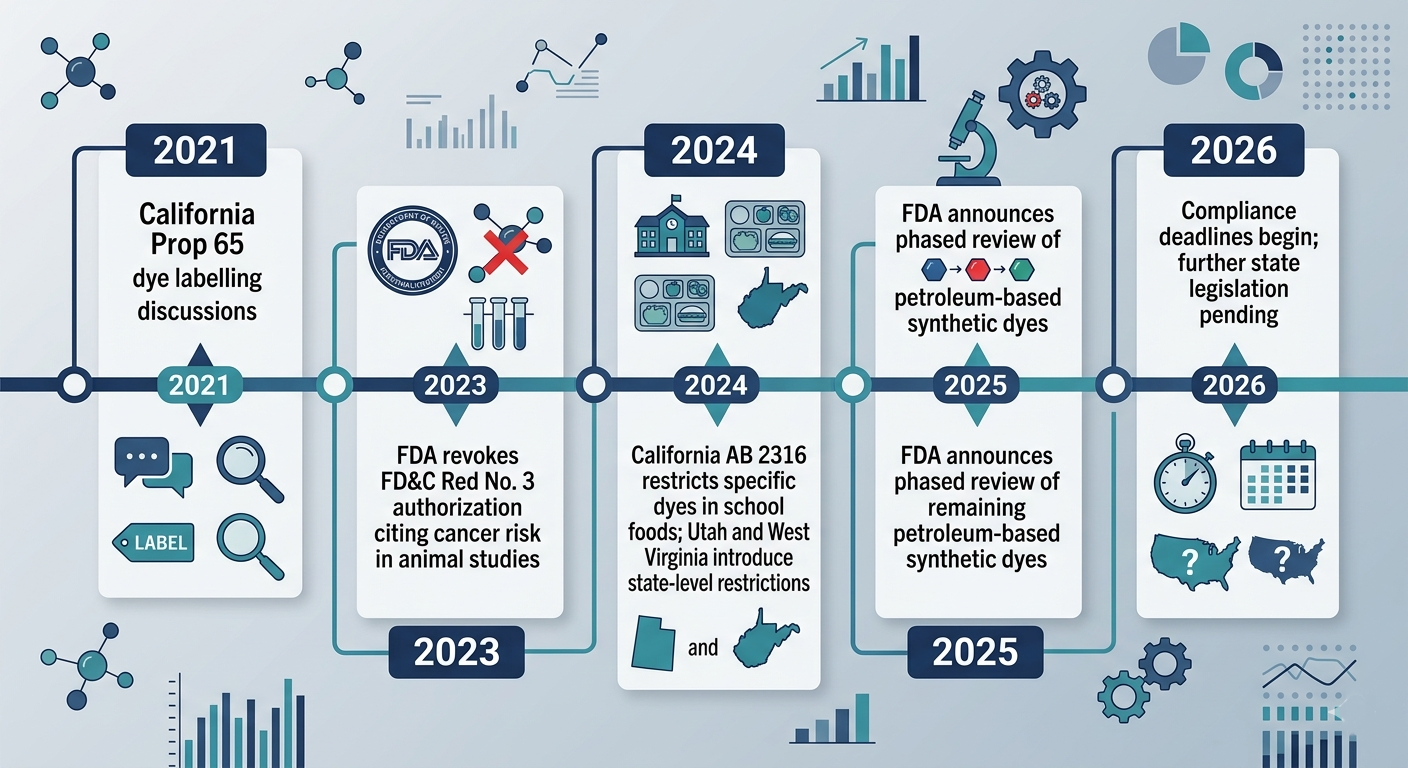
The regulatory story around food dyes in 2026 is not a sudden ban but an accelerating series of actions at both federal and state levels that, taken together, represent a significant shift in how the United States regulates synthetic food coloring.
The FDA's Action on Red No. 3
The most consequential federal move in recent years was the FDA's revocation of the authorization for FD&C Red No. 3 (erythrosine). This action was long anticipated, the FDA had itself determined as far back as 1990 that high doses of Red No. 3 caused cancer in male rats, but a legal provision known as the Delaney Clause (which prohibits approval of food additives shown to cause cancer in any species) was not applied until consumer advocacy groups successfully pressured for action.
The FDA's revocation set compliance deadlines for food manufacturers to reformulate products containing Red No. 3 for ingestion. The timelines differ for ingested products versus maraschino cherries and certain other specific categories. Critically: the revocation does not mean Red No. 3 has disappeared from shelves overnight. Manufacturers have compliance windows, and products already in distribution continue to move through the supply chain.
State-Level Restrictions
Several states have moved ahead of federal action with their own restrictions, particularly focused on dyes in foods served in public schools:
California passed legislation restricting certain food additives including specific dyes from school meals, a significant move given the scale of California's school food procurement.
West Virginia passed legislation restricting multiple synthetic dyes from foods served in state schools.
Utah introduced restrictions that align with growing legislative pressure across the mountain west.
Additional states have legislation under consideration, reflecting rising political consensus that children's food should be subject to stricter standards.
The Broader Petroleum-Based Dye Review
Beyond Red No. 3, the FDA has indicated broader scrutiny of petroleum-derived synthetic dyes, the group that includes Red 40, Yellow 5, Yellow 6, Blue 1, and others that remain in widespread use. This does not mean they are banned. It means they are under increased regulatory review, and the political and consumer environment has shifted in ways that make further action increasingly possible.
What 'Banned' Actually Means in This Context
In media coverage, 'banned' is often used loosely. In regulatory terms, FD&C Red No. 3 has had its food-use authorization revoked by the FDA, meaning manufacturers must reformulate products intended for ingestion. Other dyes remain legally permitted but under heightened scrutiny. State-level restrictions apply within those states, primarily to school food contexts. No wholesale ban on all synthetic food dyes has been enacted at the federal level as of 2026.
3. What Are Artificial Food Dyes?
Artificial food dyes are synthetic chemical compounds used to add or restore colour to food and beverages. The vast majority of the dyes currently in commercial use in the United States are derived from petroleum, a fact that surprises many consumers who have not encountered it before.
Why Petroleum?
Petroleum-derived compounds called azo dyes provide consistent, vivid, stable colouring that resists fading in light and heat, properties that make them commercially attractive for mass food production. They are also significantly less expensive than natural colouring alternatives, which typically come from plants, fruits, vegetables, minerals, or insects.
Natural vs Synthetic Colouring
Characteristic | Synthetic Dyes | Natural Colouring |
|---|---|---|
| Origin | Petroleum (crude oil derivatives) | Plants, fruits, vegetables, minerals, insects |
| Examples | Red 40, Yellow 5, Yellow 6, Blue 1 | Beet juice, turmeric, spirulina, annatto |
| Stability | High — heat and light resistant | Variable — many fade under heat or light |
| Cost | Lower — cost-effective at scale | Higher — depends on source and processing |
| Label appearance | 'Red 40', 'Yellow 5' | 'Beet juice concentrate', 'turmeric' |
| Regulatory status | Certified by FDA; some under review | Generally GRAS; carmine requires labelling |
| Common concern | Hyperactivity links; animal study findings | Allergen potential (carmine) |
Why Manufacturers Use Them
Colour significantly influences consumers' food perception, taste expectations, and purchasing behaviour. A pale or brownish version of a product that consumers expect to be bright red or orange performs poorly in consumer testing, even when the flavour is identical. Food manufacturers use dyes to standardise appearance across batches, compensate for colour loss during processing, and create the visual consistency that consumers have come to expect.
As consumer demand for cleaner labels has grown, many manufacturers are reformulating, replacing synthetic dyes with natural alternatives. This is a market-driven trend that has accelerated significantly in the last three to five years, though the transition involves considerable technical and cost challenges.
4. Which Food Dyes Are Most Controversial in 2026?
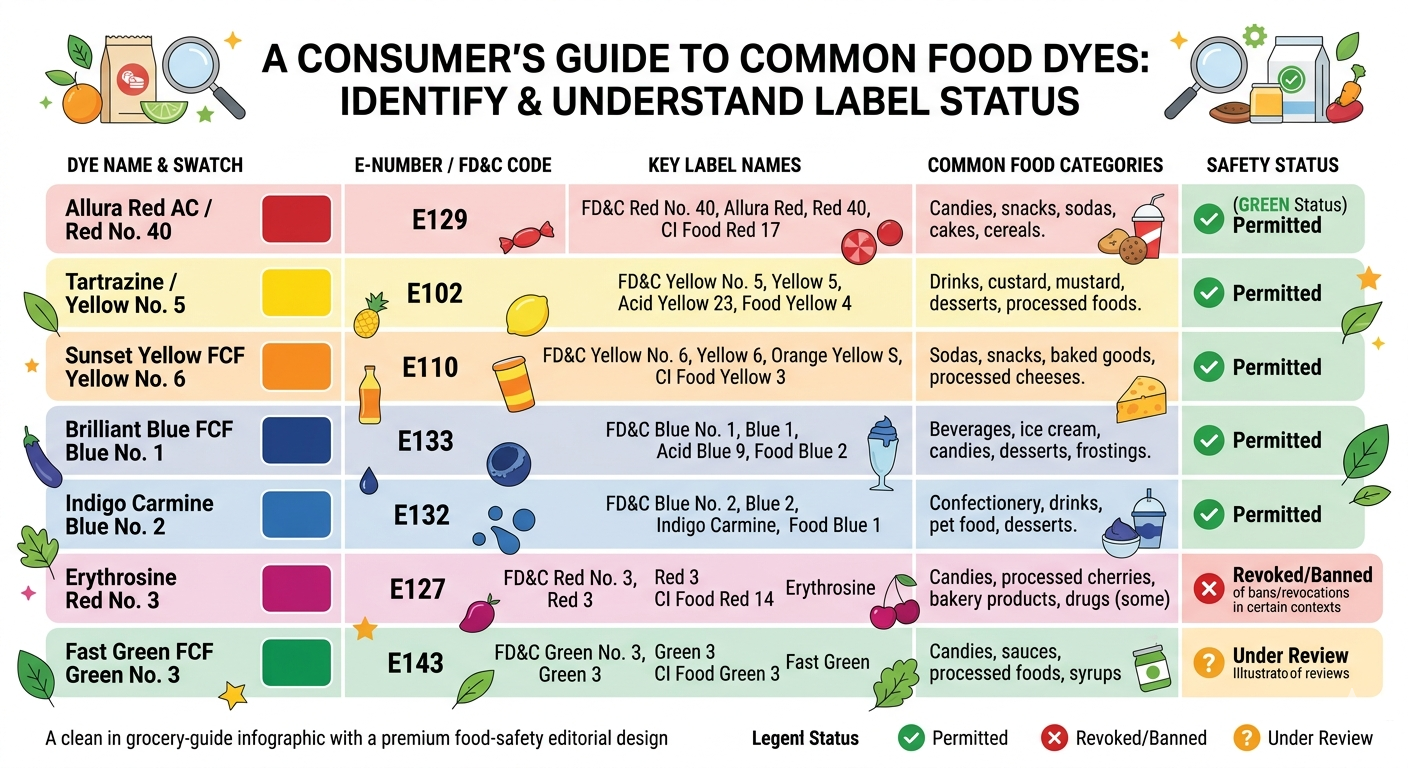
| Dye Name | Label Code | Status (2026) | Commonly Found In |
|---|---|---|---|
| FD&C Red No. 3 (Erythrosine) | Red No. 3 | Banned — Revoked | Maraschino cherries, some candies, certain medications |
| FD&C Red No. 40 (Allura Red) | Red 40 | Permitted — Under Review | Candy, cereals, sports drinks, gelatin, frosting |
| FD&C Yellow No. 5 (Tartrazine) | Yellow 5 | Permitted — Under Review | Cereals, chips, sports drinks, pickles, candies |
| FD&C Yellow No. 6 (Sunset Yellow) | Yellow 6 | Permitted — Under Review | Cereals, beverages, candy, baked goods |
| FD&C Blue No. 1 (Brilliant Blue) | Blue 1 | Permitted — Under Review | Sports drinks, candy, ice cream, cake frosting |
| FD&C Blue No. 2 (Indigo Carmine) | Blue 2 | Permitted — Under Review | Candy, pet food, some baked products |
| FD&C Green No. 3 (Fast Green) | Green 3 | Permitted | Mint products, canned peas, some beverages (less common) |
A Note on Red 40 — The Most Prevalent
Red 40 (Allura Red AC) is by far the most widely used food dye in the American food supply. It appears in hundreds of products, from children's cereals and fruit punch to certain medications and fast-food beverages. Its prevalence means it dominates conversations about dye exposure, particularly for children.
Red 40 remains legally permitted in the United States as of 2026. It has not been banned. However, it is the subject of ongoing scientific debate regarding its potential role in behavioural effects in sensitive children, and it faces increasing pressure from both consumer advocacy groups and some state legislators.
Yellow 5 and Mandatory Warning Labels in Europe
It is worth noting that Yellow 5 and Yellow 6, along with four other synthetic dyes, are required in the European Union to carry a warning label stating: 'may have an adverse effect on activity and attention in children.' No such mandatory warning exists in the United States. This regulatory divergence frequently features in public debate and has influenced consumer and legislative pressure.
5. Which Foods Commonly Contain Artificial Dyes?
Artificial dyes appear across a wider range of products than many consumers realise. The following categories are the highest-exposure areas, particularly for children.
| Food Category | Typical Dyes Present and Context |
|---|---|
| Breakfast cereals | Many brightly coloured or fruit-flavoured cereals contain multiple dyes, Red 40 and Yellow 5/6 are particularly common in character-branded and marshmallow cereals. |
| Candy and confectionery | Gummies, hard candies, sour sweets, and candy-coated chocolates are among the highest-dye categories, often containing three or more dyes per product. |
| Sports and flavoured drinks | Brightly coloured sports drinks, fruit punches, and flavoured water products are major sources of Red 40 and Blue 1 exposure. |
| Frosting, cake mixes, and icings | Pre-made frosting and decorating gels are consistently high in synthetic dyes. Yellow, orange, and pink frostings typically contain multiple dyes. |
| Packaged snack foods | Flavoured crisps, cheese-flavoured snacks, and some crackers contain Yellow 5 and Yellow 6 to produce characteristic orange-yellow colouring. |
| Yogurt and dairy products | Flavoured and fruit-bottom yogurts, particularly those marketed to children, frequently contain Red 40 or Yellow 5. |
| Ice cream and frozen desserts | Particularly bright-coloured novelties and fruit-flavoured ice creams. Strawberry ice cream is a frequent source of Red 40. |
| Fast food beverages and desserts | Fountain beverages, slushes, and certain dessert items at fast-food chains are significant sources of synthetic dye exposure. |
| School snacks and cafeteria foods | Processed snacks commonly served in school lunch programmes, flavoured gelatin, certain baked goods, packaged desserts, are a concern driving state-level school restrictions. |
Medications and vitamins | Many liquid children's medications and chewable vitamins contain Red 40 or Yellow 5, a fact many parents do not register when calculating dye exposure. |
Quick Visual CheckAs a general rule of thumb: if a packaged food is a vivid, unnatural shade of red, orange, yellow, green, blue, or purple, it almost certainly contains synthetic dyes. Natural colouring alternatives produce noticeably less saturated, more muted hues. The intensity and uniformity of colour across a product is often the clearest visual signal. |
6. Are Artificial Food Dyes Harmful? The Honest Answer
This is the question at the heart of the public debate, and it deserves a careful, honest answer rather than a simple yes or no.
The Hyperactivity and Behaviour Research
The most widely cited concern about food dyes, particularly for parents, is their potential link to hyperactivity and attention difficulties in children. The research in this area is real but genuinely contested.
A significant 2007 study published in The Lancet found that a mixture of artificial food colours combined with sodium benzoate (a preservative) was associated with increased hyperactivity in children across two age groups. This study influenced the EU's decision to require warning labels on products containing those specific dyes. However, subsequent research has produced mixed results, and the mechanism, if there is one, remains unclear.
The current scientific consensus, reflected in positions from the FDA and major nutrition bodies, is that synthetic dyes do not cause ADHD or hyperactivity in the general population, but that a subset of children, estimated at between 5 and 10 percent, may show behavioural sensitivity to high doses of certain dyes. For parents of children who appear to be in that sensitive group, the evidence provides reasonable grounds for reducing dye exposure even in the absence of definitive proof.
Cancer Risk — Specifically Red No. 3
The FDA's revocation of Red No. 3 was specifically based on studies showing that high doses caused thyroid tumours in male rats. The Delaney Clause, a legal provision, requires the FDA to revoke authorisation for any food additive shown to cause cancer in any species at any dose, regardless of the relevance of the animal study to human exposure.
Importantly, this does not mean that consuming Red No. 3 at typical dietary levels is considered a cancer risk in humans. The doses used in the animal studies were far higher than typical consumer exposure. The FDA has explicitly stated that the evidence does not indicate a safety concern at levels present in food. The revocation was legally mandated rather than driven by human risk assessment.
Allergic Reactions
Yellow 5 (tartrazine) is the dye most frequently associated with allergic reactions and sensitivity, particularly in individuals with aspirin sensitivity. Reactions can include hives, itching, and in rare cases, more significant responses. Allergy to other synthetic dyes is less common but documented.
Where the Evidence Stands
| Claim | What the Evidence Actually Supports |
|---|---|
| Causes ADHD in all children | Not supported. The research does not indicate that synthetic dyes cause ADHD in the general population. |
| May worsen hyperactivity in sensitive children | Plausible. A meaningful subset of sensitive children may respond to high dye doses. Parental observation is clinically relevant. |
| Red No. 3 poses a human cancer risk | Not established at dietary exposure levels. Revocation was legally required by animal study findings, not human risk data. |
| Yellow 5 can cause reactions in some people | Supported. Tartrazine sensitivity, particularly in aspirin-sensitive individuals, is documented. |
| Dyes are toxic at normal dietary levels | Not established by current evidence. Regulatory bodies maintain that approved dyes are safe at normal exposure levels. |
| European dye regulation is more protective | Context-dependent. The EU requires warning labels based on the 2007 hyperactivity study; the FDA reached a different regulatory conclusion from the same evidence. |
7. Why Parents Are So Concerned — And Why That's Reasonable
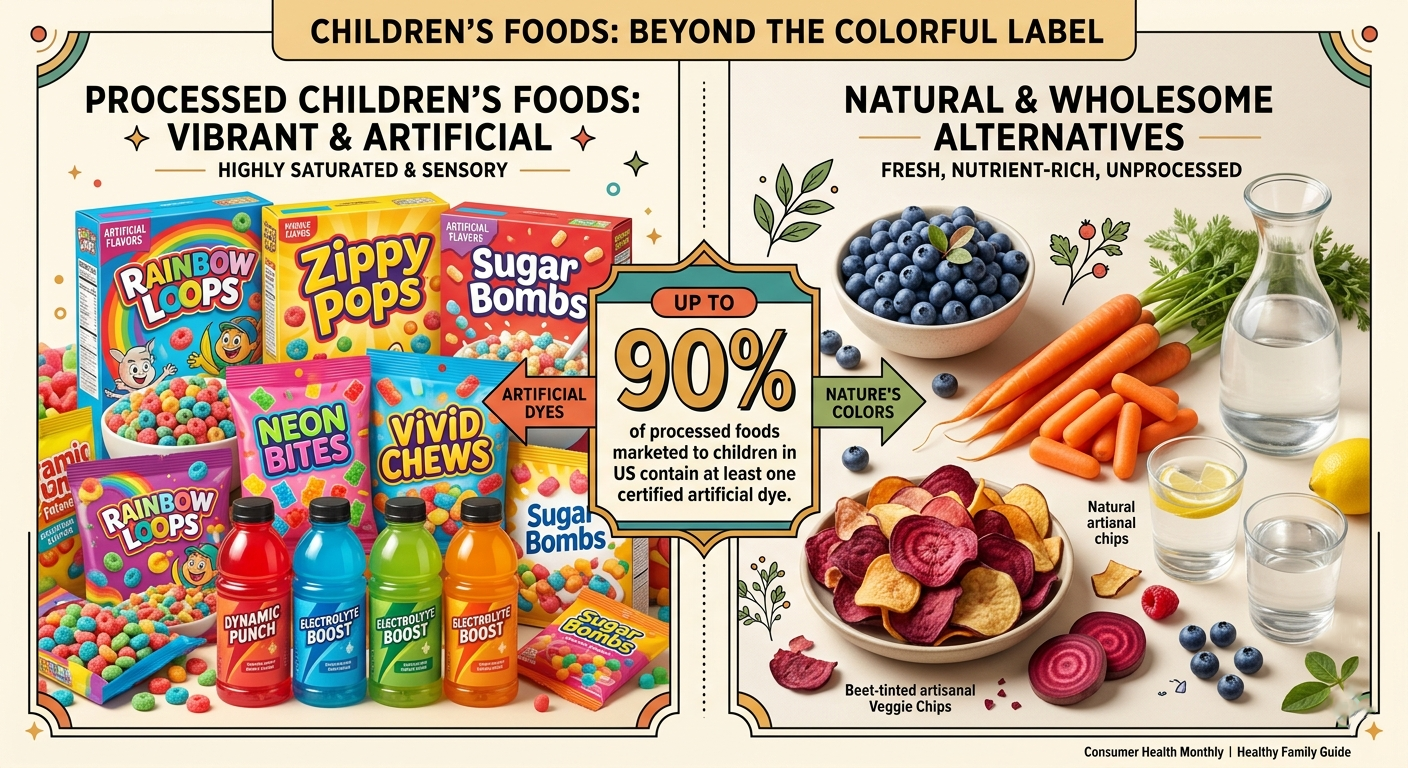
The parental concern around food dyes is not irrational, and it should not be dismissed by simply citing the current regulatory status of each dye. Understanding why this concern persists, and why it has intensified, helps put the issue in its proper context.
The volume of processed food in children's diets means dye exposure is cumulative. A child eating a bright cereal, a coloured sports drink, and a packet of gummy snacks in one day has a very different exposure profile from one consuming a single small portion of one item.
The regulatory context has genuinely changed. When the FDA revokes approval for even one dye, it signals that the assumed safety of the broader group deserves renewed scrutiny, and reasonable consumers are right to take note.
The information environment is confusing. Headlines conflate 'banned,' 'under review,' 'restricted in schools,' and 'reformulated' in ways that make it very difficult for non-specialist consumers to understand what has actually changed.
Parents of children with ADHD, hyperactivity, or food sensitivities have reported observing behavioural changes after dye-containing foods for years, and have often felt dismissed by both medical professionals and food manufacturers.
The comparison with European regulation is genuinely concerning to many consumers. The fact that the same dyes require a warning label in the EU but not in the US is a factual regulatory divergence that is difficult to explain away.
None of this means synthetic dyes are proven harmful at typical exposure levels. But it does mean that parental concern is grounded in legitimate questions, not health hysteria, and that consumers who choose to reduce dye exposure for their families are making a rational, informed decision.
8. What 'Clean Label' Actually Means
'Clean label' has become one of the most powerful terms in the food industry — and one of the most loosely used. Understanding what it does and does not mean is essential for making genuinely informed purchasing decisions.
What It Can Mean
A shorter, simpler ingredient list with recognisable ingredients
No artificial preservatives, flavours, or colours
Minimally processed formulation
Transparent sourcing and ingredient disclosure
Use of natural colouring alternatives in place of synthetic dyes
What It Does NOT Mean
'Clean label' is not a legally defined term and has no standardised regulatory meaning
A product labelled 'clean' is not guaranteed to be nutritionally superior or healthier
'No artificial colours' does not mean no colouring, natural alternatives still colour the product
'Natural' colouring does not automatically mean safe for all people, carmine (from insects) is a common allergen; annatto is linked to reactions in some individuals
High sugar, high sodium, and highly processed ingredients can coexist with a 'clean' colour claim
'No artificial dyes' is meaningful progress. 'Clean label' is a marketing claim. Know the difference.
Meaningful vs Marketing-Driven Clean Labels
| Label Claim | What It Actually Means for Shoppers |
|---|---|
| No artificial colors / colours | Meaningful — confirms no synthetic dyes are present |
| Made with natural ingredients | Vague — can include extensively processed natural extracts |
| Free from artificial preservatives | Meaningful for preservative-avoiders; unrelated to dye content |
| Clean eating | Marketing term — no regulatory definition |
| Simple ingredients | Generally meaningful — look at the actual ingredient count |
| Colored with fruit and vegetables | Meaningful — indicates use of natural colouring sources |
| No Red 40 / Yellow 5 / Blue 1 | Specific and meaningful — confirms particular dyes absent |
| All natural | Vague and unregulated as a general claim |
9. How to Read Food Labels Like a Smarter Shopper
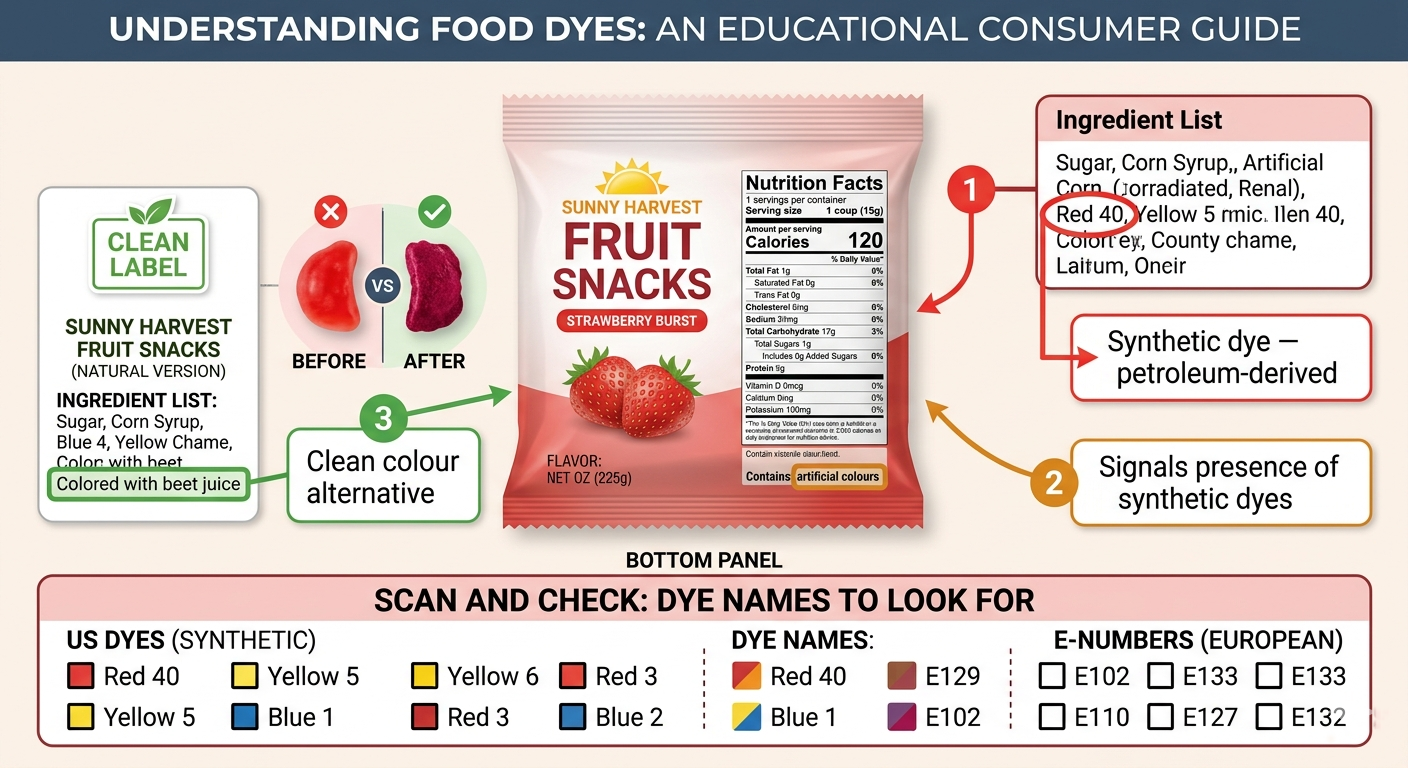
The ingredient label is the single most reliable source of information about what is in a packaged food. Marketing claims on the front of a product, 'made with real fruit,' 'wholesome,' 'natural', tell you what the manufacturer wants you to believe. The ingredient list tells you what is actually there.
The Six Names to Look For
Synthetic food dyes appear on ingredient lists under their FD&C designations. These are the six you are most likely to encounter:
| Dye | How It May Appear on the Label |
|---|---|
| Red 40 | FD&C Red No. 40 | Allura Red AC | Red 40 Lake |
| Yellow 5 | FD&C Yellow No. 5 | Tartrazine | Yellow 5 Lake |
| Yellow 6 | FD&C Yellow No. 6 | Sunset Yellow | Yellow 6 Lake |
| Blue 1 | FD&C Blue No. 1 | Brilliant Blue | Blue 1 Lake |
| Blue 2 | FD&C Blue No. 2 | Indigo Carmine | Blue 2 Lake |
| Red 3 | FD&C Red No. 3 | Erythrosine | Red 3 (revoked; still in supply chain) |
The 'Lake' Distinction
'Lake' versions of dyes (e.g., Red 40 Lake, Yellow 5 Lake) are aluminium salts of the base dyes. They are less water-soluble and used in products with lower moisture content, coated tablets, confectionery coatings, and baked goods. For consumers avoiding synthetic dyes, both the base dye and its lake form should be avoided.
Shopping Shortcuts That Work
Scan the ingredient list BEFORE checking nutrition facts — dyes always appear in the ingredient list, not the nutrition panel
If the ingredient list is long, start at the end — artificial dyes are used in small quantities and appear toward the bottom
Colour equals caution: vivid unnatural shades on a packaged product almost always mean synthetic dyes
Look for 'No artificial colours' on the front — this claim, when present, is generally accurate
Ingredient scanning apps such as Yuka, Open Food Facts, and similar tools can identify dyes by scanning a barcode
School Lunch Strategies
Pack lunch when school policies are unclear — home-packed meals give full control
Contact your school nutrition coordinator to ask about the district's current dye policy
Advocate for clear school dye policies if your state has not yet enacted restrictions
Explain dye awareness to older children — teenagers can read labels themselves
10. What to Buy Instead — A Practical Substitution Guide
Transitioning away from artificially dyed foods does not require a complete diet overhaul or a significant budget increase. Here is a category-by-category guide to practical alternatives.
If You Currently Buy... | Better Clean-Label Alternative | Whole Food Option | Notes |
|---|---|---|---|
| Brightly coloured cereals | Look for brands using turmeric, annatto, or beet-based colours | Whole-grain oats with fruit | Read labels — some 'natural' cereals still contain synthetic dyes |
| Coloured candy and gummies | Brands using fruit/vegetable colouring exist in most supermarkets | Dried fruit, fresh fruit, dark chocolate | Price point is often higher for natural-colour confectionery |
| Sports and flavoured drinks | Coconut water, sparkling water with real fruit juice, kombucha | Water with fresh fruit slices; herbal tea | Check juice blends — 'natural flavour' does not guarantee dye-free |
| Coloured frosting | Brands using vegetable-based colouring; DIY with beet or turmeric powder | Yogurt-based toppings; nut butter spreads | Natural dyes in frosting fade faster — expect colour variation |
| Packaged flavoured snacks | Snacks coloured with paprika, turmeric, or vegetable extracts | Vegetable crisps, nuts, seeds, rice cakes | Paprika extract is a natural red-orange colouring — check labels |
| Children's yogurt | Plain yogurt with added real fruit or fruit puree | Plain Greek yogurt with berries | Many clean-label yogurts exist — compare sugar content too |
| Ice cream and frozen treats | Brands using real fruit or vegetable colouring; fruit sorbets | Homemade fruit ice lollies | Vanilla and chocolate rarely contain synthetic dyes |
| School snack box items | Whole fruits, cheese portions, plain crackers, hummus packs | Nuts (age-appropriate), plain popcorn, hard-boiled eggs | Convenience is achievable without dyes — plan for weekly prep |
A useful framing: you do not need to eliminate every artificially dyed product from your household immediately. A gradual swap, replacing the highest-exposure items first, is both more sustainable and more consistent with the evidence, which concerns cumulative exposure rather than single-product risk.
11. Four Real Consumer Stories
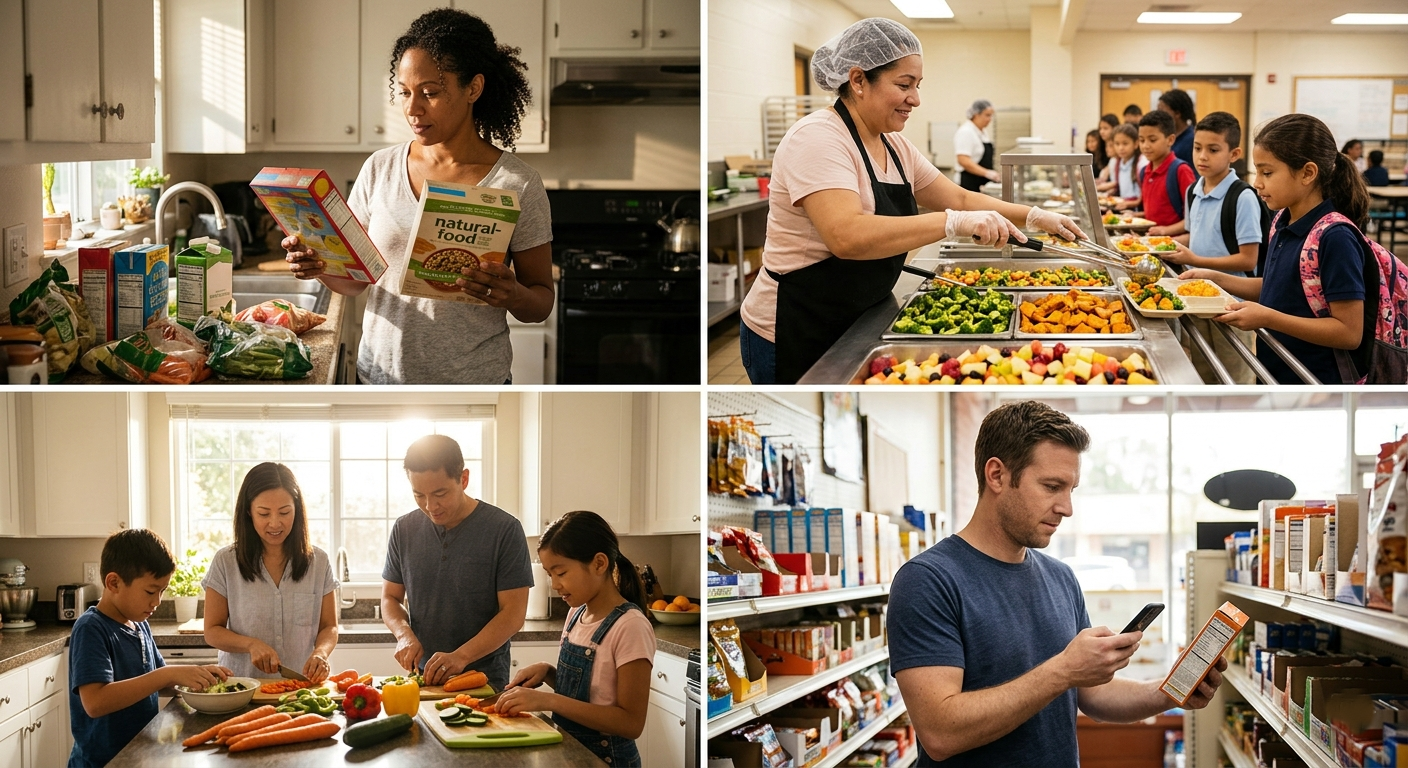
The Ramirez Family — Gradual Transition, Not Perfection
When Maria Ramirez began hearing about food dye restrictions in early 2025, she felt simultaneously concerned and overwhelmed. 'I looked at our kitchen and nearly everything was in the high-dye category,' she said. 'The cereal, the sports drinks, the gummies we used as road-trip snacks.'
Rather than attempt a complete overhaul, Maria made three specific swaps: a different cereal brand (lower cost than she expected), water instead of coloured sports drinks, and fresh fruit instead of gummy snacks for car journeys. She did not change everything. 'My daughter still has birthday cake at parties. That's fine. But at home, the default changed.' Six months later, the transition is embedded, not as a strict rule but as a household preference.
Jefferson Elementary School — A Policy Shift
A parent-teacher group at Jefferson Elementary raised the question of food dye content in school snacks in early 2026, prompted partly by state legislation in their district and partly by several parents of children with ADHD who had observed dietary impacts.
The school nutrition coordinator worked with suppliers to identify the highest-dye items in the current snack rotation and replaced them with dye-free alternatives over a two-month period. 'The children didn't notice the change in most items,' she noted. 'The one item that got pushback was the gelatin, kids noticed that one immediately.' A fruit cup replaced it without incident.
David, 42 — Learning Ingredient Awareness Without Anxiety
David describes himself as 'not a health person', someone who had never thought seriously about food ingredients before his daughter was born. At her five-year check-up, their paediatrician mentioned that some children with attention difficulties show sensitivity to synthetic dyes and suggested a trial elimination for three weeks.
'I downloaded a label-scanning app and it genuinely changed how I shop,' David said. 'Not because I think dyes are poison, I don't, but because I realised how many products had them and I'd never clocked it. Now I just prefer to buy without them when the option is easy and similarly priced.'
Alicia — Balancing Convenience and Cleaner Choices
Alicia is a single working parent with two children and a tight grocery budget. 'The clean-label products in the premium section of my supermarket are not realistic for my budget every week,' she said. 'But I found that store-brand products with natural colouring are often the same price or cheaper than the name-brand version with artificial dyes.'
Her approach is practical: she uses a simple mental list of the highest-exposure categories (sports drinks, gummies, cereals) and buys dye-free versions of those while treating the rest of her shop normally. 'Eighty percent better is achievable. A hundred percent perfect is not happening in my household, and I refuse to feel bad about that.'
12. Common Myths About Food Dyes — Fact-Checked
| Common Myth | The Factual Reality |
|---|---|
| All food dyes are banned in 2026 | FALSE. Only Red No. 3 has had its federal food-use authorization revoked. Other dyes remain legally permitted. State restrictions apply in specific contexts (primarily school foods) in select states. |
| Natural colouring is automatically safe for everyone | NUANCED. Most natural colours are safe for most people, but carmine (from insects) is a recognised allergen; annatto causes reactions in some individuals; and any ingredient can cause individual sensitivities. |
| If you avoid dyes, your child's ADHD will be cured | FALSE. Food dyes are not the cause of ADHD. A subset of sensitive children may show behavioural responses to high dye doses, but dietary change is not a treatment for ADHD and should not replace appropriate medical guidance. |
| 'No artificial flavours' means no artificial dyes | FALSE. These are separate categories. A product can have no artificial flavours and still contain synthetic dyes — and vice versa. Check specifically for artificial colour disclosures. |
| European food is dye-free | FALSE. Synthetic dyes are permitted in the EU, including Red 40, Yellow 5, and Yellow 6, though products containing them must carry advisory warning labels. The EU approach is more precautionary, not a ban. |
| Once a dye is banned, it disappears from shelves immediately | FALSE. Regulatory revocations include compliance timelines for reformulation. Products manufactured before the compliance deadline can remain in distribution. Check production dates on products of concern. |
| Every artificial ingredient is dangerous | FALSE. The presence of an ingredient on an artificial additive list does not establish that it is harmful at normal exposure levels. Regulatory evaluation considers dose, frequency, and population. Concern is valid; panic is not warranted. |
13. The Business of Clean Labels
Consumer concern about artificial dyes is reshaping the food industry in measurable ways — and the commercial incentives are now firmly aligned with reformulation rather than resistance.
Industry Reformulation — Already Underway
Several major food manufacturers began transitioning high-profile products from synthetic to natural colouring ahead of regulatory requirements, responding to consumer purchasing signals. General Mills reformulated some of its cereal products. Nestlé made commitments in this direction. Kraft Heinz has explored natural alternatives. These moves are market-driven as much as regulatory, clean-label products command a price premium and growing market share.
The Cost of Natural Colouring
The primary challenge in industry reformulation is cost and technical complexity. Natural colouring alternatives are typically more expensive, less stable under heat and light, and less consistent batch-to-batch than synthetic alternatives. Manufacturers reformulating at scale face real technical and economic challenges — which is why the transition is gradual rather than immediate.
Marketing vs Meaningful Transparency
The growth of clean-label demand has also created an environment in which 'clean' and 'natural' language is used liberally by brands whose products do not represent meaningful improvements. Consumers who understand the specific claims to look for, 'no artificial colours,' specific dye-free declarations, named natural colouring sources, are better equipped to make genuinely better purchases than those who respond to aesthetic packaging signals alone.
Consumer demand is the most powerful force in food reformulation. Every purchasing decision is a signal — and the industry's reformulation pace is responding to those signals in real time.
14. The Future of Food Transparency
AI-Powered Ingredient Scanning
Consumer-facing applications that scan product barcodes and return detailed ingredient analyses, flagging synthetic dyes, allergens, additives, and nutritional concerns, have matured significantly. Apps such as Yuka, Open Food Facts, and similar platforms give ordinary consumers the ability to access detailed product analysis at the point of purchase. In 2026, these tools are increasingly integrated with loyalty programmes and online grocery platforms, reducing the friction of clean-label shopping considerably.
QR Code Label Expansion
The FDA's Smarter Food Safety initiative has accelerated adoption of QR codes on food packaging that link to detailed ingredient, sourcing, and production information beyond what fits on a traditional label. As this expands, consumers will have access to a depth of product transparency that was not previously possible.
Legislative Momentum
The state-level legislative activity that accelerated in 2024 and 2025 shows no sign of slowing. Consumer advocacy organisations are actively tracking pending legislation across multiple states. The political environment, with bipartisan concern about children's food safety, suggests further federal action on petroleum-derived dyes is increasingly likely, even if not imminent.
Personalised Nutrition Technology
As wearable health monitoring and genetic nutrition profiling mature, some consumers will gain access to personalised guidance about which specific additives their individual biology is most sensitive to. For the general population, clean-label awareness remains the most accessible and broadly applicable tool — but the future of food safety is moving toward individual-level insight.
15. Frequently Asked Questions
Is Red 40 banned in the United States?
No. As of 2026, Red 40 (Allura Red AC) remains a legally permitted food additive in the United States. It has not been banned at the federal level. It is subject to ongoing regulatory scrutiny and is restricted in school food contexts in some states. It is the most prevalent synthetic dye in the American food supply.
Do I need to avoid all artificial dyes?
That depends on your circumstances. For most healthy adults, current evidence does not establish that approved synthetic dyes at normal dietary levels pose a health risk. For parents of children with ADHD, hyperactivity, or suspected dye sensitivity, a trial reduction in dye exposure is reasonable and low-risk. For families who simply prefer to minimise synthetic additives in their diet, clean-label alternatives are increasingly available at comparable prices.
Which dye is actually banned in 2026?
FD&C Red No. 3 (erythrosine) has had its food-use authorization revoked by the FDA. Compliance timelines mean products containing it may remain in distribution during transition periods. All other major synthetic dyes, Red 40, Yellow 5, Yellow 6, Blue 1, Blue 2, remain federally permitted as of 2026.
Are natural food colours always better?
Natural colours are generally preferable for consumers seeking to avoid petroleum-derived additives. However, 'natural' does not guarantee universally safe, carmine (derived from insects) is an allergen; annatto causes reactions in some individuals. Natural colouring is also more variable in intensity and less stable. For most people, natural colouring alternatives represent a meaningful improvement; individual sensitivities should be assessed on a case-by-case basis.
What is the best app for scanning food labels?
Several effective apps exist in 2026. Yuka is widely used and consumer-friendly, with a colour-coded rating system. Open Food Facts is open-source and comprehensive. The EWG Food Scores database provides detailed ingredient analysis. Most major smartphone grocery platforms now integrate ingredient scanning functionality. Download one and use it the next time you are unsure about a label, the learning curve is minimal.
My child's school still serves dye-containing foods. What can I do?
First, confirm the situation by speaking with the school nutrition coordinator. Many schools are actively working on reformulation even in states without legislative requirements. If the school's current policy is not aligned with your concerns, consider: (1) packing lunch for the days of most concern; (2) raising the issue through the parent-teacher association; (3) referencing state legislative trends to support your advocacy. Change in school nutrition typically happens through coordinated parent engagement rather than individual requests.
16. Conclusion — Informed Shoppers Make the Market Better
The story of food dye regulation in 2026 is not a simple villain narrative, it is a nuanced, ongoing renegotiation between consumer expectations, regulatory science, commercial interests, and genuine public health concern. The confusion in the headlines is real, but so is the progress.
Red No. 3 is being phased out. States are protecting children's school foods. Consumer demand is reshaping what major manufacturers put in their products. Ingredient scanning technology is putting analytical tools in every shopper's pocket. And the regulatory conversation about petroleum-derived dyes is happening with a seriousness that did not exist a decade ago.
What you can do, right now, is straightforward. Learn the six dye names. Use the ingredient list, not the front of the package. Make gradual swaps in the highest-exposure categories. Use an ingredient app at the grocery store. Ask your child's school about their policy. And make these changes from a place of informed confidence, not from fear.
You do not need to be perfect. You need to be informed. The rest follows naturally from there.
The market responds to informed consumers. Every time you choose a product without synthetic dyes, you are sending a signal that reaches the food industry's product development team. The improvement in clean-label availability over the last five years happened because enough consumers made that choice. The next five years will continue in the same direction, and you are part of that.
Regulatory Disclaimer
This article reflects publicly available regulatory information as of mid-2026. Food additive regulations are subject to ongoing change. Always verify current FDA guidance and state-specific regulations for the most up-to-date information. This content is for consumer education purposes only and does not constitute medical or nutritional advice. Consult a registered dietitian or your healthcare provider for personalised dietary guidance.